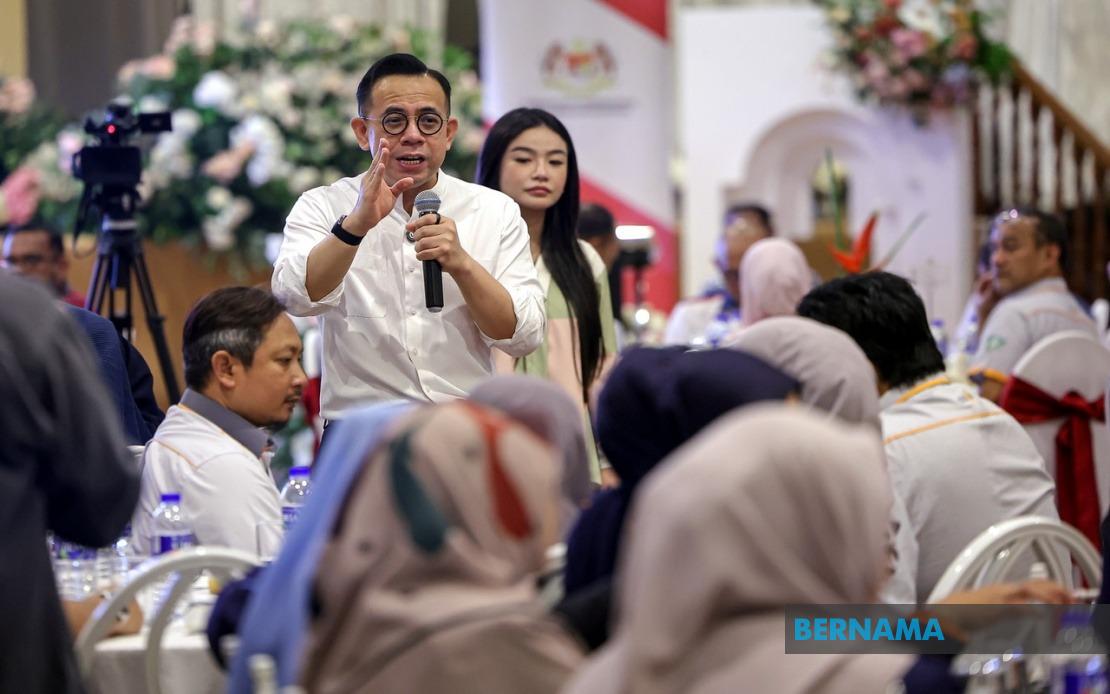
The Ministry of Entrepreneur Development and Cooperatives (KUSKOP) has made substantial progress in its mission to support Malaysia's entrepreneurial ecosystem, dispersing close to RM7 billion across various financing and assistance schemes during the opening half of 2026. This significant injection of capital has reached more than 213,000 micro, small and medium-sized enterprises nationwide, reflecting an accelerating effort to inject liquidity into the grassroots business sector. The distribution underscores a deliberate strategy to fortify the resilience of Malaysia's MSME landscape against the backdrop of persistent global economic headwinds and structural market uncertainties.
Minister Steven Sim disclosed that the funds channelled thus far represent part of a broader, more ambitious annual target of RM15 billion allocated under the Power Up 10K initiative. This trajectory suggests an expected doubling of disbursement rates in the second half of the year, indicating either an acceleration in application processing or an expansion in the schemes' accessibility. The mid-year checkpoint reveals that KUSKOP is roughly halfway through its annual disbursement obligations, putting the ministry on track to meet or potentially exceed its fiscal targets by year-end, contingent on maintaining current deployment momentum.
Simulating the initiative's reach at the state level provides granular insight into its effectiveness. Negeri Sembilan alone has received RM345 million in Power Up allocations distributed to approximately 6,600 local entrepreneurs, translating into an average disbursement of roughly RM52,000 per recipient business. This per-capita metric offers a useful benchmark for evaluating whether funding volumes are proportionate to actual business needs versus nominal distribution targets. The state-level performance also demonstrates that government capital is flowing through to smaller economic centres, not concentrating exclusively in urban commercial hubs, thereby serving a more geographically dispersed entrepreneurial base.
Minister Sim framed these disbursements as evidence that governmental support mechanisms are functioning effectively at the ground level, reaching entrepreneurs who might otherwise lack access to conventional banking finance. This assertion carries particular weight in Malaysia's context, where historical gaps in credit availability to informal and semi-formal enterprises have constrained business formation and expansion. By positioning KUSKOP's network as a bridge between fiscal policy intent and actual entrepreneur access, the ministry is signalling that bureaucratic intermediaries are successfully translating high-level funding allocations into tangible business support.
Beyond raw disbursement figures, KUSKOP is recalibrating its operational philosophy to emphasise agency proactivity rather than reactive service delivery. Sim outlined a strategic reorientation toward reducing the compliance burden that entrepreneurs face when navigating regulatory and administrative requirements. This approach acknowledges a systemic inefficiency: external cost pressures such as commodity price volatility remain beyond government control, but internal friction costs emanating from regulatory complexity can be engineered downward. By reducing compliance friction, KUSKOP aims to preserve more entrepreneur capital for productive investment rather than administrative navigation.
The ministry's emphasis on expanding business resources and enhancing public service delivery efficiency reflects a modernisation agenda targeting the procedural interfaces between government and entrepreneurs. Rather than assuming a purely financial role, KUSKOP is positioning itself as a comprehensive support ecosystem addressing multiple dimensions of entrepreneurial constraint. This holistic framing—encompassing finance, regulatory guidance, and resource access—suggests recognition that capital alone does not constitute sufficient entrepreneurial enablement without accompanying institutional support.
A notable directive from Minister Sim involved encouraging state-level agencies to transition from passive service provision to aggressive outreach and promotion. Rather than awaiting entrepreneurs to proactively seek assistance, state entities are being tasked with intensifying roadshows, scaling social media engagement, and implementing ground-level promotional campaigns. This shift represents a cultural repositioning within bureaucratic delivery, inverting the traditional service paradigm whereby customers must identify and approach providers. By mandating competitive dynamism among state agencies, the ministry is attempting to accelerate scheme awareness and application rates beyond what passive availability would naturally generate.
The digital and physical promotional intensification strategy carries implications for rural and less digitally connected entrepreneur segments. While social media outreach efficiently reaches urban, digitally literate business operators, complementary physical roadshows ensure that traditional entrepreneurs in peripheral areas maintain information parity. This dual-channel approach broadens the potential beneficiary universe, reducing information asymmetries that historically disadvantaged entrepreneurs lacking sophisticated market intelligence networks.
For Malaysian entrepreneurs and regional observers, the Power Up 10K initiative represents a significant fiscal commitment to MSME competitiveness during a period of global economic fragmentation. The RM15 billion annual allocation, if fully deployed, constitutes a meaningful injection into Malaysia's small business sector, potentially influencing employment dynamics, local supply chain development, and broader economic resilience. The initiative's implicit acknowledgement that MSMEs require government support to compete effectively signals policy recognition of structural imbalances between small enterprises and larger, better-capitalised competitors.
The targeting of over 213,000 enterprises in the first half of 2026 positions KUSKOP's delivery mechanisms as genuinely high-volume, suggesting that application backlogs or procedural delays are not substantially constraining access. This operational capacity contrasts with historical criticisms of government financing programmes moving slowly or accumulating pending applications. If sustained, such delivery velocity could enhance programme credibility and encourage wider participation among eligible entrepreneurs.
Regionally, Malaysia's KUSKOP initiative may serve as a reference point for other Southeast Asian nations considering similar MSME support frameworks. The emphasis on reducing compliance costs while maintaining fiscal discipline offers a policy model potentially adaptable to varied national contexts. As regional economies simultaneously pursue digital transformation and MSME development, the Malaysian experience of combining technology-enabled outreach with state-level competitive efficiency could inform broader regional approaches to entrepreneurial support infrastructure.
Looking forward, the success of Power Up 10K will likely depend on post-disbursement support mechanisms ensuring that capital injections translate into sustainable business growth rather than consumption or debt servicing. Monitoring frameworks tracking beneficiary enterprise trajectory, employment creation, and revenue growth will be essential for evaluating the initiative's longer-term economic impact beyond mere disbursement metrics. The second half of 2026 will prove decisive in determining whether KUSKOP can maintain current deployment momentum while scaling outreach, ultimately validating whether Malaysia's MSME sector possesses the absorptive capacity and investment discipline to deploy such substantial capital flows productively.

