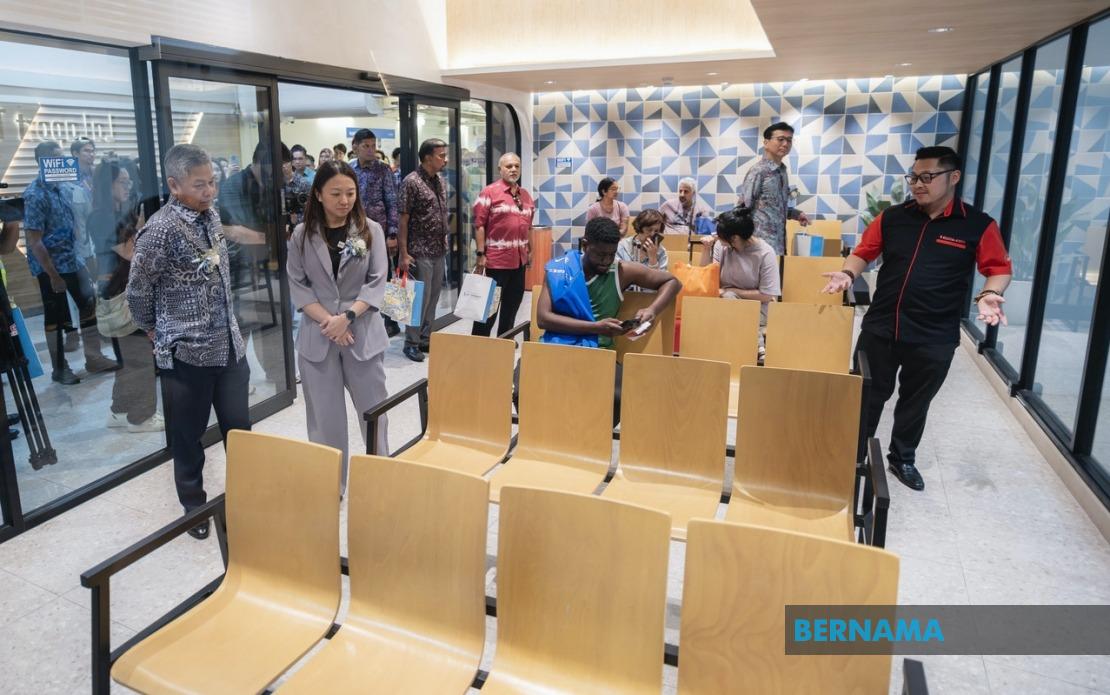
Kuala Lumpur's burgeoning urban transport network has received a significant boost with the opening of the LaLaport Transportation Hub, an ambitious integrated facility designed to handle the city's mounting mobility demands. Positioned adjacent to the Hang Tuah LRT and Monorail interchange in the heart of the capital, the new terminal is projected to accommodate approximately 10,000 travellers daily whilst facilitating seamless transfers between multiple transport modes including rail services, express coaches, e-hailing platforms, taxis, and bike-sharing schemes. The launch, overseen by Hannah Yeoh, Minister in the Prime Minister's Department (Federal Territories), represents a strategic investment in addressing the complexities of urban congestion and passenger convenience in Southeast Asia's bustling commercial hub.
The infrastructure challenge that prompted this development is substantial. With 1.2 million people entering and exiting Kuala Lumpur daily, and a staggering 5.5 million individual journeys recorded within the city's boundaries each day, transport planners have long grappled with the need for better-integrated mobility solutions. The LaLaport Transportation Hub responds directly to this pressure by consolidating services that were previously scattered across multiple locations, thereby reducing passenger confusion and travel time. For Malaysian commuters accustomed to navigating fragmented public transport systems, this centralisation offers tangible benefits in terms of convenience and efficiency.
The physical design of the facility underscores its ambitions to provide passenger comfort and accessibility. Located on the LG1 level of the East Atrium, the hub encompasses a fully sheltered environment featuring eleven dedicated bus parking bays, climate-controlled waiting areas, staffed ticket counters, self-service kiosks, and an automated Passenger Information Display System that offers live updates on bus schedules and service disruptions. These amenities address longstanding complaints from Malaysian bus users regarding inadequate shelter, unclear information dissemination, and safety concerns in traditional transport terminals. The covered pedestrian walkways connecting different transport modes represent a particular quality-of-life improvement for travellers during monsoon seasons when exposure to weather constitutes a genuine hardship.
Operationally, the hub is expected to manage approximately 150 bus journeys daily, with particular emphasis on cross-border services connecting Kuala Lumpur with Singapore. Aaron Chuah, chief executive officer of Asia Success Resource Sdn Bhd, the facility's operator, highlighted the inclusion of a round-the-clock express coach service linking Malaysia's capital with the island republic, addressing a transport corridor increasingly vital to business travel and regional integration. Additionally, approximately thirty bus operators are anticipated to establish the LaLaport hub as their primary city-centre transit point, concentrating services that had previously operated from dispersed terminals throughout the urban area. This consolidation carries implications not only for passenger convenience but also for urban planning, as it reduces traffic congestion from multiple bus terminals competing for road space.
The hub's connectivity extends beyond traditional public transport modes. Recognising the rapid evolution of urban mobility, the facility incorporates support for e-hailing services, integrated taxi ranks, and the Boleh-Boleh Ride on-demand shuttle service, which connects passengers to major destinations across the city centre. Crucially, shuttle van services to Kuala Lumpur International Airport's Terminals 1 and 2 provide seamless last-mile connectivity for international travellers, addressing a persistent gap in airport access from the city centre. For Malaysian business professionals and leisure travellers, this integration eliminates the need to arrange separate transport modes for different journey segments, a significant convenience advantage.
The policy framework supporting the hub's establishment reflects evolving best practices in transport regulation. The Dewan Bandaraya Kuala Lumpur has introduced three-year operating licences for transport terminals, superseding the previous annual renewal system. This shift provides operators with greater operational certainty and incentivises long-term investment in service quality improvements. For passengers, the licensing reform carries implicit promises of greater stability and accountability, as operators now have stronger incentives to maintain service standards throughout their licence period rather than operating in short-term cycles. This regulatory modernisation positions Kuala Lumpur as increasingly sophisticated in its approach to public transport governance.
Safety and security considerations have been woven into the broader transport enhancement programme accompanying the hub's launch. The Kuala Lumpur City Hall is currently installing approximately 10,000 operational closed-circuit television cameras across the city, representing a major surveillance infrastructure expansion. Whilst such projects invariably generate debate regarding privacy and civil liberties, transport operators argue that comprehensive CCTV coverage deters criminal activity and facilitates rapid incident response. For the travelling public, particularly women and vulnerable passengers, such surveillance may provide reassurance when using the facility during off-peak hours or late-night services.
The international dimension of the LaLaport Transportation Hub reflects Malaysia's positioning within broader regional development frameworks. Japanese Ambassador to Malaysia Noriyuki Shikata attended the launch, emphasising the close cooperation between Malaysia and Japan in advancing sustainable urban development. This involvement underscores that the facility represents more than a local infrastructure project; it embodies bilateral commitment to modern transport standards and environmental sustainability principles. Japan's well-documented expertise in integrated transport systems, exemplified by Tokyo and Osaka's seamless rail-bus-taxi ecosystems, has clearly influenced the LaLaport design philosophy, suggesting that Malaysian urban planners have successfully imported international best practices.
The hub's establishment arrives at a moment of heightened bilateral attention. Prime Minister Datuk Seri Anwar Ibrahim's recent visit to Japan reaffirmed both nations' commitment to expanded cooperation across energy security, trade, and infrastructure development. The transportation facility thus assumes symbolic significance as a tangible manifestation of Malaysia-Japan partnership, with both countries preparing to commemorate the 75th anniversary of diplomatic relations. For Malaysian observers, such infrastructure investments serve as barometers of the country's development trajectory and its capacity to execute complex urban projects.
From a broader Southeast Asian perspective, the LaLaport Transportation Hub exemplifies the regional pattern of major cities attempting to modernise urban mobility systems in response to rapid economic growth and urbanisation. Cities across Southeast Asia—Bangkok, Jakarta, Ho Chi Minh City, and others—face similar challenges of integrating diverse transport modes and accommodating millions of daily journeys. Kuala Lumpur's solution, whilst locally specific, contributes to a regional knowledge ecosystem where transport solutions are increasingly shared and adapted across borders. Malaysian cities eyeing their own transport modernisation, such as Penang and Johor Bahru, may draw lessons from the LaLaport model regarding hub integration, operational licensing, and passenger amenity standards.
Looking forward, the hub's success will depend substantially on passenger adoption and operator cooperation. Initial projections of 10,000 daily passengers represent ambitious targets that require sustained marketing to both regular commuters and occasional users. The thirty bus operators committing to use the facility must coordinate schedules effectively and maintain service reliability, conditions that historically prove challenging in fragmented operator environments. Should the hub successfully achieve its capacity targets, it would validate the integrated terminal concept and potentially stimulate similar projects elsewhere in Malaysia. Conversely, underperformance would suggest that passengers continue preferring direct routes from dispersed terminals, necessitating strategic recalibration.
For Malaysian commuters and transport planners alike, the LaLaport Transportation Hub represents a concrete manifestation of contemporary urban mobility thinking. By consolidating rail, bus, e-hailing, and airport connectivity within a single, comfortable, well-lit, and digitally-enabled facility, the hub addresses numerous longstanding frustrations with Kuala Lumpur's fragmented transport landscape. The regulatory modernisation accompanying the facility's launch—the three-year licensing system and expanded CCTV coverage—similarly reflects institutional learning regarding how to incentivise operator compliance and passenger safety. Whether the hub ultimately transforms Kuala Lumpur's mobility patterns as optimistically projected remains an open question, but its opening undeniably signals that Malaysian urban planning has embraced integrated solutions to metropolitan transport challenges.

