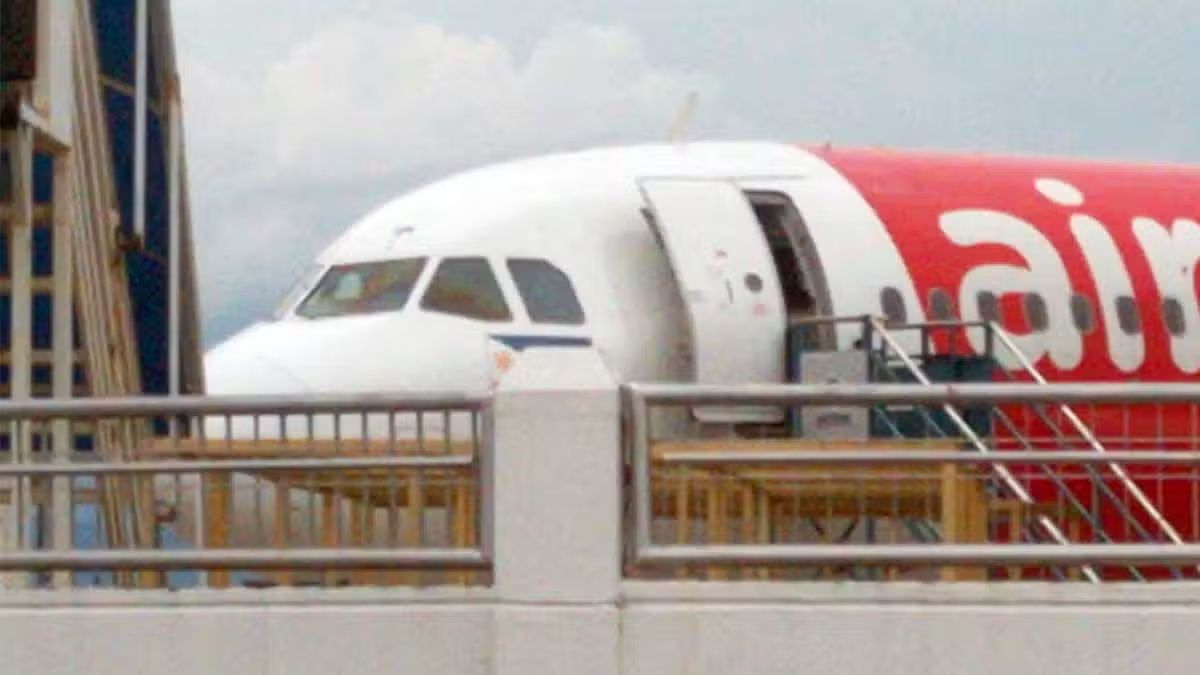
An AirAsia flight departing from the Philippines' Tacloban City towards Manila was cancelled on Saturday, August 1st, following the discovery of a technical defect in the aircraft's landing gear system detected during pre-flight procedures. The malfunction, identified at approximately 6 in the morning, forced the Daniel Z. Romualdez Airport's Civil Aviation Authority of the Philippines division to issue a Notice to Airmen and temporarily modify normal flight sequences, disrupting a critical transportation hub that serves millions of passengers annually across Eastern Visayas and the wider Philippine archipelago.
The sudden grounding of the aircraft created a cascade of scheduling complications across the airport's bustling timetable. Multiple incoming and outgoing services experienced delays as ground personnel managed the unexpected diversion and the aircraft remained positioned on the operational runway, effectively limiting the capacity for other planes to maneuver. The situation underscored the delicate coordination required to maintain smooth operations at a facility that handles competing demands from several carriers throughout the day.
Authorities worked methodically to resolve the situation, eventually moving the affected aircraft safely away from active runways to the airport's maintenance bay area by mid-morning. This tactical repositioning allowed normal airport functions to resume at approximately 9:45am, restoring the facility's ability to process its standard flight volumes. The relatively swift containment of the disruption reflected established emergency protocols and the coordination between airport management, civil aviation authorities, and the airline operator.
AirAsia responded to the incident by implementing passenger care procedures aligned with regional aviation standards. The airline has since rescheduled the cancelled service and initiated arrangements to accommodate travellers originally booked on the affected departure. The Philippine Information Agency's Eastern Visayas division confirmed these measures, indicating the carrier's commitment to minimizing inconvenience to affected customers through alternative flight options and rebooking assistance.
The technical inspection and assessment phase proved essential in determining the aircraft's airworthiness before any subsequent operations could be authorized. AirAsia technicians conducted detailed examinations throughout Saturday afternoon and into the evening, with civil aviation authorities maintaining oversight to ensure all safety standards were satisfied before clearance for future flights. This methodical approach prioritizes passenger safety over operational convenience—a principle that underpins aviation regulation across Southeast Asia and internationally.
While airport management withheld specific details regarding the flight designation, the precise nature of the landing gear malfunction, and the exact number of passengers impacted, such information restrictions are standard during ongoing technical investigations. Disclosure of these particulars typically occurs once comprehensive assessments are finalized and any necessary corrective actions are documented and approved by relevant regulatory bodies. The information vacuum underscores how civil aviation authorities balance transparency with operational security protocols.
Daniel Z. Romualdez Airport serves as Eastern Visayas' primary commercial aviation gateway, functioning as an essential connector linking the region with Metro Manila and the broader Philippine network. The facility accommodates multiple daily rotations operated by three major carriers—AirAsia, Cebu Pacific, and Philippine Airlines—reflecting the competitive regional market and diverse transportation preferences among Filipino travellers. This tri-carrier presence demonstrates the airport's significance as a revenue generator and connectivity provider for the eastern island region.
For Malaysian readers and regional observers, the incident illustrates universal aviation maintenance challenges faced by carriers operating aging fleets across Southeast Asia's expanding route networks. Landing gear systems represent critical safety components requiring rigorous inspection cycles, and mechanical discoveries before departure, while operationally disruptive, represent the safety system functioning as intended. AirAsia's Philippines operations serve as a case study in how low-cost carriers balance growth imperatives with mandatory maintenance obligations across diverse market conditions.
The cancellation's minimal operational disruption—with full recovery within three-and-a-half hours—demonstrates modern airport resilience and the effectiveness of pre-departure screening protocols. In an era where even minor technical issues can cascade into significant cascades of delays, the swift containment here reflected both procedural competence and the relative capacity slack available at mid-sized regional airports compared to congested mega-hubs. This contrasts sharply with similar incidents at capacity-constrained facilities elsewhere in Asia, where technical problems routinely cascade into day-long disruptions.
Looking forward, the incident reinforces the operational reality that technical maintenance issues remain an inevitable component of high-frequency regional aviation, particularly on routes dependent on budget carriers operating under intense pressure to maintain cost competitiveness. For passengers planning travel through Philippine and broader Southeast Asian networks, such disruptions underscore the wisdom of maintaining schedule flexibility and ensuring comprehensive travel insurance coverage when booking flights through regional carriers dependent on aging or extensively utilized aircraft platforms.

