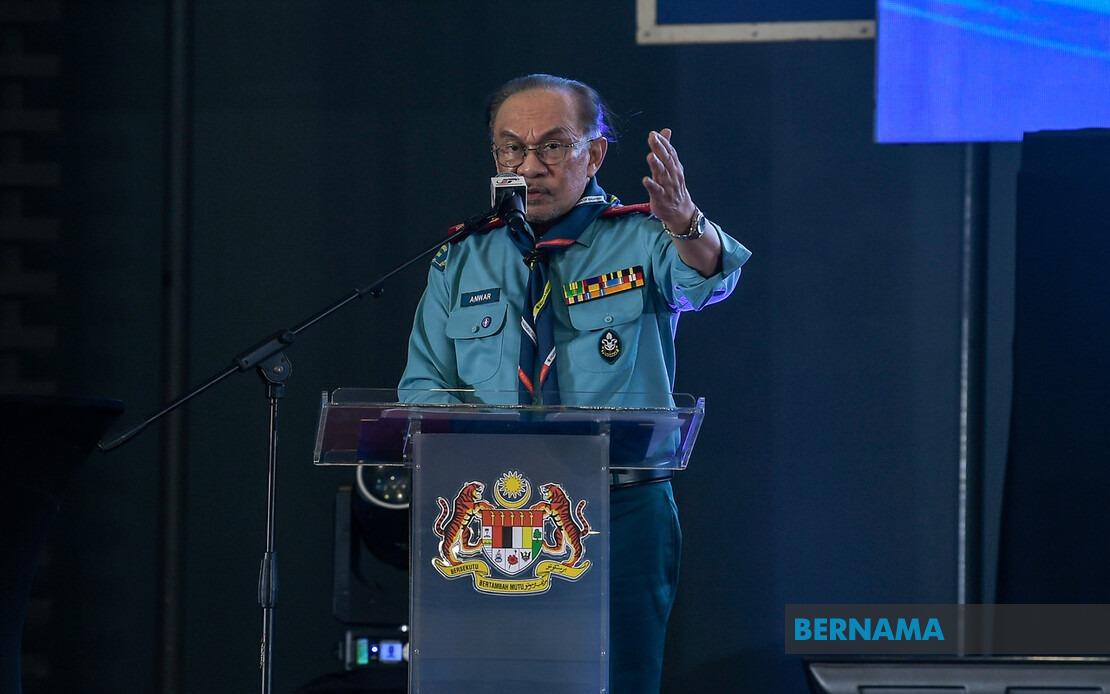
Prime Minister Datuk Seri Anwar Ibrahim has moved to dispel concerns that prioritising Malay as the national language represents a rejection of multilingualism, emphasising instead that linguistic competence across multiple languages serves Malaysia's long-term interests. Speaking at the Ambang Merdeka Sahabat MADANI 2026 programme held at Universiti Teknologi MARA (UiTM) Permatang Pauh on August 29, Anwar framed language acquisition as a complementary rather than adversarial framework, where mastery of Malay should coexist with proficiency in regional and global tongues.
The Prime Minister's remarks appear designed to address lingering sensitivities surrounding language policy in Malaysia, where debates over the relative prominence of Malay, English, Mandarin, and Tamil have periodically surfaced in political discourse. By characterising the relationship between languages as non-zero-sum, Anwar signals an approach that seeks to ease tensions between different communities whose cultural and educational interests may intersect with language preferences. This positioning reflects broader efforts by his administration to project an inclusive vision of national development that acknowledges Malaysia's multicultural fabric.
Central to Anwar's argument is the proposition that English, while not replacing Malay, should be embraced as a complementary global language essential for participating in international commerce, technology, and diplomacy. He acknowledged English's ascendancy as a lingua franca in contemporary global systems, suggesting that Malaysian educational and economic competitiveness depends partly on ensuring citizens achieve functional fluency. This stance aligns with regional trends across Southeast Asia, where governments increasingly recognise that English proficiency opens pathways to employment and educational advancement in an interconnected economy.
Equally significant is Anwar's recognition of Mandarin's growing importance within the regional economic sphere. He noted that proficiency in Chinese represents an increasingly valuable asset given the language's prevalence among major trading partners and investors throughout East and Southeast Asia. Rather than viewing Mandarin acquisition as competing with national identity constructed around Malay, the Prime Minister framed language learning as pragmatic investment in future opportunity. This approach acknowledges demographic realities in Malaysia, where significant Chinese-speaking communities maintain heritage language ties and where many Malaysian businesses operate within Chinese-language networks.
The Prime Minister also referenced Tamil as a language worthy of strengthened proficiency among Malaysian citizens, reflecting the presence of Tamil-speaking communities and the language's connections to broader South Asian economic and cultural spheres. By naming Tamil alongside English and Mandarin, Anwar sought to position his vision as genuinely inclusive of Malaysia's Indian-origin populations, whose historical and ongoing contributions to the nation's development merit recognition through educational and policy attention.
Crucially, Anwar rejected the notion that multilingual competence undermines national cohesion or dilutes commitment to Malay as the constitutional official language. He argued instead that children should attain command of multiple languages provided their grasp of Malay remains solid, framing this as an educational imperative rather than a threat to national symbols or identity. This framing attempts to navigate a delicate political terrain where concerns about cultural preservation coexist with recognition that global economic participation increasingly requires polyglot capabilities.
Anwar's economic framing of language acquisition addresses practical concerns about Malaysia's international competitiveness. He characterised linguistic diversity not as a luxury or cultural indulgence but as essential infrastructure for economic security and individual advancement. By grounding language policy in economic rationale, the Prime Minister shifted discourse away from identity politics and toward pragmatic considerations about workforce development and national prosperity. This approach may resonate with parents and policymakers concerned that Malaysia's educational system adequately prepares students for global labour markets.
Beyond specific language prescriptions, Anwar used the UiTM platform to reinforce broader themes of social cohesion and interethnic cooperation. He cautioned citizens against sowing discord among different racial communities, warning that Malaysia's celebrated harmony cannot be sustained passively but requires deliberate, ongoing commitment. This messaging reflects concerns within the current administration about rising polarisation and appeals for renewed emphasis on shared national purpose transcending sectional interests.
The Prime Minister's call for a culture of sharing, caring, and mutual assistance underscores his vision of inclusive development benefiting all Malaysians regardless of ethnic origin. By linking language policy to these broader values, Anwar positioned linguistic pluralism as consistent with, rather than opposed to, national unity. This rhetorical strategy attempts to reframe language debates as expressions of collective commitment to equal opportunity rather than competitions for cultural dominance.
Anwar's intervention carries significance beyond rhetorical flourish. Educational policymakers and curriculum designers frequently reference prime ministerial statements when determining resource allocation and pedagogical priorities. By explicitly endorsing multilingualism, the Prime Minister may influence schools and universities to maintain robust teaching of English and other languages alongside strengthened Malay instruction. Such policy stability benefits Malaysian students and institutions navigating an increasingly complex linguistic landscape.
The timing of these remarks at a UiTM event merits attention, given that institution's historical association with Malay-language and Bumiputera-focused education. By articulating a multilingual vision within that setting, Anwar signalled that even institutions traditionally emphasising Malay and indigenous advancement can accommodate expanded language curricula. This sends subtle signals to educational administrators that linguistic diversity need not conflict with institutional missions rooted in constitutional provisions regarding Malay and indigenous educational access.
For Southeast Asian observers, Anwar's language stance reflects regional patterns whereby nations simultaneously prioritise national languages and accommodate global communicative demands. Countries including Indonesia, Thailand, and Vietnam navigate similar tensions between affirming local linguistic identity and ensuring international connectivity. Malaysia's approach, as articulated by its Prime Minister, positions it within this regional conversation while attempting to address its particular demographic composition and historical language sensitivities.

