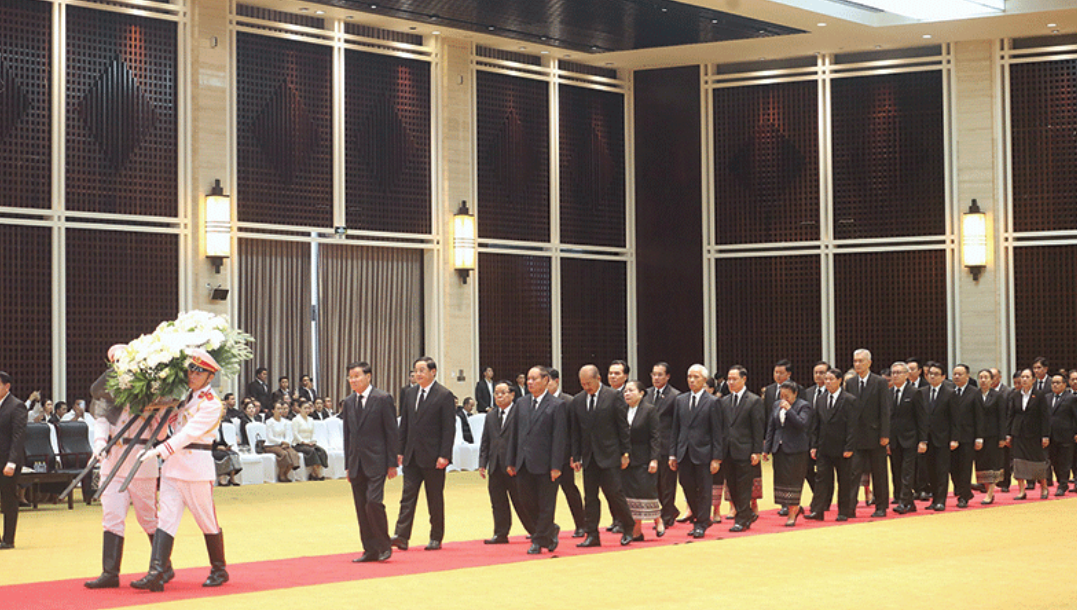
Laos observed a solemn state ceremony on Sunday as Party and State leaders, spearheaded by President and Party Secretary General Thongloun Sisoulith, gathered at the National Convention Hall to honour the memory of National Assembly President Xaysomphone Phomvihane, who passed away on Saturday. The occasion brought together a cross-section of the nation's political establishment, including members of the Lao People's Revolutionary Party, government officials, National Assembly deputies, and representatives from civil society organisations, all united in commemorating a figure whose career spanned decades of service to the Lao state.
Xaysomphone's death represents a significant loss within Laos' political hierarchy. As a member of the powerful Politburo of the Party's Central Committee and head of the National Assembly, he occupied one of the most influential positions in the one-party system that has governed Laos since 1975. His leadership of the legislature made him central to the country's legislative agenda and the broader governance structures that shape policy affecting the entire nation. The expressions of grief at the ceremony reflected the weight of his departure from the political landscape.
The structure of the wreath-laying ceremony itself conveyed the protocols and hierarchies embedded within Laos' political system. President Thongloun led the first delegation representing the Central Committee of the revolutionary party, establishing the primacy of party institutions over state bodies in the formal hierarchy. Subsequent delegations from the National Assembly's Standing Committee, chaired by Vice President Sounthone Xayachack, and the government, led by Prime Minister Dr Sonexay Siphandone, each carried wreaths in prescribed order. This ceremonial sequencing underscores how Laos maintains distinct lines of authority between party and state apparatus, even within expressions of collective mourning.
The presence of prominent family delegations highlighted Xaysomphone's lineage within Laos' revolutionary elite. Born on December 12, 1956, he was one of six sons of Kaysone Phomvihane, the founding father of the Lao People's Democratic Republic who served as both party secretary general and prime minister during the country's formative decades. His brother Santiphab Phomvihane, who led the family delegation, currently holds the position of Deputy Prime Minister and Finance Minister, indicating how power and influence continue to flow through interconnected family networks at the apex of the Lao state. This concentration of authority among related families has long characterised the Lao political system.
The ceremony also underscored the enduring strategic partnership between Laos and Vietnam, which has been a cornerstone of regional geopolitics since the communist victories of the 1970s. Vietnamese dignitaries, including Tran Thanh Man, Chairman of Vietnam's National Assembly and a senior Communist Party member, attended the ceremony to pay respects on behalf of the Vietnamese state. Representatives from Vietnam's Ministry of Public Security and Ministry of National Defence also participated, signalling the depth of defence and security cooperation between the two neighbours. This Vietnamese presence at a senior Lao state funeral demonstrates the extent to which the two nations' governing structures remain integrated and mutually supportive.
The scale and duration of mourning declared across both countries reflected Xaysomphone's diplomatic and political standing. Laos implemented five days of national mourning from August 8 to 12, while Vietnam declared two days of official mourning on August 10 and 11. The decision by both governments to suspend regular activities and observe commemorative periods suggests that Xaysomphone was viewed not merely as a domestic Lao figure but as someone whose influence extended into Vietnam's own political calculations. Such reciprocal mourning among communist states carries symbolic weight, affirming their commitment to shared ideological heritage and regional solidarity.
The continued wreath-laying ceremonies extending through August 11 facilitated broader participation beyond the initial state ceremony. Line ministry officials, Vientiane municipal authorities, former Party and government veterans, foreign diplomats stationed in Vientiane, and members of the business community visited the National Convention Hall to express condolences. This extended observance period transformed the ceremony into a more inclusive national moment of reflection, allowing various sectors of Lao society to participate in acknowledging Xaysomphone's contributions. The attendance of foreign diplomatic representatives also underscored how succession moments within senior communist hierarchies attract international interest and scrutiny.
Xaysomphone's cremation, scheduled for August 12 at the That Luang esplanade—Laos' most sacred Buddhist site—will occur with full state honours beginning at 1 p.m. The location chosen for the final rites carries considerable symbolic meaning. That Luang functions as the spiritual heart of Lao national identity, and holding a state funeral there confers a status reserved for figures deemed central to the nation's founding and ongoing development. This ceremonial geography demonstrates how modern Lao state rituals continue to interweave Buddhist religious traditions with communist political symbolism, a synthesis that has characterised Lao governance since 1975.
For regional observers, Xaysomphone's death prompts broader reflection on succession dynamics within communist parties across Southeast Asia. The Lao People's Revolutionary Party maintains a gerontocratic structure where senior positions have long been held by individuals connected to the 1975 revolution. Xaysomphone represented a transitional generation, being considerably younger than earlier revolutionary leaders yet still embedded within established networks. His passing raises questions about how the party will manage the eventual departure of remaining revolutionary-era figures and whether institutional mechanisms exist to ensure stable, predictable transitions of power. In a region where leadership succession sometimes triggers instability, the relative tranquility surrounding this death suggests the party's institutions remain intact, at least for now.
The comprehensive tributes also reveal something about how the Lao state maintains social cohesion within its one-party system. By orchestrating elaborate ceremonies that incorporate the party, government, mass organisations, business interests, and international partners, the state demonstrates its capacity to mobilise diverse constituencies around shared narratives of national loss and collective continuity. The ceremony functioned simultaneously as a funeral, a reaffirmation of party authority, a demonstration of Vietnam-Laos solidarity, and an assertion of state control over significant political moments. In this sense, Xaysomphone's death, while representing a genuine loss to those who knew him, also provided the Lao leadership an opportunity to showcase institutional resilience and organisational capacity at a moment of transition.

