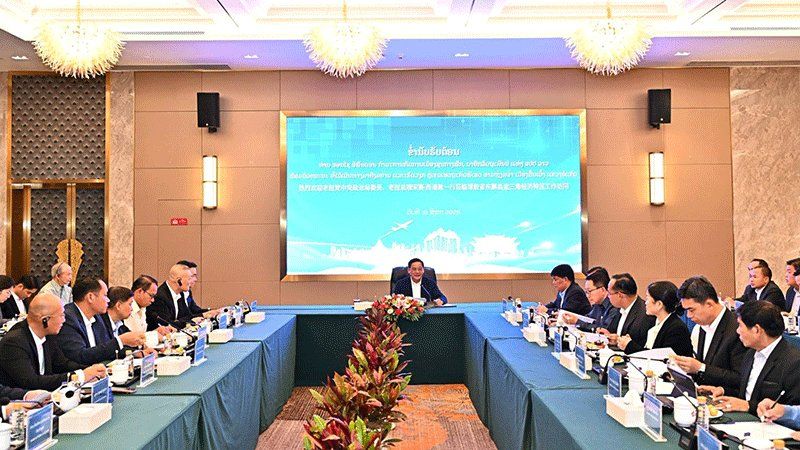
Laos's Prime Minister Sonexay Siphandone has moved to tighten governance at the Golden Triangle Special Economic Zone, expressing concern that development in the region has not kept pace with the scale of capital committed. During a working visit to the 10,000-hectare facility in Bokeo province's Tonpheung district on Tuesday, he signalled that the time has come for more rigorous oversight and a sharper focus on projects that generate sustainable economic returns for the nation.
The Zone, which straddles Laos, Myanmar, Thailand and sits near the Chinese border, has attracted approximately US$10 billion in investments over the past 19 years since its establishment in 2007. Yet the Prime Minister's own assessment revealed a troubling gap: only 60 per cent of the activities stipulated in investment contracts have been realised to date. This shortfall points to a fundamental challenge facing Laos as it seeks to translate foreign capital inflows into tangible economic development and employment creation. The disclosure suggests that despite the zone's strategic location providing access to sprawling consumer and labour markets across the region, execution and accountability remain weak.
Prime Minister Sonexay outlined a comprehensive reform agenda during his visit, emphasising the need to strengthen the zone's management infrastructure and enforcement mechanisms. He instructed authorities to implement stricter border controls on worker entry and exit, to overhaul the zone's concession agreements to align with national legislation, and to enhance the capacity of the zone's Management and Administration Committee. These measures underscore growing recognition in Vientiane that merely attracting foreign investors is insufficient; what matters is ensuring they comply with local laws and deliver the promised jobs and infrastructure.
A critical element of the Prime Minister's push involves formalising financial flows through Laos's banking system. He explicitly called for all commercial transactions relating to trade, investment, wages and services to be processed through official banking channels rather than informal mechanisms. This directive addresses a longstanding concern across Southeast Asia regarding illicit financial flows and money laundering risks in special economic zones, where loose regulation and cross-border movement of capital can facilitate criminal activity. By anchoring transactions to the banking system, Laos aims to improve transparency and reduce the zone's vulnerability to exploitation.
The Prime Minister also identified priority sectors for future development. Beyond manufacturing and processing, he highlighted tourism, transport, education and public health as domains requiring concentrated effort. This strategic narrowing reflects a shift away from indiscriminate investment attraction toward a more selective approach aligned with national development goals. Tourism especially holds potential given the zone's location in the famed Golden Triangle, a region of considerable historical and cultural significance that has long attracted visitors from across Asia.
Coordination with neighbouring countries emerged as another pillar of the revitalised approach. Prime Minister Sonexay stressed the importance of expanding airline connectivity to the zone and establishing clearer mechanisms for managing the cross-border movement of workers. With over 10,000 registered employees and an additional 10,000 investors, business operators, residents and tourists present, the zone has become a micro-economy requiring sophisticated administrative infrastructure. Enhanced cooperation with Myanmar and Thailand could unlock additional growth potential while mitigating social and security challenges associated with rapid cross-border labour migration.
The zone's current composition reflects its early-stage development profile. Businesses operating there span manufacturing, real estate, housing, hotels, trade, banking, tourism and services. However, the concentration of investment in real estate and housing, rather than productive sectors, may partly explain why contracted activity targets remain unfulfilled. The Prime Minister's emphasis on attracting higher-value manufacturing and processing capacity suggests concern that the zone is becoming primarily a speculative property play rather than a genuine engine of employment and export-oriented growth.
The administrative presence at the zone is substantial: more than 400 government officials from various sectors are stationed there, coordinating policy implementation and investment facilitation. Yet this large bureaucratic footprint has apparently failed to prevent the performance shortfall. The Prime Minister's call for improved management suggests these officials lack either the authority, resources or political will to enforce compliance with contract terms. Strengthening the zone's governance apparatus may therefore require not simply adding more oversight mechanisms but fundamentally reshaping incentives and accountability structures.
For Malaysian and Southeast Asian investors, the Prime Minister's directive signals both a warning and an opportunity. The tightening of regulations and financial controls may increase compliance costs and reduce opportunities for informal or grey-zone arrangements that some businesses have exploited. Simultaneously, it suggests Laos is serious about creating a level playing field where well-managed, legitimate operations can thrive without being undercut by competitors engaged in questionable practices. The zone's proximity to major regional markets, combined with improving governance, could enhance its attractiveness to multinational companies seeking manufacturing and logistics bases within the ASEAN region.
The Golden Triangle SEZ remains one of Laos's most ambitious development projects, and the Prime Minister's intervention reflects the strategic importance attached to it. As the government moves toward tighter regulation, the zone will serve as a test case for whether Laos can simultaneously attract foreign capital and maintain rigorous standards of financial and operational oversight. Success here could reshape perceptions of Laos among international investors and set a template for managing other economic zones across the country.

