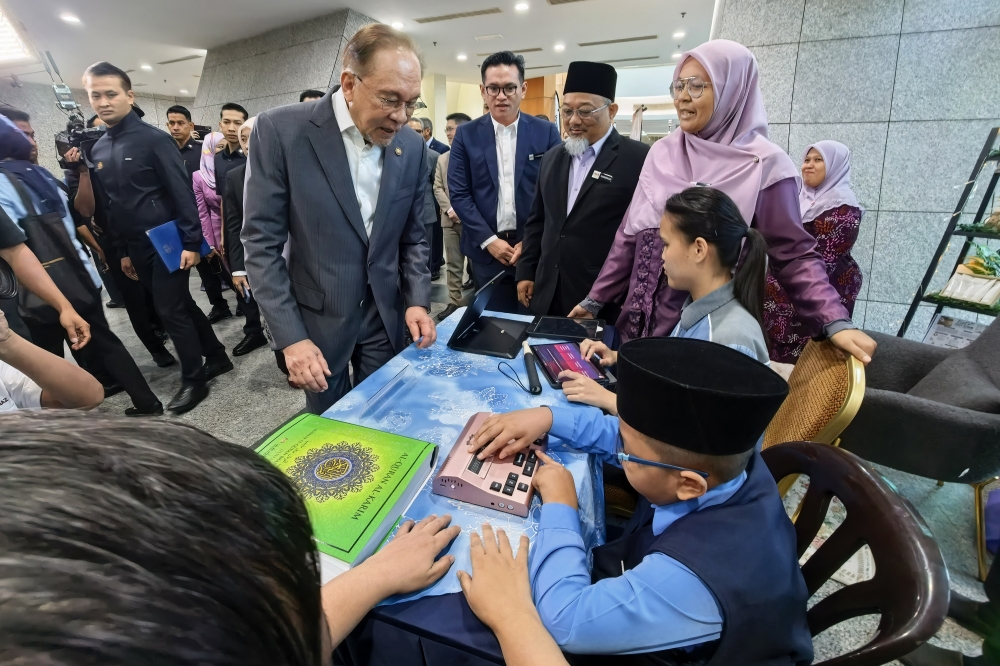
Prime Minister Datuk Seri Anwar Ibrahim has pushed back against persistent concerns that encouraging Malaysians to master foreign languages poses a threat to Bahasa Melayu's constitutional and cultural status, framing the debate around linguistic diversity as one rooted in confidence rather than defensiveness.
Addressing concerns that have periodically surfaced in public discourse, Anwar articulated a vision of national language policy centred on pragmatism and economic advantage. The Prime Minister's comments reflect a broader strategic recalibration within the government, signalling that Malaysia can simultaneously champion Bahasa Melayu's national importance whilst recognising the practical necessity of English proficiency and other languages in an increasingly interconnected world.
The distinction Anwar drew is significant for Malaysian policymakers grappling with longstanding tensions between protecting the constitutional position of Bahasa Melayu and acknowledging global realities. Bahasa Melayu's status as the sole official language remains entrenched in Article 152 of the Federal Constitution, a foundational element of the social contract established at independence. Yet Anwar's framing suggests the government need not view linguistic pluralism as inherently contradictory to this constitutional arrangement.
This perspective carries particular relevance for Malaysia's education system, where debates over the medium of instruction and the allocation of curriculum time between Bahasa Melayu and English have generated considerable controversy. By normalising the notion that bilingualism and multilingualism strengthen rather than undermine national linguistic identity, Anwar appears to be creating rhetorical space for educational reforms that might otherwise face resistance rooted in protectionist language sentiment.
The Prime Minister's position also reflects economic reasoning that has gradually gained acceptance among Malaysian technocrats and business leaders. English proficiency, along with competency in Mandarin, Japanese, or Korean depending on sectoral focus, has become recognised as essential for workforce competitiveness. Young Malaysians seeking employment in multinational corporations, technology sectors, or professional services increasingly find that limited English capacity directly constrains their career prospects. By legitimising multilingualism at the highest political level, Anwar acknowledges this economic imperative without abandoning the cultural and constitutional primacy of Bahasa Melayu.
International evidence supports this measured approach. Countries such as Singapore and the Netherlands have maintained robust national identities whilst achieving near-universal English proficiency among their populations. These examples demonstrate that learning additional languages need not erode first-language competency or cultural cohesion. Indeed, research suggests that bilingual citizens often develop stronger metalinguistic awareness, benefiting their overall command of language itself.
For Southeast Asian regional dynamics, Anwar's comments position Malaysia within the broader ASEAN context where English functions as a lingua franca for diplomatic, economic, and cultural exchange. Malaysian students and professionals compete regionally not only with counterparts from Singapore and the Philippines—where English proficiency is traditionally high—but increasingly with peers from Vietnam, Thailand, and Indonesia who are investing heavily in English education. Maintaining this competitive position requires both preserving Bahasa Melayu's role as the binding national language whilst ensuring Malaysians possess the linguistic tools necessary for regional engagement.
The political sensitivity surrounding language policy in Malaysia cannot be understated. Historical experience, including the riots of May 1969, has meant that discussions of Bahasa Melayu's status touch upon fundamental questions of national identity and social contract. The constitutional agreement that made Bahasa Melayu the sole official language in exchange for guarantees regarding citizenship and bumiputera privileges remains foundational to Malaysian federalism. Any government pronouncement on language must therefore navigate this historical terrain carefully.
Anwar's framing sidesteps potential controversy by emphasising addition rather than substitution. He is not arguing that English or other languages should replace Bahasa Melayu in any institutional capacity, but rather that individuals and institutions can cultivate multilingual capability without jeopardising the national language's constitutional standing or cultural significance. This distinction, whilst subtle, proves politically important for maintaining consensus around educational and economic modernisation efforts.
The practical implications extend beyond education into cultural and media domains. Malaysian broadcasting, publishing, and arts institutions could potentially feel emboldened by such endorsement from the highest executive office to explore greater linguistic diversity in programming and content production. A Malaysian child growing up with fluency in Bahasa Melayu, English, and perhaps a third language gains access to broader intellectual and cultural resources whilst remaining rooted in national linguistic identity.
Implementing this vision does require reconciling different constituencies with varying interests in language policy. Vernacular education advocates, educators emphasising classical Malay literature and linguistic heritage, parents prioritising English-language schooling, and employers seeking multilingual workforces all bring legitimate perspectives to ongoing policy discussions. Anwar's comments appear designed to suggest that government can accommodate these diverse interests through a framework that treats linguistic diversity as complementary rather than competitive.
Moving forward, the real test of whether this rhetorical reframing translates into substantive policy changes will emerge through curriculum developments, teacher training initiatives, and resource allocation decisions across Malaysia's education system. Whether the government proves willing to invest adequately in English language instruction, explore new instructional methodologies, and support teacher development in ways consistent with Anwar's multilingual vision remains to be determined. His comments establish the intellectual and political foundation for such moves, but implementation challenges will ultimately determine whether Malaysia successfully achieves the pragmatic linguistic pluralism the Prime Minister is advocating.

