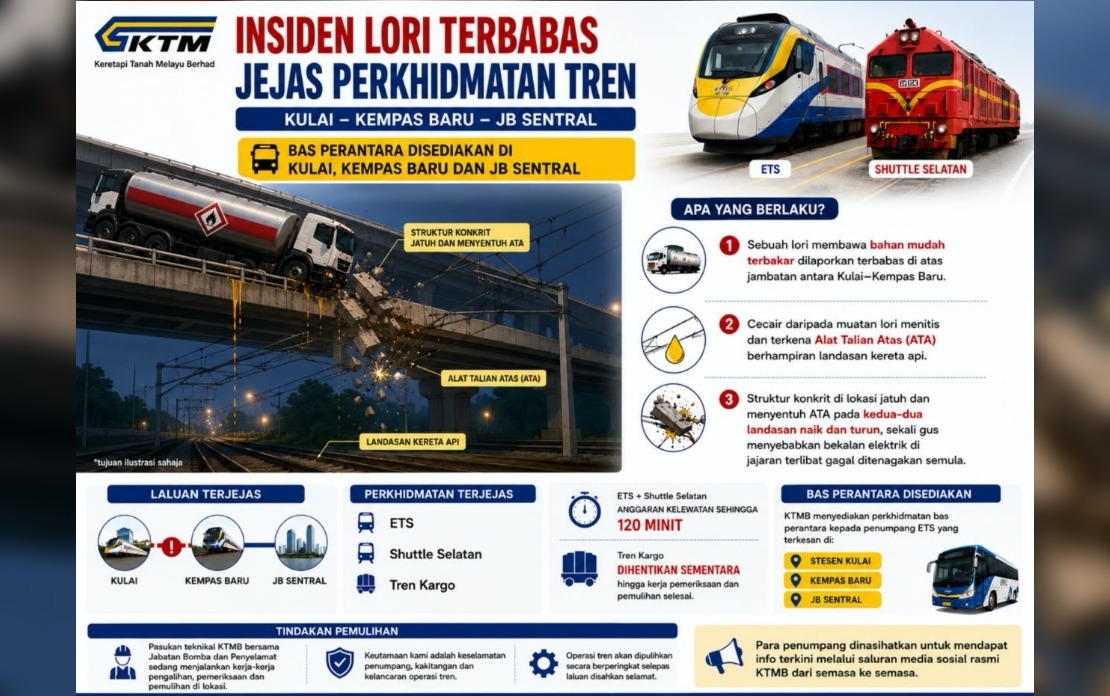
A road accident involving a lorry transporting flammable materials brought disruption to rail commuters along the Johor Bahru corridor on August 5, as the vehicle's collision with infrastructure near the tracks knocked out the power supply feeding the railway line. The incident affected both the Shuttle Selatan service and the Electric Train Service (ETS) operating between Kulai and Kempas, forcing operator Keretapi Tanah Melayu Berhad (KTMB) to implement contingency measures to minimise passenger inconvenience.
The immediate fallout saw multiple trains running considerably behind schedule as KTMB crews worked simultaneously on two fronts: clearing the accident site and restoring electrical supply to the line. At 10.37 pm, when KTMB issued its situation report, ETS9449 was trailing its timetable by 32 minutes whilst ETS9533 faced a 55-minute shortfall, with the operator cautioning that these figures remained fluid depending on progress in repair works. For a commuter belt as busy as the Johor Bahru region, any disruption to the efficient movement of passengers between satellite towns and the state capital poses significant ripple effects across the broader economy and daily routines of thousands of workers.
The logistics of managing such disruptions tested KTMB's crisis response capabilities. Rather than leaving passengers stranded or forcing them into congested alternative arrangements, the operator activated shuttle bus services at three cardinal points: Kulai, Kempas Baru, and JB Sentral. This provided ETS passengers with a genuine alternative to lengthy waits, though the real-time coordination of replacement vehicles across multiple stations represents a substantial operational undertaking. The provision of shuttle services, whilst standard practice for major disruptions, still demands rapid mobilisation of vehicles and trained personnel.
Shuttle Selatan users faced a different calculus. Rather than being offered replacement bus services, passengers were directed toward other transport modes, a decision that likely reflected the regional nature of the Shuttle Selatan service and the patchwork of private and public transport options across Johor. KTMB promised fare adjustments for affected passengers, though the mechanics of claiming compensation and the extent of such adjustments remained unspecified in the operator's initial announcements. This gesture sought to acknowledge passenger frustration, though compensation mechanisms in Malaysian public transport often require follow-up administrative engagement.
The incident underscores the vulnerability of critical transport infrastructure to incidents occurring beyond the railway's immediate control. A vehicle operating on public roads, albeit adjacent to the railway corridor, precipitated service failures across an entire route segment. This relationship between road and rail infrastructure reflects patterns seen across developed economies, where careful separation and protective measures are essential to prevent single-point failures. In the Malaysian context, where rail networks thread through increasingly urbanised and industrialised landscapes, such proximities are often unavoidable legacy issues.
Transport safety officials and infrastructure managers will likely review this incident as a case study in accident prevention. The circumstances surrounding why a lorry carrying flammable liquid came to skid near the railway tracks merit thorough investigation. Whether the cause relates to driver error, vehicle maintenance deficiency, road surface conditions, or loading imbalance carries implications for how similar risks might be mitigated. Carriers of hazardous materials operate under strict regulatory frameworks in Malaysia, and breaches or failures in adherence become serious compliance matters.
For the broader commuting population across the southern corridor, such disruptions impose hidden costs beyond immediate delays. Workers risk tardiness to employment, students miss scheduled travel to educational institutions, and businesses depending on just-in-time logistics face complications. Whilst a single evening's disruption remains manageable within most schedules, the cumulative effect of periodic service interruptions shapes public perceptions of rail reliability and influences modal choices. Travellers increasingly sceptical of rail punctuality gravitate toward private vehicles, compounding congestion on highways and contributing to air quality degradation in urban centres.
KTMB's public communication strategy in the wake of the incident balanced transparency with reassurance. By providing specific train numbers and delay minutes, the operator offered genuine situational awareness rather than vague assurances. The invitation for affected passengers to seek assistance from station staff established a support pathway, though the effectiveness of such mechanisms depends heavily on staff training and the complexity of individual passenger circumstances. In modern transport management, communication often matters as much as the actual remedial actions.
The electrical infrastructure supporting the Kulai-Kempas line presumably comprises overhead cables or trackside equipment vulnerable to vehicle impacts, particularly from tall vehicles or those carrying elevated loads. The restoration timeline for such outages typically spans several hours to overnight, depending on the extent of physical damage and the availability of specialised repair crews. KTMB's ongoing commitment to repair efforts reflected the operational priority attached to restoring service, with the implicit message that passenger flows would resume once technical restoration completed.
Broader implications for Malaysian transport planning emerge from such incidents. As rail networks mature and carry increasing passenger volumes, the maintenance and protection of infrastructure becomes ever more critical. The southern corridor, serving as Johor Bahru's connection to broader peninsular networks, handles substantial daily traffic. Any recurrent disruptions jeopardise the reliability narrative that rail operators seek to establish as they compete with road transport for modal preference. Investment in incident prevention, whether through improved road-rail separation or traffic management near vulnerable stretches, represents a longer-term strategic consideration for infrastructure authorities.

