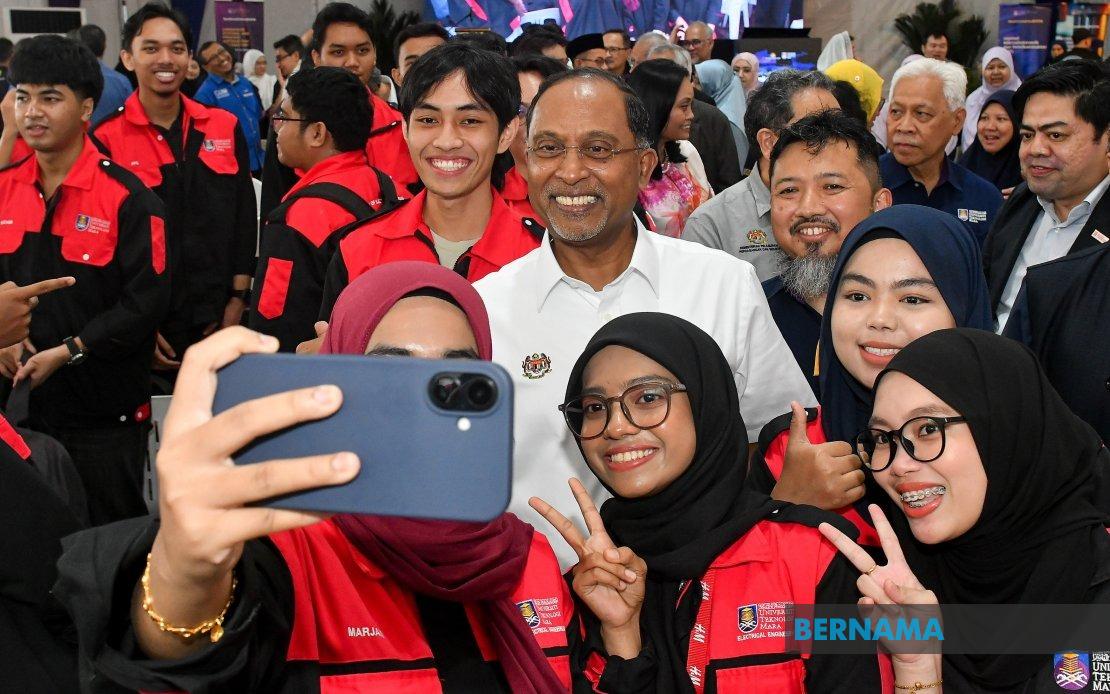
The launch of the Light Rail Transit 3 Shah Alam Line represents a watershed moment for transportation accessibility in Malaysia's premier technology university precinct. Higher Education Minister Datuk Seri Dr Zambry Abd Kadir underscored the tangible impact on UiTM Shah Alam students, whose daily commuting experience has been fundamentally reshaped by the arrival of dedicated rail connectivity to the campus. The infrastructure project, which commenced passenger operations recently, addresses long-standing mobility challenges that have constrained student movement and contributed to traffic pressures around this rapidly developing region of Selangor.
The minister's observations during his visit to the UiTM campus reflected the palpable enthusiasm among the student body, with many experiencing their first encounters with reliable mass transit to their academic institution. For a university community that historically relied on personal vehicles or informal transport arrangements, the UiTM Shah Alam Station represents genuine liberation from the daily congestion that plagued the surrounding arterial roads. Beyond immediate convenience, the line delivers economic relief by substantially reducing transport expenses for movement across the wider Klang Valley, a consideration that carries particular weight for students managing constrained budgets.
Prime Minister Datuk Seri Anwar Ibrahim's decision to offer complimentary fares for the entire service from June 29 through July 31 constitutes a powerful incentive for public adoption during this critical establishment phase. This promotional period effectively removes financial barriers to trial usage, allowing commuters to experience the system's benefits without hesitation. The timing proves strategic, enabling the university and transport authorities to build ridership momentum precisely when habit formation occurs and word-of-mouth advocacy spreads most effectively through the student population.
The Shah Alam Line itself comprises an extensive 20-station network stretching across the metropolitan region, anchoring connectivity between Bandar Utama in the north and Johan Setia in the south. Beyond the UiTM Shah Alam Station, the line serves critical commercial and residential nodes including Stadium Shah Alam, multiple sections of Shah Alam itself, and the historically significant port town of Klang. This comprehensive coverage transforms the line from a campus convenience into a genuine metropolitan circulation backbone, serving workers, shoppers, and residents throughout the corridor with unprecedented rapid-transit options previously unavailable to these communities.
Paralleling the transport infrastructure announcement, Zambry unveiled the strategic Semiconductor@UiTM initiative, a RM20 million government-funded programme designed to position the institution as a cornerstone of Malaysia's semiconductor manufacturing ambitions. This initiative reflects deliberate policy integration between physical infrastructure and human capital development, recognising that world-class transportation access means little without corresponding educational excellence in high-value industries. The semiconductor sector represents Malaysia's pathway toward sustained economic competitiveness in an increasingly technology-dependent global economy, and the government's investment in UiTM reflects confidence that the university can deliver the sophisticated talent required.
The Semiconductor@UiTM programme fundamentally restructures how the institution approaches Electrical and Electronics Engineering education. Rather than maintaining traditional classroom separation from industry realities, the initiative mandates integrated curriculum design aligned with international manufacturing standards and informed by active engagement with multinational semiconductor corporations operating within the region. Enhanced facilities and upgraded laboratories provide students with hands-on exposure to contemporary production technologies and methodologies, ensuring graduates arrive at employment ready for immediate contribution rather than requiring extensive post-hire retraining.
Minister Zambry contextualised the initiative within Malaysia's established position as a significant global semiconductor player, noting that the domestic industry currently commands approximately thirteen percent of worldwide market share while generating more than RM300 billion in annual economic value. This substantial foundation nevertheless faces strategic vulnerability, as geopolitical tensions and supply-chain regionalisation create unpredictable conditions for future growth. The National Semiconductor Strategy accordingly prioritises domestic talent development as an insurance mechanism, reducing Malaysia's dependence on international labour recruitment while deepening local technological capabilities that generate multiplier effects throughout the broader economy.
The minister characterised UiTM's achievement as a potential template for broader university sector transformation, suggesting that coordinated government investment and institutional commitment could establish similar excellence hubs across Malaysian higher education. This benchmarking approach reflects recognition that semiconductor manufacturing concentration within a small number of institutions creates dangerous knowledge monopolies and vulnerabilities to brain drain. By distributing advanced capability across multiple campuses, Malaysia multiplies its resilience against talent migration and creates competitive internal pressures that drive continuous improvement across the university system.
The symbolic convergence of Zambry's official activities—combining the LRT3 inaugural ride with the Semiconductor@UiTM launch—demonstrates governmental understanding that modern economic competitiveness requires simultaneous attention to transportation infrastructure and human capital development. Students travelling efficiently to a world-class engineering facility become the mechanism through which national semiconductor aspirations translate into concrete economic outcomes. The UiTM Shah Alam campus thus evolves from an isolated academic institution into a strategically positioned node within Malaysia's technology innovation ecosystem, physically connected to regional labour markets and intellectually engaged with global semiconductor manufacturing standards.
For broader Southeast Asian context, Malaysia's infrastructure and education coordination strategy merits observation as regional competitors increasingly recognise that transport accessibility directly influences university recruitment and student success metrics. Thailand, Vietnam, and Indonesia all compete for semiconductor industry development and talent accumulation; Malaysia's transparent commitment to simultaneous transport and education investment signals strategic seriousness that may influence both investor confidence and student decision-making throughout the region. The LRT3 line and Semiconductor@UiTM initiative thus carry implications extending far beyond Shah Alam, establishing reference points for how national governments can align infrastructure spending with sectoral industrial policy to create competitive advantages in high-technology manufacturing competition that will define Southeast Asia's economic trajectory across the coming decades.

