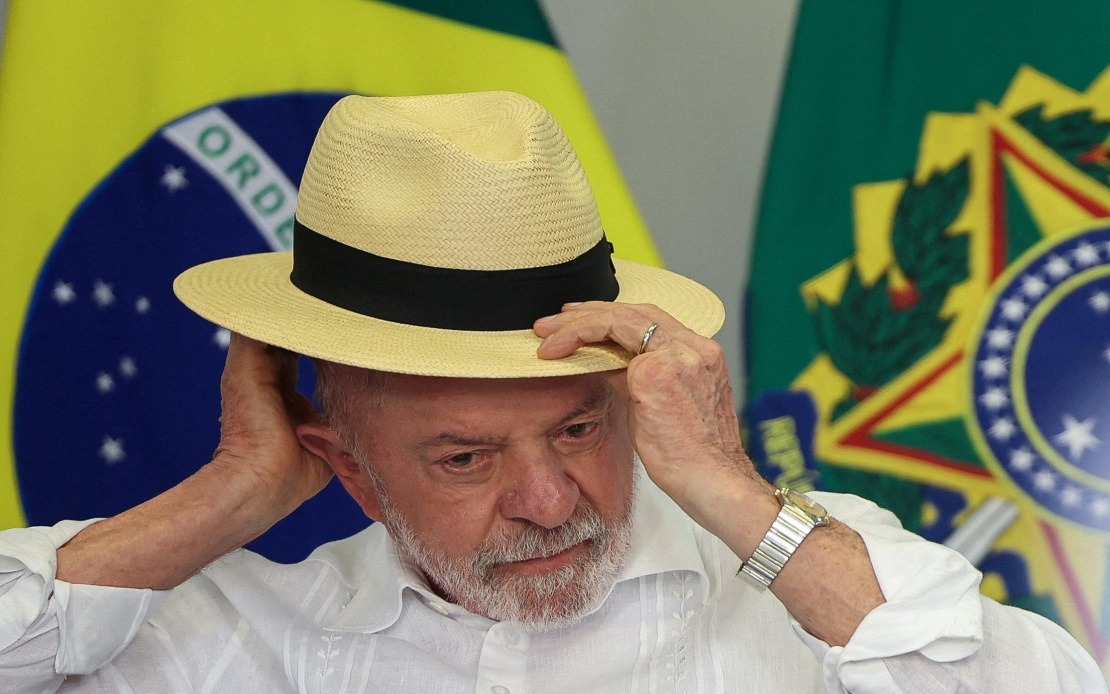
Brazilian President Luiz Inacio Lula da Silva maintains a razor-thin lead over Senator Flavio Bolsonaro in the countdown to October's presidential election, according to findings from a fresh Quaest survey commissioned by media heavyweight Globo. The poll reveals that in a head-to-head runoff scenario, Lula commands 43 per cent support compared to Bolsonaro's 40 per cent—a margin that falls comfortably within the survey's two-point error threshold, effectively rendering the race deadlocked in statistical terms. Data gathered between August 10 and 13 from 2,004 respondents underscores the intensifying competitive dynamics as Brazil approaches one of its most polarised electoral contests in recent memory.
The latest soundings represent a modest contraction of Lula's advantage from just days earlier. A comparable survey conducted on August 5 had shown the incumbent leading 44 per cent to 39 per cent, indicating that momentum appears to be shifting incrementally toward the Bolsonaro camp. Should no candidate achieve an outright majority in the first round, Brazilian electoral law mandates that the two leading contenders advance to a decisive runoff vote, a mechanism that fundamentally shapes campaign strategy and voter calculus across the political spectrum.
In a first-round voting scenario, Lula's support registers at 38 per cent, maintaining clear distance from Bolsonaro's 31 per cent. However, the broader field reveals fragmentation among alternative candidates, with former judge Renan Santos and Goiás governor Ronaldo Caiado each attracting four per cent of respondents, while Minas Gerais governor Romeu Zema captures two per cent. This splintering of the anti-Lula vote across multiple conservative candidates actually benefits the left-wing incumbent in preliminary rounds, though a runoff would likely consolidate opposition support behind the stronger rightist contender.
Flavio Bolsonaro's emergence as the primary standard-bearer for Brazil's political right reflects the seismic shift created by his father's exclusion from the race. Jair Bolsonaro, the polarising former president who dominated Brazilian politics from 2019 to 2022, was declared ineligible by the nation's electoral court following findings that he abused presidential powers. His legal troubles have deepened considerably, with conviction on charges stemming from an alleged conspiracy to overturn his election defeat to Lula through extra-constitutional means. For the Bolsonaro family, this electoral cycle represents a pivotal test of whether their political project can survive without the former president's direct participation.
The younger Bolsonaro's candidacy carries significant weight among the incumbent's core constituency, many of whom view him as carrying forward his father's nationalist agenda and resistance to what they characterise as left-wing governance. His status as a sitting senator provides him with institutional credibility and media access that distinguishes his campaign from typical outsider challenges. Nevertheless, polling consistently shows him trailing the incumbent across demographic groups and geographic regions, a structural disadvantage that explains the tightening trend captured in recent surveys.
Lula, meanwhile, has centred his re-election campaign around themes of national sovereignty and protection of Brazil's strategic resources. His formal campaign launch on August 2 at the Workers' Party convention in Sao Paulo deliberately positioned the election as a referendum on Brazil's independence in an increasingly contested geopolitical environment. The incumbent has repeatedly warned against foreign interference, particularly from the United States, explicitly invoking concerns that Washington might seek influence over Brazil's abundant mineral wealth and critical raw materials essential to global energy transition industries.
The president's rhetorical positioning reflects genuine anxiety within Brazil's establishment about potential pressure from the Trump administration, which maintains historically cordial relationships with the Bolsonaro family. Lula's June warning to Trump—delivered in characteristically blunt fashion—drew a direct parallel between Brazilian and American electoral sovereignty, effectively telling the US leader to refrain from meddling. His August campaign messaging amplified these themes, promising that China, the United States, and France would access Brazilian mineral resources only on terms respectful of national interests. This framing transforms what might otherwise be a domestic political contest into a broader struggle over Brazil's autonomy within the Western hemisphere.
For Malaysian and Southeast Asian observers, Brazil's election carries implications beyond Latin America's borders. The region shares Brazil's dependence on commodity exports and vulnerability to great-power competition, particularly as the US and China vie for influence over critical supply chains and resource access. A Lula victory would reinforce a multipolar approach to international relations and resistance to Washington's hegemonic pretensions, potentially emboldening similar positioning across the Global South. Conversely, a Bolsonaro-aligned administration might tilt toward closer US alignment, reshaping the geopolitical balance that currently underpins ASEAN's strategic autonomy.
The tightening contest also reflects broader polling challenges inherent in capturing Brazilian electoral sentiment. Polarisation runs extraordinarily deep, with significant portions of the electorate holding intense preferences that may translate differently at the ballot box than in telephone surveys. Undecided voters, particularly in a runoff scenario, could prove decisive, as voters who express ambivalence or refusal to state preferences may drift systematically toward one candidate. The incumbent's continued narrow advantage, despite obvious momentum shifts, suggests the race remains genuinely competitive with outcome uncertainty genuine rather than rhetorical.
With roughly two months separating the survey from the October election, both campaigns face critical windows for consolidating support and persuading marginal voters. Lula's strategy emphasises continuity and sovereign defiance against foreign pressure, appealing to nationalist sentiment and working-class constituencies benefiting from recent economic improvements. Bolsonaro's team will attempt to exploit voter frustration over inflation and inequality while questioning Lula's ability to manage the economy effectively. The current polling snapshot captures a moment of genuine flux, where historical trends and emerging sentiment shifts remain in dynamic tension, ultimately leaving the Brazilian electorate's final decision genuinely open.

