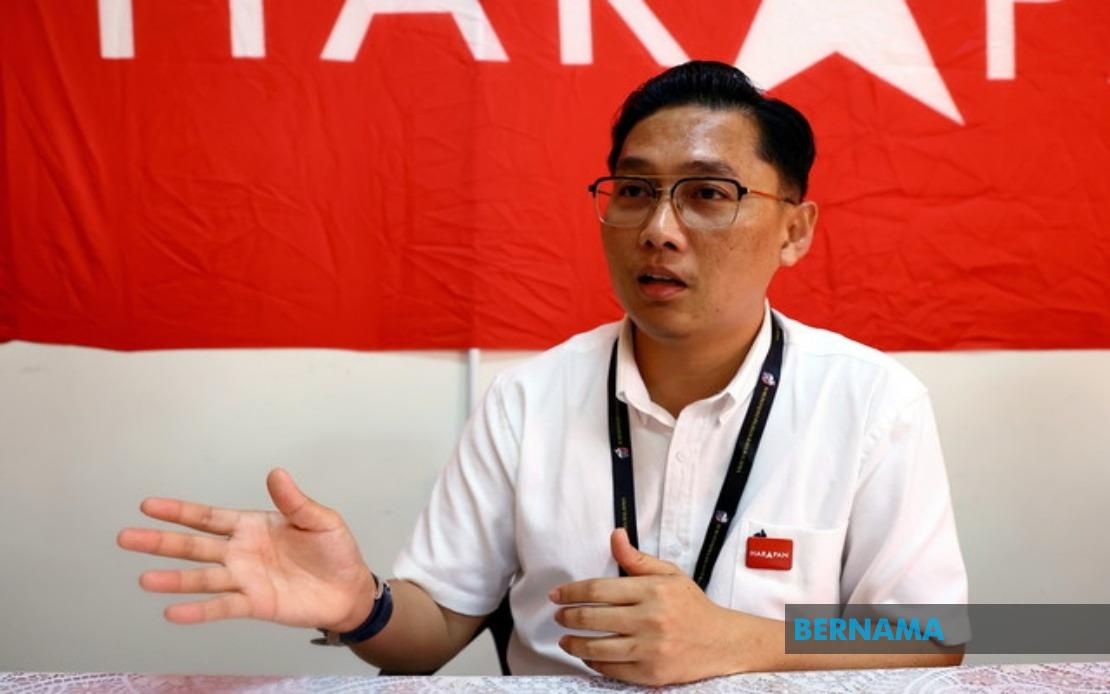
Nur Hafiz Roslan, the Pakatan Harapan nominee for Machap, has dismissed concerns about challenging one of Johor's most prominent political figures, declaring his readiness to contest against the state's incumbent Menteri Besar Datuk Onn Hafiz Ghazi in the July 11 state election. Speaking from the PH campaign headquarters in Simpang Renggam, the legal professional drew confidence from nearly two decades of courtroom experience, suggesting that expertise in navigating complex legal terrain would serve the constituency well in addressing constituent grievances and securing equitable development.
Machap has long been regarded as a fortress for Barisan Nasional, with Onn Hafiz securing a commanding majority of 6,543 votes in the 2022 state polls. Despite this historical advantage, Nur Hafiz expressed unwavering determination, framing the contest not as a mismatch but as an opportunity to shift the narrative of what Machap politics could become. His assertion that electoral history defies inevitability reflects a growing trend among opposition candidates across Malaysia who increasingly challenge the notion that certain constituencies remain permanently locked within establishment control.
The candidate pointed to instructive precedents within Johor's own political annals, invoking the electoral defeats suffered by former Mentri Besars Tan Sri Abdul Ghani Othman and Datuk Seri Khaled Nordin as evidence that even entrenched incumbents can be unseated when conditions align. This historical reference carries particular weight in the Johor context, where the state has witnessed remarkable political shifts over the past decade, including the 2018 election that dramatically altered the political balance across the peninsula. Such examples suggest that voter preferences, even in traditionally conservative constituencies, remain subject to change when candidates present compelling alternatives and constituents perceive tangible benefits in a transition.
Central to Nur Hafiz's campaign strategy is a deliberate pivot away from what he characterises as outdated political frameworks rooted in divisive sentiments. He has explicitly rejected what he terms the "3R" approach—politics centred on race, religion, and royalty—contending that such appeals generate artificial fear among communities and obstruct the development of coherent policy solutions. This positioning reflects broader dissatisfaction among segments of the Malaysian electorate with campaign strategies that prioritise emotional appeals over substantive governance platforms. For voters increasingly concerned with cost of living pressures, healthcare access, and economic opportunity, the promise of mature, issues-focused representation may resonate more powerfully than traditional identity-based messaging.
The candidate envisions a governance model that transcends the federal-state divide, positioning himself as a bridge to facilitate smoother communication between Machap constituents and both the state and federal governments. This bridging rhetoric acknowledges the reality that effective constituency service often requires navigation of multiple bureaucratic layers and political jurisdictions. In Malaysia's federal system, where power is distributed between state and national governments, a representative who can coordinate across these boundaries potentially delivers more tangible benefits than one limited to state-level advocacy. For a constituency like Machap, which likely faces issues spanning education, infrastructure, and commerce, such cross-level engagement could prove decisive.
The PH machinery in Machap appears cohesive heading into the contest, with Nur Hafiz noting the absence of internal discord that has plagued opposition campaigns elsewhere in Malaysia. Campaign unity assumes heightened importance when facing an entrenched incumbent, as fractionalised opposition votes typically benefit the leading candidate. The discipline and organisational stability Nur Hafiz describes suggest that PH has invested serious organisational effort in this particular contest, despite the challenging electoral terrain. This stands in contrast to several other opposition campaigns in Johor where internal tensions and competing candidacies have fragmented opposition support.
Onn Hafiz's position as Menteri Besar provides substantial institutional advantages, including control over state resources and the ability to direct development projects toward constituencies—advantages typically reflected in electoral outcomes. Yet the straight fight format in Machap, with no third candidate splitting votes, creates a binary choice that could amplify the salience of non-incumbent candidate messaging. Voters presented with a clear alternative to the incumbent, rather than scattered choices, sometimes reconsider their preferences more carefully. The absence of a splinter candidate from smaller coalition partners or independent contenders means that dissatisfaction with the incumbent cannot be diffused across multiple alternatives.
The July 11 election date arrives at a particular moment in Malaysia's political evolution, when voters across multiple states have demonstrated willingness to reassess their allegiances. The early voting period commencing July 7 suggests a relatively compressed campaign window, potentially limiting the time available for Nur Hafiz to saturate the constituency with his messaging. Nonetheless, in an era of digital political communication, the intensity of engagement during shorter campaigns sometimes compensates for duration. The candidate's emphasis on legal expertise and professional credentials represents an implicit contrast with incumbent representatives, appealing to voters who prioritise administrative competence and systematic problem-solving.
Machap's electoral dynamics deserve attention not merely as a local contest but as an indicator of voter sentiment in a state that remains pivotal to Malaysia's broader political trajectory. Johor, historically a BN stronghold and significant contributor to federal government support, increasingly shows signs of political contestation. Nur Hafiz's campaign represents one of many efforts by PH to penetrate constituencies long written off as unwinnable. Whether his challenge succeeds or falls short, the very fact of his confident candidacy reflects a shifting political landscape where entrenched advantages face genuine pressure from organised opposition determined to reshape constituency representation around policy substance and cross-community governance.

