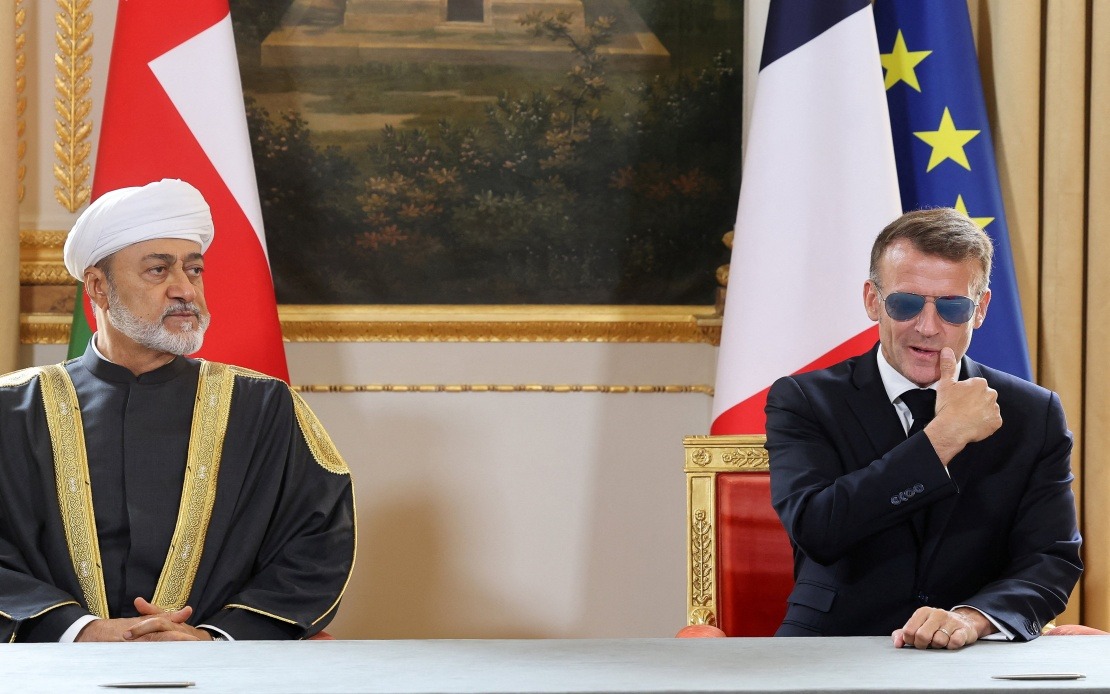
French President Emmanuel Macron donned his now-famous aviator sunglasses during a diplomatic visit to meet Sultan Haitham bin Tariq of Oman on Monday, reviving memories of the eyewear that captured international headlines earlier this year. According to French media reports citing sources close to the president, the decision to wear the dark shades was medically motivated, with Macron managing an ongoing eye problem that necessitated the protective accessory during the formal engagement at the Élysée Palace.
The choice of eyewear immediately drew reference to Macron's appearance at the World Economic Forum in Davos in January, where similar aviator-style sunglasses became an unexpected focal point of global media coverage. At that high-profile gathering, the French leader's fashion statement transcended typical diplomatic dress codes and became the subject of considerable commentary, with reactions ranging from playful criticism to outright mockery from international figures, most notably US President Donald Trump.
French officials had previously disclosed that Macron experienced a minor eye inflammation condition requiring corrective eyewear for roughly two weeks during the early months of 2024. The medical explanation, though straightforward, stood in sharp contrast to the speculation and humour that had swirled around his Davos appearance. At the time, commentators and social media users in France had compared his look to Tom Cruise's iconic appearance in action films, turning a simple medical accommodation into cultural commentary and internet fodder.
During the Oman engagement, Macron maintained the sunglasses throughout both the greeting ceremony with Sultan Haitham bin Tariq outside the presidential residence and the subsequent bilateral discussions. This sustained wearing of the accessory underscored the legitimacy of the medical justification, distinguishing this instance from the more fashion-forward deployment of similar eyewear at the Davos gathering months earlier. The consistency of the choice demonstrated that this was not a deliberate style statement but rather a practical response to a persistent health concern.
The phenomenon surrounding Macron's sunglasses offers a fascinating case study in how modern politics and celebrity culture intersect, particularly in the age of social media where seemingly minor sartorial decisions acquire outsized significance. What might otherwise have been an unremarkable accommodation for a medical condition transformed into a global conversation about presidential style, international diplomacy, and the pressure placed on world leaders to maintain certain aesthetic standards regardless of practical considerations.
Interestingly, the commercial sector capitalised on the sunglasses phenomenon with notable speed and sophistication. Henry Jullien, the French luxury eyewear manufacturer behind the model worn by Macron, reported a substantial increase in customer inquiries following his Davos appearance. The company subsequently leveraged this unexpected celebrity endorsement by incorporating photographs of Macron wearing the sunglasses into their promotional materials, transforming an accidental fashion moment into a deliberate marketing strategy that continues to generate consumer interest.
For Malaysian readers observing this diplomatic exchange, the interaction between Macron and Sultan Haitham bin Tariq carries particular relevance given Malaysia's historical ties with Oman and both nations' shared regional interests in the Indian Ocean. French diplomatic overtures toward Gulf monarchies reflect broader European efforts to strengthen Middle Eastern partnerships, an arena where Malaysia also maintains strategic engagement. The bilateral discussions likely encompassed matters of mutual commercial and security concern, making the summit significant beyond the surface-level attention garnered by Macron's eyewear choice.
The incident also illuminates the contemporary challenges facing political leaders in balancing personal wellbeing with public perception management. In an earlier era, a minor eye condition would likely have gone unnoticed by the general public, with leaders simply adjusting their schedules or activities to accommodate temporary health concerns. Today, every visible decision becomes potentially newsworthy, forcing modern statesmen to navigate the awkward intersection of medical necessity and perpetual media scrutiny.
The Oman visit demonstrates that Macron's eye condition remains present several months after the initial January diagnosis, suggesting the inflammation may be more persistent than initially indicated. This detail invites speculation about the underlying cause and whether the French president has required ongoing medical management throughout the intervening period. The continued need for corrective eyewear indicates that what was initially framed as a temporary two-week issue may require longer-term adaptation.
Ultimately, the continued presence of Macron's aviator sunglasses in diplomatic settings represents a normalisation of the practical accommodation, moving beyond the novelty factor that dominated coverage during the Davos forum. As the French leader conducts bilateral meetings and international engagements while managing this eye condition, the sunglasses transition from an attention-grabbing anomaly to a standard aspect of his appearance. This evolution underscores how public figures gradually reshape narratives around their visible characteristics simply through consistent presence and continued execution of their official duties.

