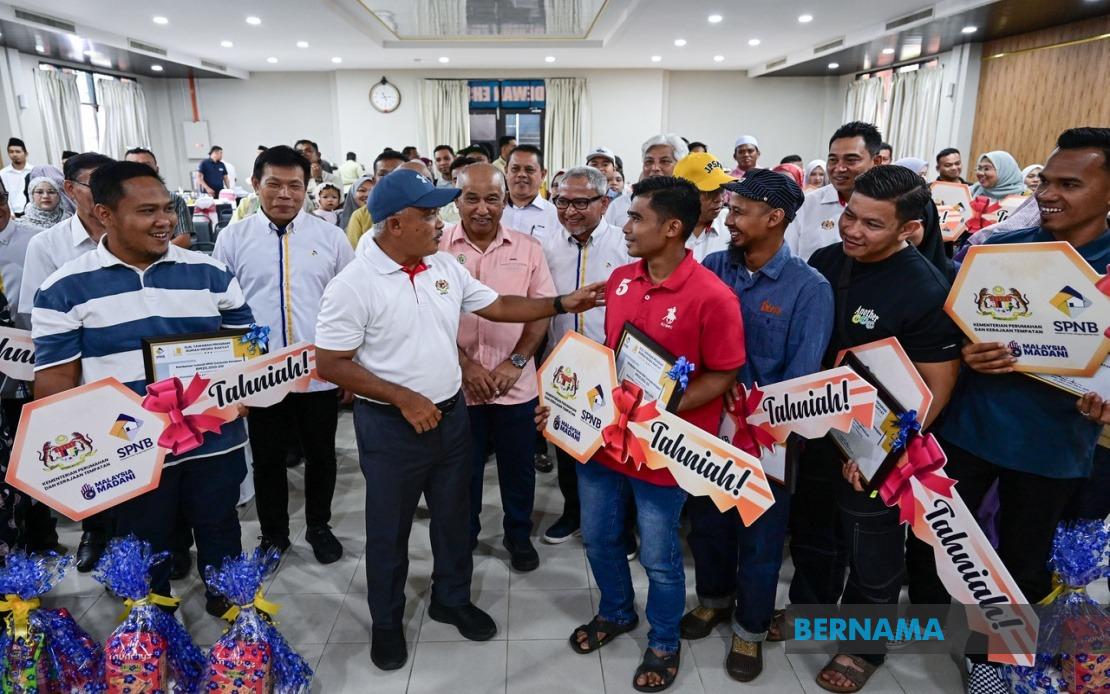
The MADANI Government has distributed housing assistance to fifty beneficiaries across two Terengganu parliamentary constituencies, marking another milestone in its push to expand affordable homeownership among lower-income Malaysians. The distribution, which took place at Dewan Ehsan in Felda Wilayah Timur on June 28, comprised thirty fully constructed homes and twenty offer letters enabling recipients to begin building new properties. The event underscored the administration's broader housing agenda, which positions residential security as fundamental to improving living standards for economically disadvantaged communities.
Implemented through Syarikat Perumahan Negara Berhad (SPNB) under the Housing and Local Government Ministry, the Rumah Mesra Rakyat (RMR) programme targets a specific demographic: landowners without adequate housing who lack the capital to construct or purchase quality dwellings independently. Rather than merely transferring properties, the initiative functions as a comprehensive intervention designed to strengthen household stability and community resilience. According to Datuk Dr M. Noor Azman Taib, the ministry's secretary-general, the programme transcends conventional housing provision by catalysing broader improvements in family welfare, social cohesion, and long-term economic security through the pathway of homeownership.
Terengganu has emerged as a significant focus area for RMR expansion, with 680 units currently in various stages of implementation across the state, supported by a combined allocation of RM46.67 million. Within the Kuala Terengganu parliamentary constituency specifically, thirty-four RMR units have been activated, with eighteen already completed and handed to occupants, while another sixteen remain under construction. The neighbouring Kuala Nerus constituency mirrors this momentum, with thirty-two units in progress—twenty-five already delivered and seven in active construction phases. This dual-constituency approach reflects the government's strategy of concentrating resources where identified needs are greatest, ensuring measurable progress in addressing regional housing deficits.
Nationally, the RMR programme has scaled significantly since its establishment two decades earlier. Over eighty thousand families have benefitted from RMR assistance since 2002, demonstrating the initiative's institutional maturity and proven effectiveness. Current nationwide implementation stands at 3,900 units, comprising 2,478 completed and transferred properties alongside 1,422 units presently under construction. The government's Budget 2026 targets an ambitious expansion, allocating resources to construct 6,545 additional RMR units across the country, suggesting acceleration in programme delivery during the coming fiscal year.
For Malaysian policymakers and observers tracking housing security outcomes, the RMR programme represents a deliberate policy choice favouring direct state intervention over market-dependent solutions. The targeting mechanism—prioritising landowners unable to self-finance construction—addresses a specific market failure where conventional lending mechanisms often exclude lower-income individuals despite their asset ownership. This approach differs from pure subsidised rental schemes or demand-side voucher systems, instead treating homeownership as a wealth-building mechanism for economically marginalised groups. The emphasis on safety, comfort, and quality standards reflects evolving governmental standards regarding adequate housing, moving beyond minimal shelter provision towards liveable residential environments.
The Terengganu distribution carries particular resonance within Southeast Asian discussions concerning urban-rural equity and regional development. As a state historically dependent on primary industries, Terengganu confronts persistent challenges regarding income generation and employment diversification. Housing insecurity, often correlating with broader economic marginalisation, compounds these structural challenges. By concentrating RMR delivery in constituencies including Kuala Terengganu and Kuala Nerus, the government signals commitment to addressing infrastructure gaps that rural and smaller-urban populations face relative to Klang Valley-centric development patterns.
The programme's evolution also reflects shifting administrative priorities across successive Malaysian governments. Earlier iterations emphasised affordable housing provision through public housing complexes in high-density urban corridors. The RMR model, by contrast, responds to demographic preferences for landed properties—deeply embedded within Malaysian cultural expectations regarding homeownership—while accommodating beneficiaries' existing asset positions. This adaptive approach suggests maturing policy sophistication regarding housing demand heterogeneity across income strata and geographic regions.
Implementation sustainability represents an ongoing consideration for programme administrators. With over 3,900 units active and 6,545 additional units targeted within Budget 2026, SPNB faces significant operational demands regarding construction quality, timeline adherence, and beneficiary support services. Project delivery delays, cost overruns, or quality deficiencies could undermine programme credibility, particularly among rural constituencies where alternative housing options remain limited. Transparent performance reporting and systematic beneficiary feedback mechanisms therefore assume heightened importance as the programme scales.
Looking forward, the RMR programme's trajectory suggests housing provision will remain politically salient within Malaysia's policy landscape. Demographic pressures—including household formation rates, rural-urban migration, and generational wealth accumulation patterns—ensure continued demand for affordable homeownership pathways. Whether current resource allocations prove sufficient to address underlying housing deficits, or whether complementary policy interventions become necessary, will likely shape housing policy debates during upcoming electoral cycles and budget deliberations. The Terengganu distribution, whilst modest in absolute numbers, reflects broader governmental commitments to translating electoral mandates into tangible improvements in residential security and family welfare outcomes across Malaysia's diverse constituencies.

