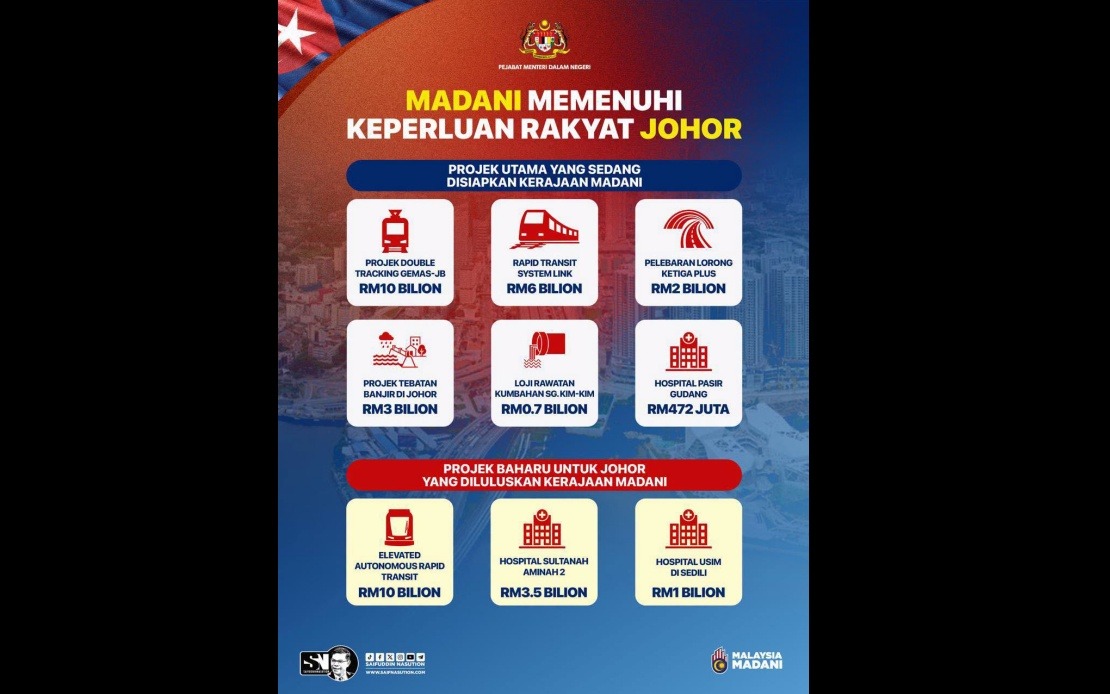
The MADANI Government's development agenda extends uniformly across Malaysia's states, with national and regional leaders reaffirming their commitment to lifting living standards through targeted investment and inclusive policy-making. Pakatan Harapan's secretary-general and Home Minister Datuk Seri Saifuddin Nasution Ismail underscored this position during remarks in Johor Bahru, positioning the state as a benchmark for the administration's broader vision of prosperity shared among all citizens.
Under Prime Minister Datuk Seri Anwar Ibrahim's stewardship, the government has identified four priority sectors as engines of improvement: infrastructure modernisation, public transportation networks, healthcare expansion, and resilience against natural disasters. This framework reflects a shift toward preventive governance, addressing both immediate service gaps and long-term environmental challenges that have historically burdened communities across the region. The allocation of resources in these domains reveals an understanding that sustainable development hinges not merely on economic growth metrics, but on tangible gains in citizens' daily lives.
Johor exemplifies this approach through a portfolio of major undertakings in transportation and emergency services. The Gemas-Johor Bahru Electrified Double Tracking Project modernises rail connectivity, while the Rapid Transit System (RTS) Link aims to reduce congestion in the southern corridor—a critical objective given Johor's position as a commercial hub and gateway to Singapore. The PLUS Highway third lane expansion addresses persistent traffic bottlenecks, particularly during peak periods and holiday seasons when gridlock has historically disrupted economic activity and endangered public safety.
Flood mitigation efforts carry particular resonance in Johor, where seasonal inundation has caused significant disruption and property damage in recent years. The state's dedicated flood mitigation project, combined with infrastructure improvements like the Sungai Kim Kim Sewage Treatment Plant, demonstrates recognition that development without environmental safeguards ultimately undermines progress. This integrated approach—linking transportation, sanitation, and flood prevention—reflects contemporary urban planning principles increasingly adopted across Southeast Asia as climate variability intensifies.
Healthcare expansion represents a cornerstone of the MADANI administration's social investment strategy. The Pasir Gudang Hospital enlargement improves emergency and specialist services for residents in one of Johor's most densely populated districts. Beyond this, the government has greenlit two new major medical facilities: Sultanah Aminah Hospital 2 and USIM Hospital in Sedili. These additions address a persistent disparity in healthcare accessibility across rural and developing districts, where residents previously faced lengthy journeys for tertiary-level care. For Malaysian readers accustomed to navigating fragmented healthcare provision, this expansion signals a deliberate attempt to standardise medical access regardless of residential location.
The Elevated Autonomous Rapid Transit (E-ART) initiative represents a frontier investment in smart urban mobility. This technology-enabled transport system signals the government's willingness to adopt innovative solutions to congestion, potentially serving as a prototype for deployment in other metropolitan areas. Such projects carry demonstration effects across Southeast Asia, where cities like Bangkok, Jakarta, and Ho Chi Minh City grapple with similar transportation challenges. Malaysia's experimentation with E-ART could yield models applicable throughout the region, positioning the country as a testbed for sustainable urban solutions.
Saifuddin Nasution emphasised that development metrics extend beyond simple investment tallies or construction timelines. Rather, governments must evaluate progress through employment generation, system efficiency, service quality, and residents' subjective experience of improved living standards. This reframing acknowledges a common criticism of development discourse—that large budget allocations and completed projects mask persistent service deficiencies or limited benefit distribution. By centering lived experience, the administration frames its agenda in terms directly intelligible to voters and affected communities.
The concentration of major projects in Johor reflects both demographic necessity and political calculation. As Malaysia's second-largest state by population and a crucial economic contributor, Johor's development trajectory influences regional competitiveness and investor confidence throughout southern Peninsular Malaysia. Yet this focus also raises questions about equitable resource distribution across less populous or economically dynamic states, a tension inherent in any federal development strategy where fiscal capacity and political leverage vary significantly among constituent units.
For Malaysian voters and observers, the MADANI Government's development platform hinges on demonstrable delivery rather than rhetorical commitment alone. Infrastructure projects require sustained funding despite economic fluctuations, while healthcare and transportation improvements demand ongoing operational investment beyond initial capital expenditure. Historical experience across Malaysian administrations reveals that project announcements frequently encounter delays, cost overruns, or scope reductions when political priorities shift or fiscal constraints tighten. The credibility of the current administration's sustainable development agenda ultimately depends on translating announced initiatives into functioning systems that meaningfully enhance citizen welfare.
The integration of flood mitigation, healthcare, and transportation within a single development framework reflects evolved governance thinking in post-pandemic Malaysia. Rather than siloed sectoral approaches, the MADANI model attempts to address interconnected needs simultaneously—recognising that efficient transportation networks reduce commute-related stress and environmental pollution, that accessible healthcare strengthens workforce productivity, and that flood resilience protects economic assets. This systems-oriented perspective aligns with contemporary international development doctrine, though implementation across Malaysia's complex federal structure and varied state capacities remains operationally challenging.

