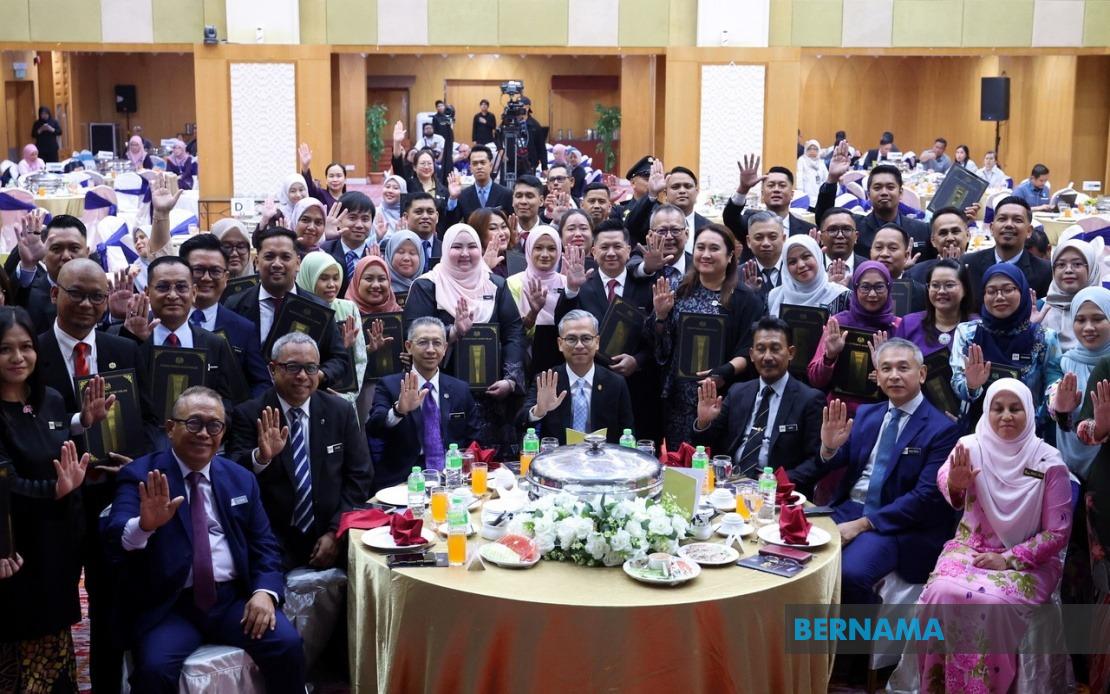
The MADANI Government views the everyday economic experiences of ordinary Malaysians as central to its economic agenda, Communications Minister Datuk Seri Fahmi Fadzil declared during an official visit to Kota Kinabalu. Speaking at the Communications Ministry's Sabah and Labuan Zone Excellent Service Awards ceremony, Fahmi underscored that while national economic metrics appear robust, their true measure lies in whether citizens actually feel the benefits in their pockets and daily routines.
Although Malaysia's economic indicators present an encouraging picture across both national and state frameworks—with improvements in investment flows, government revenue, foreign reserves, gross domestic product expansion, and trade volumes—Fahmi stressed these figures remain meaningless unless they improve quality of life for ordinary people. The minister articulated a philosophy that distinguishes between headline macroeconomic performance and the lived reality of economic citizens, a distinction increasingly important for Southeast Asian governments balancing growth aspirations with social expectations.
To illustrate this principle, Fahmi pointed to the implementation of targeted diesel subsidy reforms under the BUDI MADANI scheme. In East Malaysian states like Sabah and Sarawak, where geographical distances between districts necessitate extensive travel for routine commercial and personal activities, blanket subsidy policies create uneven impacts. The minister noted that Prime Minister Datuk Seri Anwar Ibrahim and the Cabinet recognise these regional variations as critical policy considerations rather than secondary details, reflecting a deliberate shift toward geography-conscious economic management.
The distinction between uniform national policy and context-specific implementation carries particular weight in the Malaysian federation. Sabah and Sarawak, as geographically dispersed states with substantial rural populations, experience transportation costs and subsidy impacts differently from densely populated Peninsular centres. Fahmi's public acknowledgment of this reality signals governmental awareness that economic policy legitimacy depends not merely on macroeconomic targets but on demonstrable alignment between policy intent and local outcomes.
Beyond subsidy design, Fahmi articulated broader governmental responsibility to ensure that economic excellence "at the national level really has an impact, so that it can be enjoyed, felt and reflected in their wallets and pockets." This framing rejects technocratic economics divorced from social outcomes, instead positioning government performance as fundamentally measured through citizen experiences. For Malaysian policymakers, this represents an intentional recalibration toward inclusive growth narratives that acknowledge divergent regional experiences within a federal system.
The minister also identified a communication dimension to the people's economy framework. Government ministries and agencies, he argued, bear responsibility for transparent and comprehensive policy explanation to prevent public misinterpretation or confusion regarding initiatives affecting household finances. This emphasis on clarity reflects recognition that policy efficacy depends partly on citizen understanding and buy-in, particularly for complex schemes like targeted subsidies that generate differential impacts across populations and geographies.
Fahmi's remarks during the Sabah and Labuan service awards ceremony—an event recognising government staff excellence—carried implicit messaging about institutional accountability. By framing ministerial priorities in terms of tangible citizen benefit rather than administrative metrics, he signalled that government service quality should ultimately be evaluated through the lens of societal outcomes rather than bureaucratic efficiency alone. This represents a meaningful rhetorical shift emphasising downstream impact over upstream process.
The people's economy concept responds to several Malaysian political challenges. Public discourse increasingly questions whether growth at the national level translates into household wage growth, cost-of-living improvements, or asset accumulation for average families. By explicitly centring this concern within ministerial statements, the MADANI administration positions itself as responsive to citizens' economic anxieties and committed to bridging the gap between macro-level prosperity and micro-level household finances.
Regionally, Malaysia's emphasis on people-centred economics reflects broader Southeast Asian trends toward inclusive growth frameworks. As neighbouring economies grapple with inequality concerns and middle-class frustration despite aggregate growth, Malaysian policy language increasingly acknowledges that economic legitimacy requires demonstrable trickle-down effects. Fahmi's articulation of the people's economy thus situates Malaysia within regional conversations about balancing development aspirations with equitable distribution of benefits.
The practical implications extend beyond rhetoric. If the government genuinely prioritises people's economy outcomes, policy design must anticipate differential regional impacts, address cost-of-living pressures in household budgets, and communicate effectively about distributional consequences of major initiatives. Subsidy retargeting, wage policies, investment incentives, and infrastructure spending should all be evaluated through this people-centred lens rather than treated as separate technocratic exercises.
For Malaysian citizens, particularly those in geographically challenging or economically marginalised areas, Fahmi's statements establish a rhetorical framework for holding government accountable to household-level economic improvements. Rather than accepting national growth figures alone as proof of governmental success, citizens can now reference ministerial commitments to people's economy as a benchmark for evaluating whether policies genuinely benefit their families and communities.

