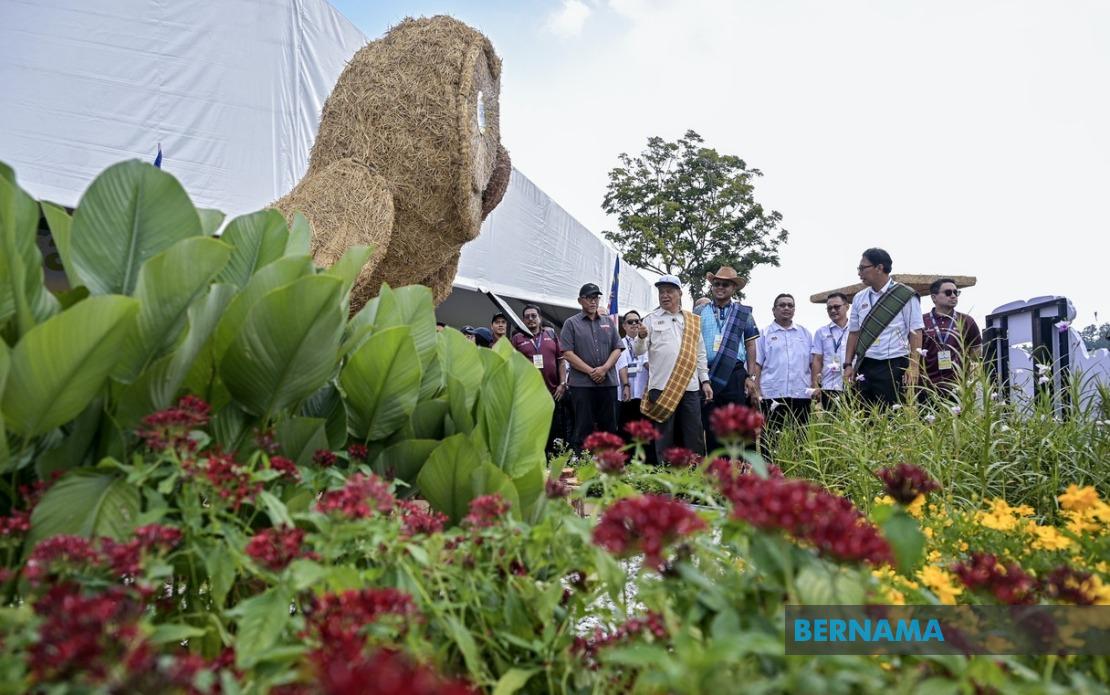
Malaysia's premier agricultural exhibition MAHA 2026 is experiencing extraordinary foot traffic in its opening week, with Agriculture and Food Security Minister Datuk Seri Mohamad Sabu confirming that 1.8 million people have passed through the gates of the Malaysia Agro Exposition Park Serdang (MAEPS) in just the first three days. The commercial performance has matched visitor enthusiasm, with the event generating approximately RM6 million in transactions during the same period—a strong indicator that the festival's ambitious RM58 million sales target is within realistic reach when the exhibition concludes on September 6.
The sheer volume of attendees has created logistical challenges that serve as a barometer of the event's success. Transportation infrastructure at MAEPS has absorbed unprecedented demand, with 184,000 vehicle movements recorded across the exhibition grounds during the initial three-day window. This figure underscores not merely the drawing power of MAHA 2026, but also the broader appeal of agricultural commerce and agritourism within Malaysia's domestic economy. For many visitors—particularly rural and semi-urban communities—such exhibitions represent accessible gateways to direct transactions with farmers, seed suppliers, and value-added producers.
Minister Mohamad acknowledged the congestion candidly, noting the intense vehicle flow has taxed local transport capacity. Rather than dismissing these growing pains as inevitable, he indicated that management has responded with expanded shuttle services and coordinated daily committee sessions designed to troubleshoot operational bottlenecks. His observation of extended queues at state pavilions reflects a curatorial structure that encourages visitors to explore regional agricultural initiatives, though such concentration points require careful crowd management.
The exhibition's programming strategy appears deliberately calibrated to generate peaks in attendance. MAHA Merdeka, an integrated event component celebrating National Day, drew particular crowds through curated entertainment including fireworks displays and drone light shows. This fusion of patriotic celebration with agricultural commerce illustrates how government initiatives leverage multiple policy objectives—promoting local farming industries whilst reinforcing national identity—within a single venue. Such cross-cutting approaches resonate with Malaysian audiences and justify substantial public investment in the event infrastructure.
Merchants within MAHA 2026 appear positioned to capitalize on diverse demand streams. While dramatic sales figures emerge, the composition of purchases—heavily weighted toward crop seeds and horticultural inputs—reveals the exhibition's fundamental character as a working marketplace rather than a consumer spectacle. For small-scale farmers contemplating seasonal planting, smallholders seeking improved varieties, and agricultural entrepreneurs exploring supply-chain opportunities, MAHA provides concentrated access to innovation and inventory that would ordinarily require multi-region travel.
The exhibition's scale reflects Malaysian agriculture's economic and cultural significance. With approximately 2,000 exhibitors across the MAEPS grounds, MAHA 2026 has assembled an ecosystem encompassing agribusiness corporations, government agencies, farming cooperatives, research institutions, and ancillary service providers. For regional observers, the event benchmarks the sector's vitality and investment confidence at a moment when food security concerns, climate adaptation, and rural income sustainability occupy policy attention across Southeast Asia.
Minister Mohamad's operational focus on transport and crowd management, whilst seemingly administrative, touches deeper governance challenges. Exhibition venues in developing and middle-income economies often struggle with infrastructure-visitor mismatch; MAHA's management has opted for responsive incremental improvements rather than restricting access, a choice reflecting confidence in underlying demand sustainability. The ongoing dialogue between organizers and attendees, mediated through daily committee review of complaints, represents a pragmatic problem-solving approach aligned with contemporary governance expectations.
For Malaysia's agricultural sector, MAHA's performance carries signals beyond immediate sales metrics. Strong visitor numbers suggest sustained consumer interest in direct purchasing from primary producers, potentially energizing rural livelihoods and reducing intermediary margins. The exhibition simultaneously functions as a networking platform, enabling knowledge transfer between research establishments and farming practitioners, and as a confidence indicator for investors evaluating agribusiness expansion opportunities within Malaysia's growing food system.
Looking toward MAHA 2026's completion on September 6, current trajectory positions the exhibition to substantially exceed the RM58 million sales projection, though weather, ongoing scheduling of special events, and weekend visitor volumes will influence final totals. Beyond quantitative metrics, MAHA demonstrates enduring appeal of face-to-face agricultural commerce in an increasingly digitalized economy, and underscores the continued relevance of place-based experiences for knowledge-intensive sectors. For Malaysian policymakers and agricultural stakeholders across Southeast Asia, the exhibition's momentum provides reassurance that investment in integrated agritourism infrastructure continues generating proportional returns in economic activity and sector engagement.

