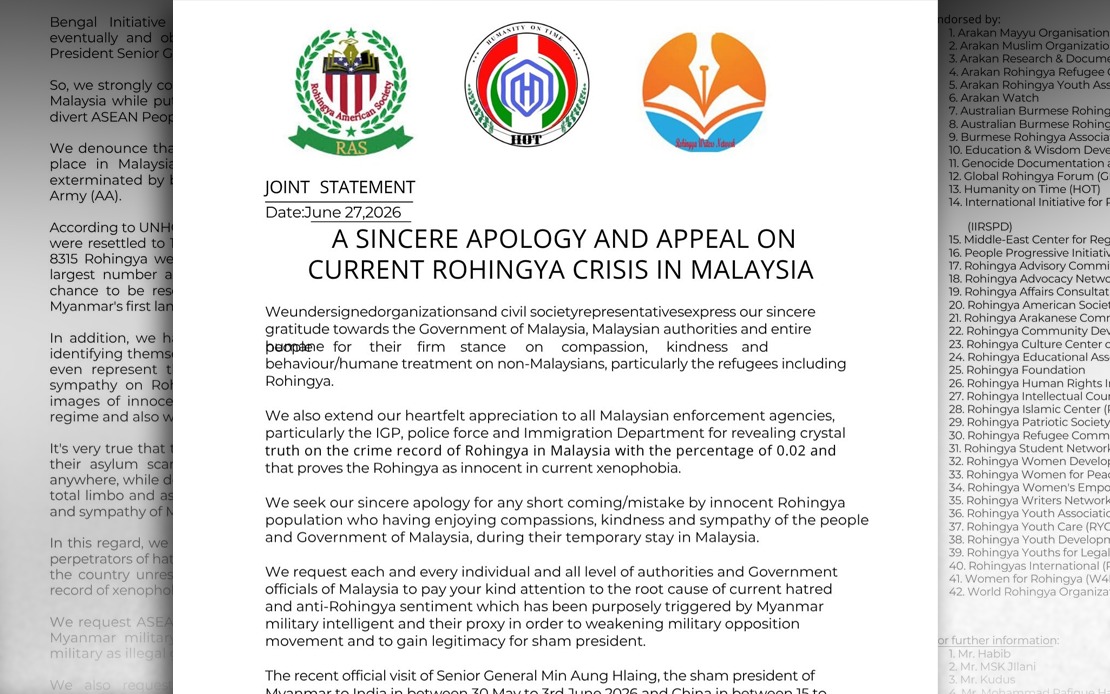
Malaysian Humanitarian Aid and Relief (MAHAR) has responded positively to an apology issued by 40 Rohingya non-governmental organisations, viewing the gesture as evidence of collective accountability. The organisation's welcome of the statement reflects a measured approach to the complex challenge of managing humanitarian assistance within Malaysia's diverse society, while simultaneously signalling expectations for higher standards of engagement from refugee-focused groups operating within the country.
Beyond the symbolic value of the apology itself, MAHAR has articulated a broader vision for how humanitarian organisations should approach their work with displaced populations. The group contends that effective aid extends far beyond the immediate provision of basic necessities such as food and shelter—a conventional understanding of humanitarian support that many organisations default to in crisis situations. Instead, MAHAR suggests that refugee-serving NGOs must incorporate educational components that inform displaced persons about their legal and social obligations while residing in Malaysia, treating integration literacy as integral to the aid process rather than secondary.
This perspective carries particular significance in Malaysia's context, where the presence of over 180,000 registered Rohingya refugees has occasionally sparked public tension. MAHAR's call for greater emphasis on civic education reflects an implicit recognition that host-refugee relations depend not only on material assistance but on mutual understanding and adherence to shared norms. The organisation advocates that NGOs intensify efforts to inculcate respect for Malaysian legal frameworks, cultural practices, and communal values within refugee populations, framing such work as essential to building productive relationships between newcomers and established communities.
International dimensions of the crisis feature prominently in MAHAR's assessment. The organisation has urged Rohingya NGOs to strengthen their advocacy efforts directed at the international community, emphasising that meaningful humanitarian intervention must ultimately address the underlying causes that displace the Rohingya population. This insistence on tackling root causes—namely, the persecution and marginalisation of Rohingya in Myanmar—reflects an understanding that sustainable solutions require not merely managing displacement consequences but working towards conditions that might allow safe repatriation or permanent resettlement options.
MAHAR President Jismi Johari introduced an additional dimension by emphasising that humanitarian work must simultaneously protect the safety and security of both refugee populations and host communities. This framing acknowledges a tension that occasionally emerges in public discourse: the need to protect vulnerable displaced persons while also addressing legitimate security concerns held by Malaysian citizens. Johari's articulation suggests that these objectives need not be mutually exclusive, though they require careful navigation.
Johari specifically acknowledged concerns raised by Malaysians regarding local safety, particularly those expressed by individuals who have experienced incidents involving members of refugee communities. Rather than dismissing such grievances as xenophobic sentiment, MAHAR has taken the position that these concerns merit serious consideration and response. This represents a departure from some advocacy positions that categorically reject security-related objections to refugee presence, instead adopting an approach that treats citizen concerns as legitimate inputs requiring substantive engagement.
However, MAHAR's framework includes an important counterbalance: the organisation has cautioned against extrapolating from individual misconduct to broader community characterisations. Johari noted that criminal behaviour and social dysfunction occur within every demographic group and society, implying that Rohingya communities should not be uniquely stigmatised based on isolated incidents. This balanced position attempts to hold space for both acknowledging concrete safety concerns and resisting categorical prejudice against an entire refugee population.
The president emphasised that addressing these tensions constructively demands empathy, mutual respect, and genuine dialogue among all stakeholders—refugees, NGOs, local communities, and government. This prescription suggests that improved refugee-host relations require more than bureaucratic management; they necessitate emotional and intellectual engagement from diverse actors working towards shared understanding and peaceful coexistence.
MAHAR's reaffirmation of its commitment to humanitarian work that integrates justice, safety, and human dignity reflects a sophisticated understanding of contemporary humanitarianism. Rather than viewing refugee protection and community security as opposing imperatives, the organisation positions itself as dedicated to outcomes that serve the fundamental interests of both populations. This stance carries implications for how humanitarian organisations throughout Southeast Asia might approach displacement crises, particularly as the region grapples with the impacts of Myanmar's continuing instability and the presence of substantial refugee and displaced populations across multiple countries including Thailand, Bangladesh, and Indonesia.

