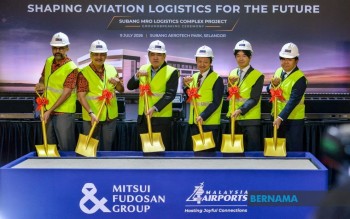
Malaysia Airports Holdings Bhd and Mitsui Fudosan Group have committed RM80 million to construct a new air cargo logistics complex at Subang Airport, marking a significant step in repositioning the facility as a regional aviation hub. The partnership sees MAHB retaining a 30 per cent equity stake while Mitsui Fudosan assumes operational control with 70 per cent ownership, a structure reflecting the Japanese company's specialised knowledge in airport logistics infrastructure development and management.
Transport Minister Anthony Loke Siew Fook underscored the strategic rationale behind the collaboration at the project's groundbreaking ceremony, explaining that MAHB is pursuing a deliberate path of monetising its substantial land holdings through partnerships with experienced international operators. The minister highlighted that Mitsui Fudosan brings proven capability in this domain, having successfully developed and managed comparable facilities at Japan's Haneda Airport, one of Asia's busiest aviation hubs. This partnership model enables MAHB to generate returns on underutilised assets whilst transferring operational risk to a partner with demonstrated expertise.
The joint venture entity, MFMA Industrial Sdn Bhd, will oversee the development of the facility within the Subang Aerotech Park precinct. This initiative exemplifies a broader trend in Malaysian aviation infrastructure, where government-linked companies increasingly pursue public-private arrangements to attract foreign expertise and capital into strategic sectors. By importing operational knowledge from Haneda—which handles over 80 million passengers annually and maintains extensive cargo operations—Mitsui Fudosan can implement proven systems and processes at Subang, potentially accelerating the facility's competitiveness.
The project sits within an evolving landscape for Subang Airport, which has undergone significant transformation since the opening of Kuala Lumpur International Airport in 1998. Once Malaysia's primary international gateway, Subang has repositioned itself as a specialist facility for cargo, maintenance operations, and business aviation. This cargo complex aligns with that strategic direction, capitalising on the airport's geographic proximity to the Klang Valley and established logistics infrastructure. The facility's location within Aerotech Park, an aerospace-focused industrial cluster, creates natural synergies with existing maintenance, repair and overhaul operations servicing the regional aviation industry.
The naming of the project as the Subang MRO Logistics Complex Project reflects its dual purpose—supporting both the maintenance ecosystem and air cargo movements. MRO services in Malaysia represent a growing sector, with regional airlines and international operators increasingly seeking cost-effective alternatives to developed-country facilities. A dedicated cargo logistics facility co-located with MRO capabilities creates competitive advantages, allowing operators to conduct routine maintenance whilst managing inventory and shipments in proximity. For Malaysian-based air cargo operators and freight forwarders, this represents expanded domestic capacity without dependency on regional competitors in Singapore or Thailand.
Mitsui Fudosan's entry into Malaysian airport logistics also signals Japanese corporate confidence in the country's aviation sector growth trajectory. The company, one of Japan's largest property developers and logistics operators, typically undertakes such investments in markets offering medium-to-long-term growth potential. Southeast Asia's rising air freight demand, driven by e-commerce expansion and supply chain regionalisation, creates tailwinds for the project. CPTPP membership and regional trade liberalisation further enhance prospects for cargo volume growth through Malaysian hubs.
For MAHB, this arrangement represents evolution in airport commercialisation strategy beyond traditional retail and parking revenues. By converting airport land into productive logistics assets whilst retaining minority stakes, the company generates ongoing dividend streams whilst reducing capital expenditure burden. The 30 per cent holding preserves strategic influence over facility operations and future expansion, whilst the majority stake held by Mitsui Fudosan ensures operational accountability to an experienced international operator accountable to global standards.
The partnership also addresses infrastructure gaps in Malaysia's aviation cargo sector. Current capacity constraints at primary hubs create opportunities for secondary facilities like Subang to capture incremental traffic. By offering state-of-the-art storage, handling, and consolidation capabilities alongside nearby MRO services, the complex positions itself as attractive to freight forwarders seeking reliable, modern facilities. Malaysian-based logistics companies particularly benefit, gaining access to world-class infrastructure without requiring offshore operations.
Minister Loke's emphasis on risk mitigation through partnership reflects pragmatic governance. Government-linked companies undertaking major infrastructure projects face scrutiny over execution timelines, cost control, and commercial viability. By enlisting Mitsui Fudosan's operational expertise and capital contribution, MAHB distributes performance risk whilst tapping the company's networks for tenant recruitment and international best practices. This approach has gained favour across Southeast Asian aviation hubs, where public authorities increasingly prefer management partnerships to full operational control.
Longer term, the project contributes to Malaysia's aspiration to position itself as a global aviation services hub, competing with established centres like Singapore and Bangkok. Subang's revival as a specialised facility capable of handling modern cargo requirements enhances the country's attractiveness for aviation companies seeking diversified operating locations. Regional airlines conducting hub-and-spoke operations may find Subang's combination of cargo capacity and MRO services valuable, potentially supporting employment and skills development in aerospace-related fields.
The RM80 million investment scale, whilst substantial, reflects realistic development costs for modern cargo facilities meeting international standards. The project timeline and phasing remain undisclosed, though groundbreaking ceremonies typically precede construction commencement within months. For stakeholders in Malaysian aviation and logistics sectors, successful execution of this project signals momentum towards infrastructure modernisation that supports regional competitiveness in air cargo markets increasingly defined by speed, reliability, and integrated service offerings.

