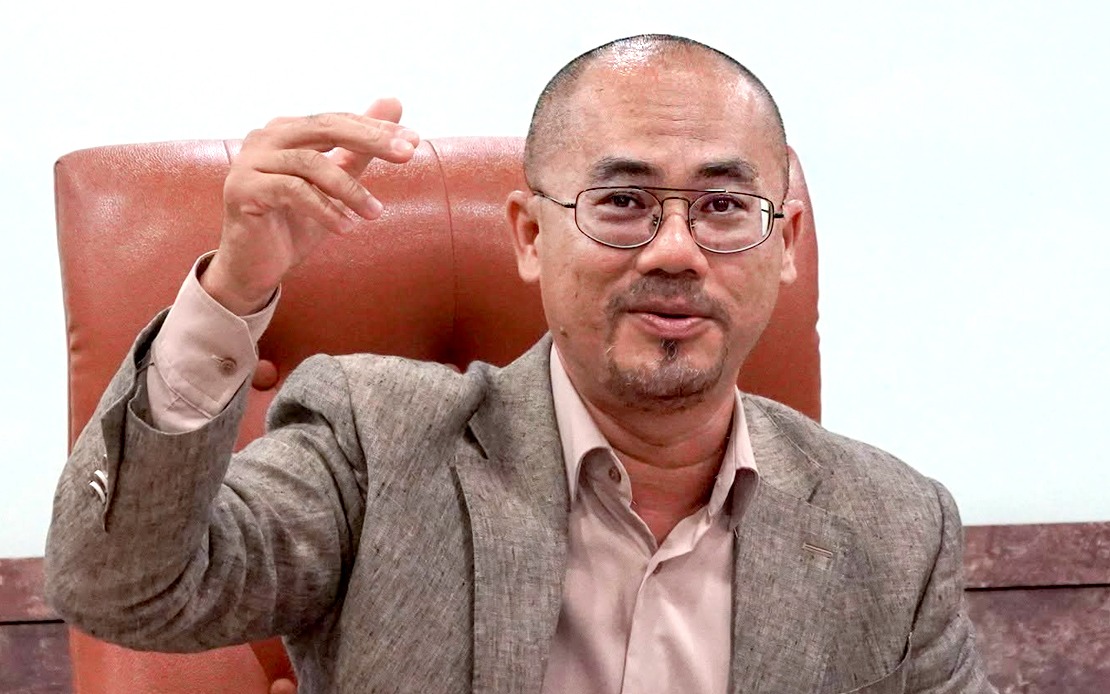
The Perak Islamic Religious and Malay Customs Council (MAIPk) has moved to quash claims circulating on social media that it had instructed traders operating near Jalan Panglima Bukit Gantang Wahab in Ipoh to cease their business operations. Chief executive officer Syamsul Hazeman Md Salleh addressed the controversy at the close of the 2026 Perak State Mosque Committee Convention held at the Casuarina Convention Centre, emphasising that any communications issued by the council carried a different purpose entirely from what had been alleged online.
According to Syamsul Hazeman, the council issued a notice to clarify its institutional position and responsibilities following a series of complications that had emerged at the premises. The central issue involved a deteriorating main water pipe that had developed a significant leak, combined with accumulated water bills reaching approximately RM100,000. Rather than representing an eviction directive, the council said the notice was designed to prevent misunderstandings and protect MAIPk from potential liability related to the infrastructure crisis and financial obligations.
During an engagement session held on July 14 with the affected traders, MAIPk representatives outlined the technical challenges facing the site. They explained the necessity for a temporary disconnection of water supply to enable repair work on the damaged main pipeline and to address the mounting arrears. The council framed this as a practical requirement rather than a punitive measure, though the announcement appears to have triggered alarm among business operators who interpreted the notice as a precursor to closure.
The backstory to this predicament traces to MAIPk's assumption of land ownership in 2024. Syamsul Hazeman disclosed that the council only became aware of the infrastructure and billing complications after taking control of the property. The previous custodians had evidently left behind a complex set of problems that the current administration inherited without warning. This revelation adds a layer of institutional challenge, as MAIPk found itself suddenly responsible for liabilities it had not created and for infrastructure it had not maintained.
Crucially, Syamsul Hazeman clarified that the outstanding water arrears did not stem from excessive consumption by the traders themselves. Each business operator paid for water according to their individual usage patterns. Instead, the arrears accumulated as a result of systemic failures within the main water supply pipeline serving the entire premises. This distinction is significant for Malaysian traders already operating on tight margins, as it absolves them of responsibility for debt they did not generate. The problem belonged to the building's infrastructure, not to the commercial users within it.
The resolution of this matter, however, lies beyond MAIPk's direct capacity and financial mechanisms. Syamsul Hazeman emphasised that the council cannot utilise zakat or waqf funds—which are designated for specific religious and charitable purposes—to settle utility arrears of this magnitude. This constraint reflects broader governance principles governing Islamic charitable institutions across Malaysia and the region. Consequently, MAIPk is actively engaging with the Perak Water Board to negotiate a path forward, recognising that the technical and financial dimensions of the crisis demand specialist intervention.
The council is simultaneously seeking guidance and support from the Perak state government to untangle the situation. Syamsul Hazeman expressed cautious optimism that a resolution could eventually materialise, though he acknowledged the process would require patience and multiple stakeholder cooperation. His comments suggest that the path to recovery involves negotiated arrangements rather than unilateral decisions, a recognition that traders' livelihoods depend on finding workable solutions that balance institutional interests with commercial sustainability.
Once the financial arrears are resolved and repair works are completed, MAIPk intends to establish new contractual arrangements with traders at the site. This would involve fresh rental agreements reflecting the updated status of the premises and clarified terms of operation. For traders currently operating without formal security about their tenure, this transition offers an opportunity to normalise their relationship with the property owner, though it will also require negotiation over lease terms and conditions.
However, an additional factor complicates the long-term picture for businesses at this location. MAIPk has flagged the proposed construction of a Perak Islamic Religious Department Complex at the site, a state government project that would eventually require the traders to relocate. Syamsul Hazeman indicated that while this development remains under state government control and its timing remains uncertain, traders would ultimately need to vacate when construction proceeds. This prospective displacement adds uncertainty to any new rental arrangements, as traders must balance immediate operational needs against the possibility of eventual relocation.
The sequence of events—from inheritance of problematic infrastructure to social media allegations to official clarification—illustrates the broader challenge facing Malaysian religious and community institutions managing commercial properties. The gap between institutional constraints and public expectations, combined with the realities of aging infrastructure and accumulated debt, creates friction points that can rapidly escalate through digital channels. MAIPk's decision to engage directly with traders and subsequently address public claims reflects a recognition that transparent communication and collaborative problem-solving offer the most sustainable path forward for all parties involved.

