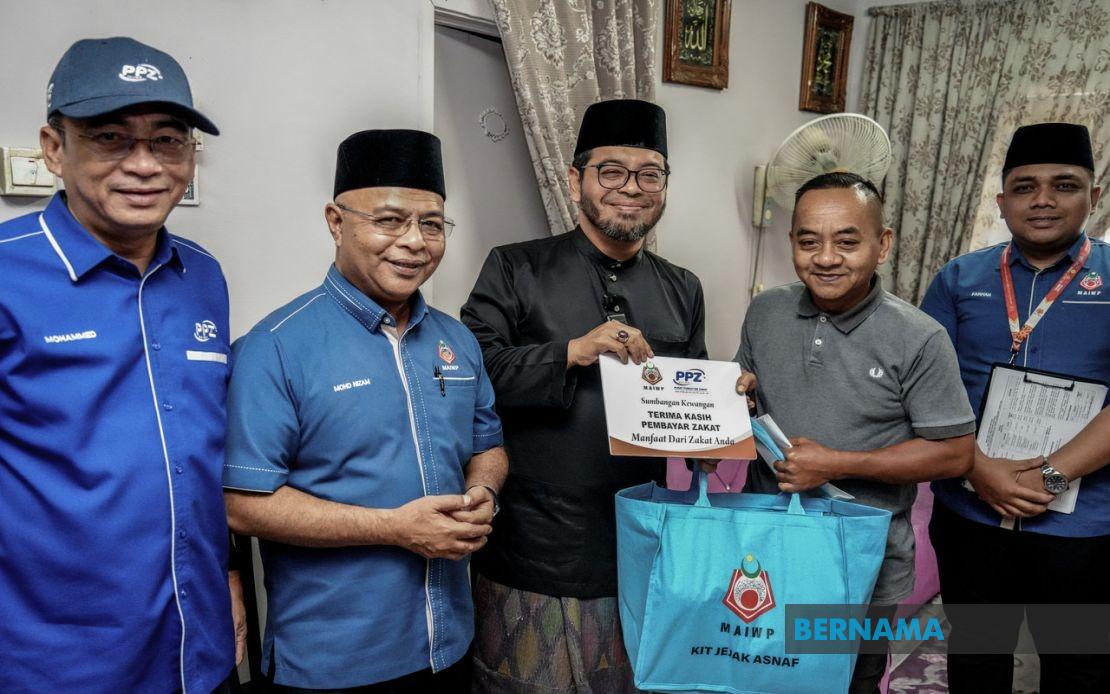
The Federal Territories Islamic Religious Council, known as MAIWP, has moved to support a widow in Kuala Lumpur who lost her husband in the early part of August and must now provide for five children ranging from six to fifteen years old. The assistance package incorporates monthly living allowances, rental subsidies, and educational support to help the family navigate the sudden loss of their primary income earner.
Minister in the Prime Minister's Department (Religious Affairs) Senator Datuk Dr Zulkifli Hasan emphasized the importance of ground-level engagement when delivering social assistance. By visiting recipients directly, MAIWP gains clearer insight into their actual circumstances and can tailor support mechanisms to address genuine needs rather than relying solely on documentation or assumptions about family situations. This personalized approach, he indicated, strengthens the effectiveness of aid programmes and builds community trust in religious institutions.
For the widow's household, MAIWP had previously provided General Schooling Aid to the children. The newly proposed assistance expands this coverage to encompass monthly living expenses and rental support, creating a more comprehensive safety net for a family suddenly facing financial instability. By combining multiple forms of assistance—educational, housing, and subsistence—the council addresses the interconnected challenges that bereaved families encounter when adjusting to single-income or no-income situations.
Beyond the widow's case, MAIWP's outreach extends to other vulnerable households within the Federal Territories. During the same visit, officials engaged with a family consisting of a married couple and eight school-age children. The father is employed as a driver by Kuala Lumpur City Hall, while the mother remains at home full-time managing the household and children. This family receives General Medical Assistance covering essential supplies including diapers and diabetic medications, alongside supplementary aid for wheelchair provisions and school-related expenses. Such targeted assistance acknowledges that working families with multiple dependents often struggle to meet both routine and unexpected medical costs.
Another household benefiting from MAIWP support is headed by a single mother divorced since 2018, who raises three school-going children independently. Her assistance package includes monthly living expense allowances, basic necessities provisions, and dedicated school support covering tuition and educational materials. This case illustrates how MAIWP's framework addresses the particular vulnerabilities of divorced women in Malaysian society, who frequently face economic disadvantages and social pressures while raising children alone.
The council's multi-pronged approach to social welfare reflects broader recognition within Malaysia's Islamic institutional framework that poverty and hardship rarely stem from single causes. Families may face simultaneous challenges involving inadequate income, housing insecurity, health complications, and educational access. By providing layered assistance—rather than one-size-fits-all monthly stipends—MAIWP attempts to address the compounding nature of these difficulties.
As of mid-August 2026, MAIWP had distributed RM699.57 million in cumulative assistance, indicating substantial resource deployment across the Federal Territories. This financial scale underscores the significant demand for social welfare services within Malaysia's federal administrative region and reflects the council's positioning as a major welfare provider alongside government agencies.
The personal visits undertaken by Minister Zulkifli Hasan serve a function beyond mere publicity. They demonstrate institutional commitment to understanding beneficiary circumstances firsthand, signal governmental attentiveness to vulnerable populations, and potentially allow officials to identify additional needs or systemic issues affecting community welfare. This approach contrasts with purely bureaucratic administration of aid, where recipients interact only with paperwork and officials may remain disconnected from lived realities.
For Malaysian readers, particularly those in Kuala Lumpur and the Federal Territories, MAIWP's initiatives represent an accessible avenue for obtaining assistance during financial crises. The council functions as an intermediary between Islamic religious principles emphasizing communal care and concrete state-level welfare delivery. Families experiencing sudden income loss, medical emergencies, or long-term unemployment can potentially access multiple support categories rather than competing within a single limited allocation.
The widow's situation—sudden loss of a breadwinner with five dependent children—represents a crisis scenario that, without intervention, could rapidly deteriorate into severe deprivation. The rapid response by MAIWP in proposing comprehensive assistance demonstrates both institutional capacity and commitment to preventing catastrophic outcomes. For regional observers, such programmes illustrate how Malaysia's religious institutions function as embedded social safety nets, particularly important given the country's mixed welfare system combining government programmes, religious organization initiatives, and family-based support structures.
Governmental attention to such cases, reflected in ministerial-level visits, also signals Malaysia's ongoing emphasis on Islamic-based social welfare as a legitimate and important governance pillar. This positioning distinguishes Malaysia's approach from purely secular welfarism, integrating religious institutions more directly into state-sanctioned social provision structures.

