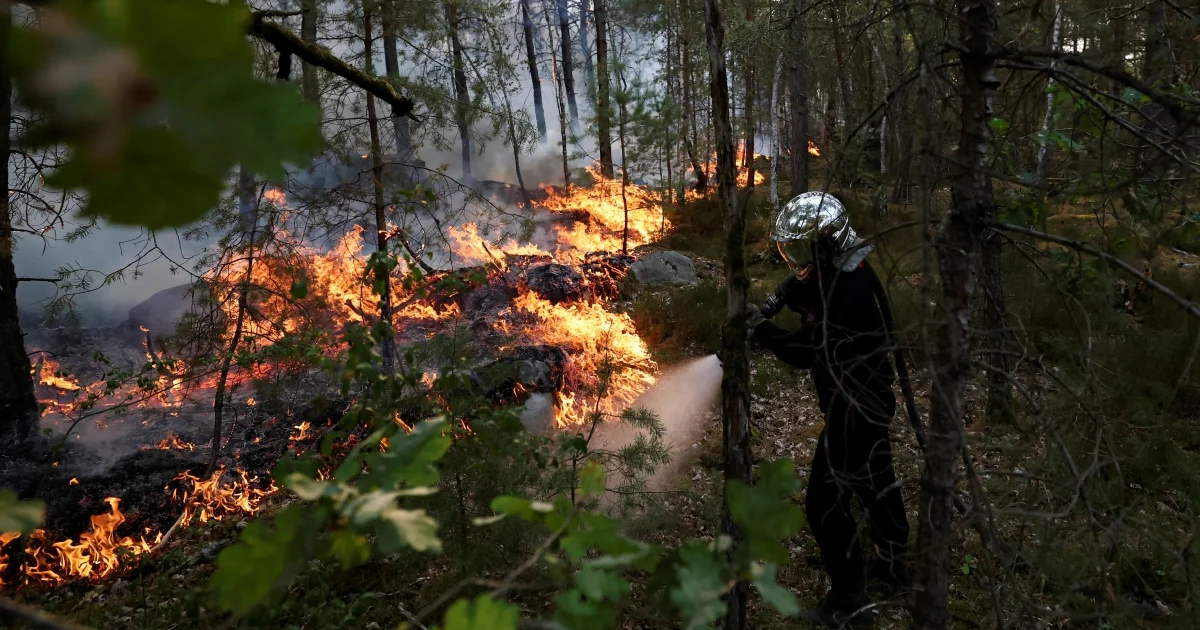
France faced a critical firefighting crisis on Monday as multiple blazes tore through the historic Fontainebleau Forest, consuming over 1,300 hectares in what authorities are investigating as potential arson. The scale of destruction in this culturally significant forest near Arbonne-la-Foret has prompted an intensive response from emergency services, with investigators moving swiftly to apprehend two individuals suspected of deliberately igniting the fires.
The Fontainebleau Forest holds particular importance in French environmental and cultural history, serving as both a natural heritage site and a refuge for diverse ecosystems. Its destruction on this scale represents a significant loss not only for France but for biodiversity across the region. The forest has long attracted painters, writers, and nature enthusiasts, making the incident resonant beyond simple environmental statistics. Losing over 1,300 hectares—equivalent to nearly 1,800 football fields—underscores the severity of the situation and the accelerating threat that uncontrolled fires pose to European forests.
The detection of arson as a probable cause adds a troubling dimension to the disaster. While natural causes such as heat waves and drought conditions have increasingly sparked European wildfires in recent years, deliberate fire-setting suggests malicious intent or gross negligence. The rapid arrests of the two suspects indicate that investigators possessed leads pointing toward human involvement, though formal charges and detailed circumstances remain under investigation. This criminal element necessitates a different response than fighting naturally occurring blazes, requiring not only firefighting resources but also forensic analysis and law enforcement coordination.
French firefighting teams mobilized extensively to combat the multiple fire fronts simultaneously. The coordination required to manage two separate significant blazes in proximity tested resources and tactical planning. Crews faced the challenge of containing spread while protecting communities and infrastructure in the surrounding areas. Weather conditions, terrain, and forest density all complicated suppression efforts, demanding experienced personnel and strategic deployment of equipment ranging from ground crews to aerial support.
The timing of this incident coincides with a broader vulnerability period for European forests. Southern Europe has experienced record-breaking temperatures and prolonged droughts in recent seasons, priming forests for rapid fire spread even when initial ignition sources are limited. Although the Paris region typically experiences cooler conditions than Mediterranean zones, the underlying trend of warming and drying landscapes across Europe means that even traditionally safer areas face emerging fire risks. Climate patterns are fundamentally altering the fire seasons, duration, and intensity across the continent.
For Malaysia and Southeast Asian readers, this incident offers instructive parallels regarding forest management and fire prevention. Peatland and rainforest fires across Indonesia and other regional nations have historically burned on vastly larger scales—sometimes millions of hectares annually—yet receive proportionally less international media attention. The arson element in the Paris case raises questions about human-driven fire initiation that apply globally, from illegal land clearing in Southeast Asia to criminal negligence in Europe. Both contexts demonstrate how forests face threats not only from climate and drought but from deliberate human action.
The investigation into suspected arson will likely yield insights into motive, methodology, and whether organized networks or isolated individuals were responsible. French authorities typically employ rigorous forensic techniques at fire scenes, potentially establishing evidentiary standards worth noting for regions developing their own fire crime investigation capacity. Understanding how perpetrators operate, what accelerants or ignition methods prove most effective, and what behavioral patterns precede major fire events can inform prevention strategies elsewhere.
The economic and ecological recovery from this disaster extends far beyond initial suppression costs. Reforestation, soil rehabilitation, erosion control, and ecosystem restoration will require sustained investment over years. Forest products, recreation, and carbon sequestration values lost to the fires represent substantial economic impact. Insurance claims, emergency response expenditures, and long-term environmental remediation create cascading fiscal consequences. These costs underscore why preventing fires through early detection, community education, and rigorous law enforcement proves more cost-effective than managing catastrophic blazes after ignition.
Authorities will scrutinize whether proper forest management protocols were implemented, including brush clearance, fire breaks, and monitoring systems. The Fontainebleau Forest's long history meant that management practices reflected older paradigms potentially not optimized for current climate realities. Adaptive management strategies that balance preservation of natural character with fire resilience increasingly challenge forest administrators across Europe. This incident may prompt reassessment of protective measures and resource allocation for France's extensive forest network.
The investigation's outcome will influence public discourse around forest security and resource allocation for prevention. If arson charges materialize with substantial evidence, prosecution and sentencing may establish precedent for fire crime jurisprudence in France. Conversely, if negligence or accident explanations emerge, attention may shift toward liability frameworks and regulatory improvements. Either path offers learning opportunities for jurisdictions worldwide grappling with escalating fire risks and the complex intersection of human activity, environmental vulnerability, and natural disaster management.
As suppression operations continue, the broader question looms: how can societies protect forests from both the escalating natural fire threat posed by climate change and the deliberate human threats exemplified by arson? The answer likely requires simultaneous investment in climate mitigation, adaptive forest management, enhanced prevention technology, and rigorous law enforcement. The Fontainebleau Forest fire serves as a stark reminder that forests face multifaceted threats requiring equally comprehensive, coordinated responses.

