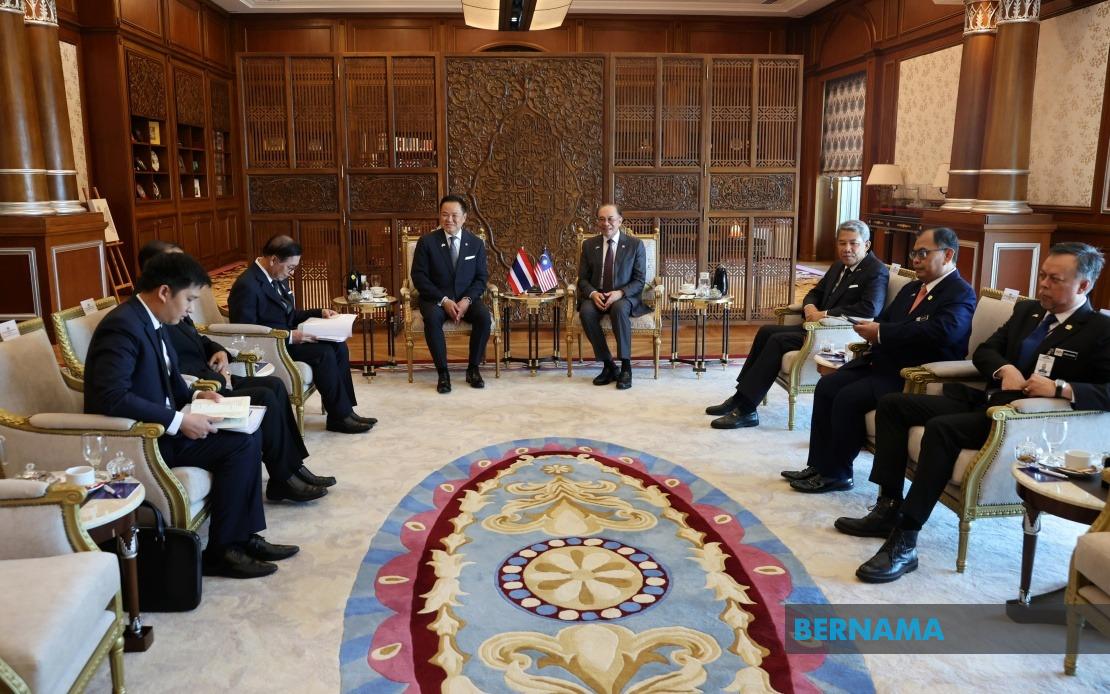
Malaysia reiterated its diplomatic stance on the Myanmar crisis during high-level discussions between Prime Minister Datuk Seri Anwar Ibrahim and visiting Thai Prime Minister Anutin Charnvirakul in Putrajaya on Thursday, emphasizing that peaceful dialogue remains the most viable path forward for addressing the country's protracted humanitarian and political turmoil. Speaking at a joint press conference following their bilateral meetings, Anwar articulated Malaysia's core position that external actors should support Myanmar's citizens in charting their own political future rather than imposing solutions from outside.
Thailand's geographical proximity and established diplomatic channels position it as a natural intermediary in regional efforts to restore stability, according to Anwar's assessment. The Malaysian premier highlighted that Bangkok, as a neighbouring state with longstanding ties to Myanmar's leadership and civil society, possesses unique leverage and credibility that could facilitate meaningful negotiations between the military junta and opposition forces. By amplifying Thailand's diplomatic role, Malaysia signals recognition that successful conflict resolution in Southeast Asia requires contributions from countries with direct stakes and cultural understanding of the region's dynamics.
The Myanmar crisis has occupied a central place in ASEAN's diplomatic agenda since the February 2021 military coup shattered the country's fragile democratic transition. The bloc's Five-Point Consensus, adopted in April 2021, outlined principles for addressing the conflict including an immediate cessation of violence, constructive dialogue, and humanitarian assistance. However, implementation has proved challenging amid the junta's intransigence, deteriorating humanitarian conditions, and the proliferation of armed resistance movements across the country. Malaysia's continued emphasis on engagement-based approaches reflects frustration with the status quo while maintaining hope that sustained diplomatic pressure can eventually compel the Tatmadaw to negotiate.
Anwar's remarks also underscore Malaysia's diplomatic maturity in acknowledging that conflict resolution demands regional rather than unilateral approaches. By publicly endorsing Thailand's mediation potential, Malaysia positions itself as a cooperative partner within ASEAN architecture while respecting the principle of non-interference in internal affairs—a foundational precept of the bloc's founding ASEAN Way doctrine. This balance allows Malaysia to advocate strongly for Myanmar's people without appearing to dictate outcomes or undermine Thai leadership's autonomy in handling its own bilateral relationship with Naypyidaw.
The timing of Anutin's visit carries additional significance as Thailand faces its own complex relationship with the Myanmar junta. Bangkok hosts hundreds of thousands of Myanmar refugees and migrants, manages significant cross-border security challenges, and navigates competing pressures from Western countries seeking tougher stances on the coup and from China and Russia offering unconditional support to the military regime. Thailand's diplomatic balancing act directly mirrors challenges faced by other ASEAN nations, making Anwar's affirmation of Bangkok's constructive role particularly meaningful for regional consensus-building.
Beyond the Myanmar file, Anwar and Anutin addressed the Thailand-Cambodia border dispute, with the Malaysian premier commending Thailand's commitment to peaceful resolution of the long-running territorial tensions. This acknowledgment serves multiple purposes: it recognizes Thailand's restraint in managing a volatile neighbour, signals Malaysia's confidence in Bangkok's judgment, and implicitly endorses the principle that ASEAN members should resolve disputes through dialogue rather than force. The stability of Thailand's borders directly affects regional security architecture and Malaysia's own interests in maintaining a peaceful Southeast Asia.
Anutin's visit represents his first bilateral trip to Malaysia since his reappointment as Thai Prime Minister in March 2026, suggesting that bilateral relations between the two countries remain robust despite occasional policy divergences. The selection of Myanmar and border issues as focal points indicates both nations prioritize regional stability and recognize that cross-border cooperation forms the foundation for addressing transnational challenges. Malaysia's willingness to host high-level Thai delegations demonstrates Bangkok's continued importance in Malaysian foreign policy calculations.
The bilateral agenda extends to practical infrastructure cooperation, with Anwar and Anutin scheduled to jointly open a cross-border road linking Malaysia's Immigration, Customs, Quarantine and Security Complex in Bukit Kayu Hitam, Kedah, with Thailand's corresponding Customs, Immigration and Quarantine facility in Sadao. This infrastructure development facilitates seamless goods and people movement across the northern maritime boundary, reducing congestion, enhancing regional supply chain efficiency, and generating economic benefits for both nations' border communities. Such projects transform diplomatic goodwill into tangible benefits that resonate with ordinary citizens on both sides.
Malaysia's consistent advocacy for dialogue-based approaches to Myanmar reflects broader Southeast Asian preferences for consensus-building and non-confrontational problem-solving. However, the persistence of the Myanmar crisis despite five years of ASEAN mediation efforts has tested this diplomatic philosophy, with some analysts questioning whether engagement without consequences can motivate junta compliance. Anwar's continued emphasis on dialogue suggests Malaysia remains committed to ASEAN's traditional methodology while acknowledging that results require concerted effort from key players like Thailand.
The emphasis on allowing Myanmar's people self-determination carries particular weight given Myanmar's cultural and historical importance to the broader Southeast Asian community. A stable, democratically governed Myanmar would strengthen ASEAN's collective legitimacy, enhance regional prosperity, and reduce the humanitarian crisis currently overwhelming neighbouring states. By positioning Myanmar's own citizens as the proper architects of their nation's future, Anwar aligns Malaysia with democratic principles while avoiding the charge of external interference—a delicate diplomatic needle to thread in ASEAN's consensus-driven environment.
Looking ahead, Malaysia's diplomatic engagement on Myanmar will likely continue emphasizing regional channels and incremental progress rather than demanding immediate transformative change. This approach frustrates international observers seeking stronger ASEAN pressure on the junta, yet reflects realistic assessments of Southeast Asian states' limited coercive capacity and their preference for preserving institutional relationships even amid serious disagreements. Thailand's pivotal position as both neighbour and diplomatic interlocutor makes Anwar's affirmation of Bangkok's role particularly significant for hopes that ASEAN-led engagement can eventually yield substantive progress toward Myanmar's political settlement.

