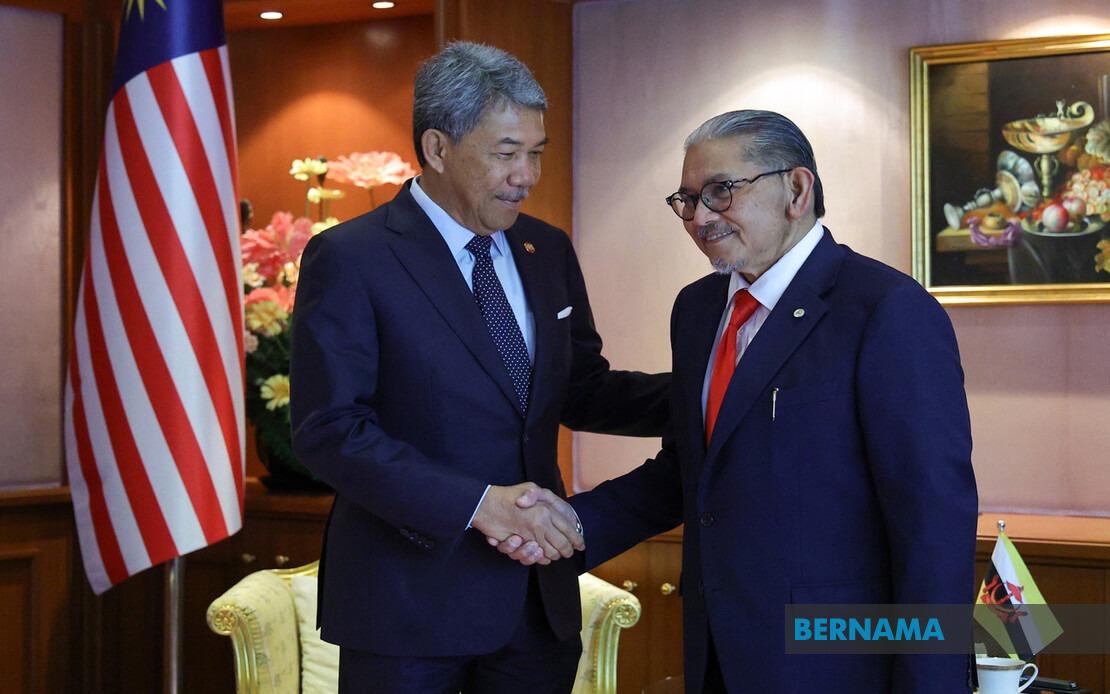
Malaysia and Brunei have advanced their partnership across several strategic areas during high-level diplomatic discussions held in Bandar Seri Begawan, signalling both nations' commitment to deepening cooperation in an increasingly integrated Southeast Asian region. The 27th Meeting on the Implementation of the Exchange of Letters brought together Foreign Minister Datuk Seri Mohamad Hasan and Brunei Second Minister of Foreign Affairs Datuk Seri Setia Erywan Mohd Yusof to address outstanding bilateral matters and chart new areas of collaboration.
Among the most substantive developments discussed was progress on the two nations' land and maritime boundaries, a perennial concern for neighbouring countries seeking to prevent misunderstandings and establish clear jurisdictional frameworks. The talks revealed that boundary demarcation efforts have reached the halfway mark, a milestone that reflects sustained technical collaboration between Malaysian and Bruneian officials despite the complex geographical and administrative challenges inherent in such undertakings. While the underlying boundary itself has long been established, the formal demarcation process requires meticulous attention to ground realities, requiring both nations to carefully document and mutually agree upon physical markers and coordinates.
The boundary demarcation work proceeds under the framework of a 2009 Terms of Reference, a foundational agreement that continues to guide the technical committees tasked with on-the-ground verification and mapping. Mohamad explained that numerous practical factors must be harmonised during this process, from topographical features to existing settlements and resource usage patterns that have evolved over decades. The systematic approach being taken suggests both countries are prioritising accuracy and mutual satisfaction over rushed timelines, reducing the likelihood of future disputes arising from ambiguous or contested boundaries.
Beyond territorial matters, the two nations have identified maritime safety and regional mobility as priority areas requiring new institutional frameworks. The most significant initiative to emerge from the discussions is the planned memorandum of understanding on Search and Rescue operations, a practical mechanism that will enable Malaysia and Brunei to coordinate emergency response across waters where their jurisdictions meet or overlap. Such arrangements are increasingly vital in Southeast Asia, where heavy maritime traffic and challenging weather patterns create frequent emergency situations requiring rapid, coordinated responses.
The establishment of a formal SAR mechanism represents a maturing of regional cooperation, moving from ad hoc coordination to standardised procedures, shared communication protocols, and pre-arranged resource-sharing arrangements. For Malaysian readers, particularly those in Sabah and Sarawak where maritime activities dominate the economy and livelihoods, such an arrangement carries practical significance for fishermen, commercial shipping operators, and oil and gas industry workers operating in the region's contested and undefined waters.
Equally important to the diplomatic agenda is the discussion of measures aimed at facilitating smoother movement of people between Brunei and the Malaysian states of Sarawak and Sabah. This reflects the practical realities of cross-border communities, workers, and traders whose livelihoods often span multiple jurisdictions. By streamlining administrative procedures and improving border crossing efficiency, both nations acknowledge that people-to-people connections and economic integration serve mutual interests and contribute to regional stability and prosperity.
The bilateral relationship between Malaysia and Brunei exemplifies the kind of mature, problem-solving approach that characterises successful regional partnerships. Despite their significant size asymmetry—Brunei's population is merely around 450,000 compared to Malaysia's roughly 34 million—both nations recognise that clear agreements on boundaries, safety mechanisms, and cross-border movement protect their respective interests while enhancing overall regional security and economic activity.
For Malaysia's broader foreign policy objectives in Southeast Asia, these discussions with Brunei also signal the country's commitment to institutionalising bilateral relationships through formal agreements and regular high-level engagement. The existence of a 27th meeting on Exchange of Letters implementation indicates an established pattern of regular consultation and follow-up, providing predictability and demonstrating that diplomatic mechanisms remain robust even when major headline issues are not in crisis.
The timing of these discussions also reflects broader regional dynamics, with Southeast Asian nations increasingly focused on internal border management and maritime governance as traditional security concerns. Rather than external threats, the region's governments now invest heavily in clarifying jurisdictional boundaries, establishing search and rescue protocols, and facilitating legitimate cross-border movement—practical governance challenges that strengthen state capacity and regional integration simultaneously.
For business communities and citizens in both countries, these developments carry indirect but meaningful benefits. Clearer boundaries reduce uncertainty for investors and property owners in border regions, standardised SAR procedures reduce risks for maritime workers, and facilitated movement encourages trade and investment flows. The agreements being negotiated represent not merely diplomatic niceties but foundational infrastructure for stable, prosperous cross-border relationships.
Looking ahead, the stated commitment to complete boundary demarcation and formalise the SAR arrangement suggests that bilateral engagement will continue apace. Both nations have invested political capital in these initiatives, implying that delivery on agreed timelines becomes important for maintaining diplomatic momentum and public confidence in government capacity to manage cross-border affairs effectively.

