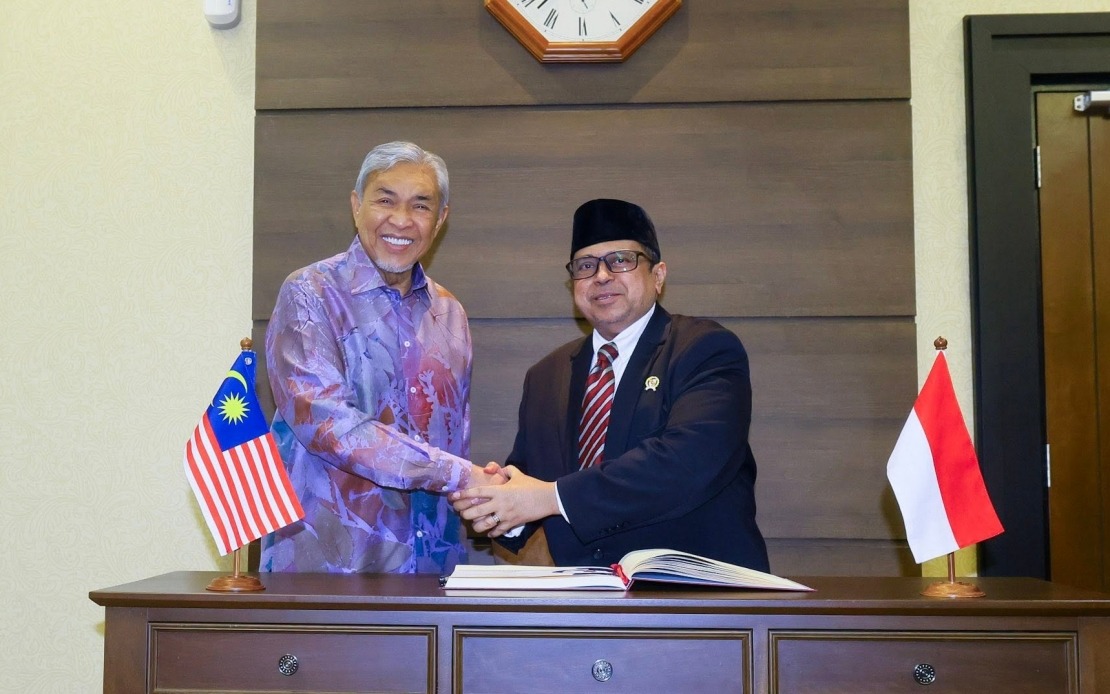
Malaysia and Indonesia are moving to cement their bilateral relationship through an ambitious agenda focused on halal industry development, trade expansion, and shared human capital initiatives. Deputy Prime Minister Datuk Seri Dr Ahmad Zahid Hamidi outlined the partnership framework following discussions with Indonesia's Ambassador to Malaysia, Raden Datuk Mohammad Iman Hascarya Kusumo, and Dr Ahmad Haikal Hassan, head of Indonesia's Halal Product Assurance Organising Body (BPJPH), at Parliament House.
The depth of engagement reflected in these talks underscores how both nations view the halal sector as a strategic pillar for economic cooperation. Beyond bilateral arrangements, the discussions examined mechanisms to elevate halal standards and market access across the broader Southeast Asian region and onto the world stage. This represents a maturation of the halal economy from domestic certification frameworks into coordinated international governance structures.
At the heart of the partnership proposal lies the establishment of three interconnected institutional bodies designed to harmonise approaches and reduce fragmentation. The Malaysia-Indonesia Halal Council (MIHC) would serve as the primary bilateral mechanism, creating a dedicated platform for addressing shared challenges in standards, certification, and market development. Operating at a regional level, the ASEAN Halal Council would extend these principles across all ten member states, potentially transforming how the entire region approaches halal compliance and cross-border trade. The proposed World Halal Development Council would then position Southeast Asia at the forefront of global halal discourse and standard-setting.
For Malaysia, which has long positioned itself as a global halal hub through its established certification infrastructure and the Halal Malaysia brand, this collaboration offers strategic advantages. Indonesian market dynamism—with a population exceeding 270 million Muslims—represents both an export opportunity and a benchmark for understanding consumer preferences in the world's largest Muslim-majority nation. The partnership acknowledges that neither country can maximise halal sector potential in isolation; coordinated approaches to standards reduce business friction and create larger, more attractive markets for producers in both nations.
The proposal to harmonise halal standards carries particular significance for manufacturers and traders navigating dual certification requirements. Currently, companies seeking to sell products across Malaysia and Indonesia often must satisfy separate regulatory frameworks, incurring additional costs and delays. A unified or mutually recognised standards system would streamline operations, lower compliance burdens, and make the combined Malaysia-Indonesia market more competitive against halal products from other regions. This efficiency gain extends to supply chain logistics, where standardised requirements reduce complexity at borders and ports.
Ahmad Zahid, wearing his dual hats as Deputy Prime Minister and chairman of the Malaysia Halal Industry Development Council, emphasized that the two countries' historical partnership serves as a catalyst for deeper integration. The longstanding diplomatic and cultural ties between Kuala Lumpur and Jakarta provide a foundation of trust and mutual understanding that can accelerate institutional development. Unlike new partnerships that must build credibility from scratch, Malaysia and Indonesia can leverage existing government-to-government channels and private sector networks to implement decisions swiftly.
From a Southeast Asian perspective, coordinated halal governance offers the region tangible competitive advantages. The combined halal market of ASEAN—encompassing over 250 million Muslims and growing middle-class consumer bases—represents an increasingly significant share of global halal trade, currently valued in the hundreds of billions of dollars. By establishing regional standards and a unified voice, ASEAN nations can shape international halal benchmarks rather than merely responding to standards set elsewhere. This shifts power dynamics in global halal commerce toward Muslim-majority producers rather than Western certification bodies.
The broader development agenda encompassing rural development and human capital initiatives reflects recognition that halal industry growth must be inclusive and sustainable. Rural communities in both countries possess agricultural and livestock resources essential for halal supply chains. Targeted capacity building—in areas ranging from animal husbandry to processing and logistics—ensures that halal sector expansion generates employment and income across diverse geographic regions, not merely in established industrial hubs. Human capital development programmes would create expertise pipelines in halal certification, quality assurance, and supply chain management.
Investment and trade expansion form the commercial backbone of this initiative. By reducing barriers to mutual recognition and alignment, the partnership aims to unlock capital flows between Malaysian and Indonesian halal businesses. Malaysian food manufacturers seeking to scale operations might establish production facilities in Indonesia to access lower labour costs while maintaining certification standards. Indonesian producers could access Malaysian distribution networks and expertise in global halal marketing. Such complementary positioning creates a virtuous cycle where investment follows standardisation.
The proposal to establish a World Halal Development Council signals ambitions extending beyond regional consolidation toward global leadership. This body would position Southeast Asia as a thought leader in halal standards evolution, influencing how nations worldwide approach halal compliance. For Malaysian policymakers, particularly Ahmad Zahid as halal council chairman, the strategy reflects a long-term vision where Malaysia remains synonymous with halal excellence but no longer stands alone—instead anchoring a coordinated regional bloc.
Implementation challenges remain substantial. Reconciling different national regulations, navigating competing commercial interests, and building consensus among diverse ASEAN members requires sophisticated diplomacy and technical expertise. Yet the framework announced suggests serious intent from both Malaysia and Indonesia to move beyond rhetoric into institutional architecture. Success would reshape halal commerce across Southeast Asia, generating economic benefits while affirming the region's identity as the global centre for authentic halal development and governance.

