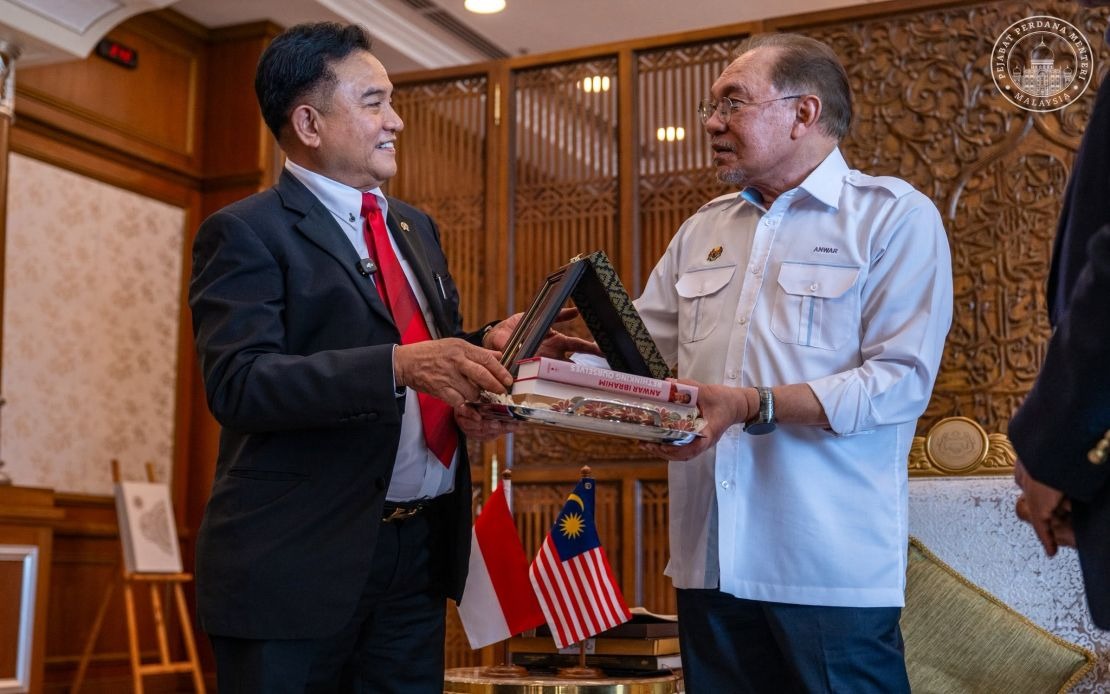
Prime Minister Datuk Seri Anwar Ibrahim has reaffirmed Malaysia's commitment to deepening institutional and legislative cooperation with Indonesia, signalling that both nations view their bilateral relationship as pivotal to regional stability and economic progress. The Malaysian premier made the declaration following a formal meeting with Indonesia's Coordinating Minister for Legal, Human Rights, Immigration and Correction, Prof Dr Yusril Ihza Mahendra, at the Prime Minister's Office in Putrajaya, emphasising the importance of sustained engagement between Kuala Lumpur and Jakarta on governance matters.
The bilateral talks represent part of a broader diplomatic framework aimed at harmonising legislative standards and administrative practices between the two largest Southeast Asian economies. Such initiatives carry particular weight given the interconnectedness of Malaysia and Indonesia's populations, with significant cross-border trade, labour migration, and cultural exchanges requiring coordinated legal and regulatory oversight. The meeting underscores both capitals' recognition that legislative alignment can facilitate smoother cooperation across multiple domains, from investment facilitation to social policy implementation.
Anwar, who holds concurrent responsibilities as Finance Minister, indicated during the discussion that both nations had explored concrete pathways for enhancing institutional capacity and governance frameworks. The emphasis on legislative and governance cooperation reflects evolving priorities in bilateral relations, moving beyond traditional diplomatic courtesies to focus on substantive regulatory collaboration. This approach aligns with broader trends in the region where countries increasingly recognise that effective governance mechanisms can unlock economic potential and improve cross-border service delivery.
The areas identified for strengthened cooperation encompass legal harmonisation, human rights standards, immigration procedures, and correction systems—sectors where Indonesia's coordinating minister holds direct oversight responsibilities. For Malaysia, such collaboration addresses longstanding challenges in managing bilateral legal matters and ensuring consistent application of regulations affecting citizens in both countries. The involvement of a senior Indonesian minister in legislative and human rights affairs suggests Jakarta's commitment to institutionalising these partnerships beyond ad-hoc negotiations.
From a Malaysian perspective, deepening cooperation with Indonesia on governance and legislation carries strategic implications for regional influence and economic integration. As the Asean bloc continues navigating complex geopolitical dynamics, bilateral partnerships that emphasise institutional strengthening become particularly valuable. Malaysia's historical role as a bridge-builder within Asean makes such initiatives important for maintaining the region's internal cohesion and demonstrating commitment to intra-regional problem-solving.
The broader context of Malaysia-Indonesia relations encompasses ongoing efforts to resolve persistent bilateral issues while capitalising on complementary strengths. Both nations face similar challenges in public administration, anti-corruption efforts, and regulatory modernisation. By institutionalising cooperation in these domains, the two countries create frameworks for sustained dialogue and potential knowledge-sharing that can benefit citizen services in both jurisdictions.
Indonesia's significant population and economic weight within Asean, coupled with Malaysia's more developed institutional infrastructure in certain areas, creates opportunities for mutually beneficial exchange. Legislative cooperation might facilitate smoother cross-border business transactions, reduce bureaucratic friction, and enhance protection of workers and investors operating in both nations. Such practical cooperation often proves more consequential than high-level political statements in improving bilateral relations and public satisfaction.
The timing of these discussions also reflects broader regional trends where Southeast Asian nations increasingly prioritise governance efficiency as a competitive advantage in attracting foreign investment and talent. Both Malaysia and Indonesia compete for similar categories of international capital and skilled professionals, making coordinated governance improvements a strategic imperative. Enhanced legislative and administrative standards benefit both economies and contribute to the region's overall attractiveness as an investment destination.
Looking forward, the success of these legislative and governance cooperation initiatives will depend on sustained implementation and periodic review mechanisms. Both nations will need to establish working groups, technical exchanges, and formal protocols to translate political commitment into practical outcomes. The involvement of Indonesia's coordinating minister suggests Jakarta's intent to approach this relationship with institutional seriousness, moving beyond symbolic gestures toward substantive regulatory alignment.
For Malaysian stakeholders—including businesses, civil society, and government agencies—the outcomes of enhanced Malaysia-Indonesia legislative cooperation could manifest through simplified procedures for cross-border transactions, improved legal certainty for joint ventures, and more consistent application of regional standards. Such improvements indirectly benefit the broader Asean community by demonstrating that bilateral cooperation on governance can yield tangible improvements in administrative efficiency and legal clarity.
The reaffirmation of commitment to strengthening bilateral ties reflects both nations' understanding that sustained cooperation requires deliberate, continuous effort. As Malaysia and Indonesia navigate economic challenges and regional geopolitical complexities, investing in institutional capacity and legislative harmony provides a foundation for addressing future challenges collaboratively. This approach transforms governance cooperation from a technical exercise into a strategic pillar of bilateral relations, offering potential benefits extending well beyond immediate policy concerns.

