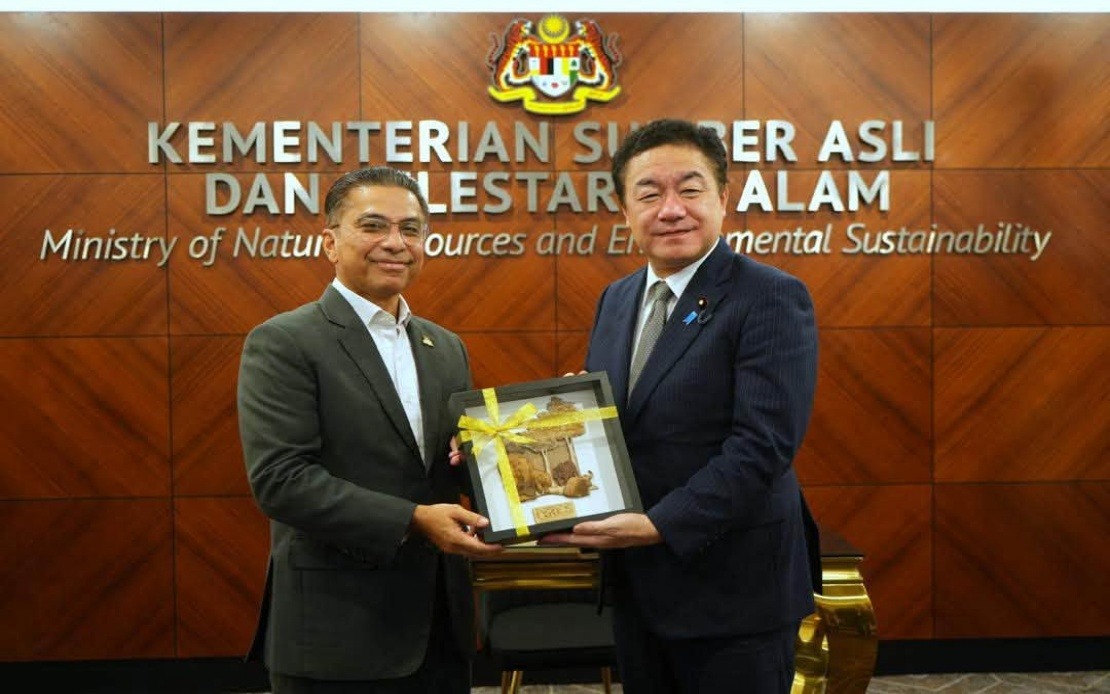
A high-level diplomatic engagement between Malaysia and Japan this week has reinforced their commitment to strategic cooperation spanning rare earth elements, critical minerals, and climate action. The Parliamentary Vice-Minister of Economy, Trade and Industry Komori Takuo visited the Ministry of Natural Resources and Environmental Sustainability in Putrajaya on August 27, meeting with Deputy Minister Syed Ibrahim Syed Noh to advance bilateral initiatives anchored in their comprehensive strategic partnership framework established in June.
The timing of this engagement reflects growing recognition across the Asia-Pacific region of the critical importance of supply chain resilience for rare earth elements and advanced materials. Japan, an industrialised nation heavily dependent on imported raw materials for its electronics and manufacturing sectors, has strategically positioned itself as a technology partner to resource-rich developing economies. Malaysia, sitting atop substantial rare earth reserves, occupies an increasingly valuable position in global supply chains, particularly as Western nations seek to diversify sourcing away from traditional suppliers.
During the talks, Malaysia underscored its appreciation for Japan's ongoing technical assistance and capability-building programmes delivered through established channels including the Japan International Cooperation Agency and the Japan Organisation for Metals and Energy Security. These institutional partnerships have facilitated knowledge transfer in mineral processing technologies, environmental management, and industrial development—areas where Japan possesses considerable expertise accumulated over decades of manufacturing excellence.
A cornerstone of Malaysia's position emerged through reiteration of its moratorium on exporting unprocessed rare earth materials. This policy represents a deliberate economic strategy to capture greater value within Malaysia's borders by incentivising domestic processing infrastructure and downstream manufacturing capabilities. Rather than exporting raw ores for processing elsewhere, the policy aims to attract investment in mid-stream and downstream industries, generating employment and technological spillovers locally. The consistency with which Malaysian officials reaffirmed this stance signals that this is not merely a temporary trade measure but a foundational pillar of national industrial strategy.
Beyond mineral affairs, the two nations made significant progress on climate cooperation. Officials welcomed the finalisation of negotiations regarding a Memorandum of Cooperation focused on the Joint Crediting Mechanism, a bilateral framework that allows countries to cooperate in reducing greenhouse gas emissions while generating tradeable carbon credits. This mechanism, established under Article 6.2 of the Paris Agreement, represents an innovative approach to climate finance and technology transfer. Rather than relying solely on multilateral funds, bilateral mechanisms allow countries to pair their specific developmental needs with partners possessing complementary technological capabilities.
Malaysia anticipates completing these climate negotiations by year-end, a timeline that aligns with its broader energy transition objectives. The Joint Crediting Mechanism is expected to direct Japanese investment and technology toward Malaysian projects in renewable energy, energy efficiency, and low-carbon industrial processes. This partnership becomes increasingly relevant as Malaysia navigates the transition away from coal-dependent power generation while maintaining energy security and economic competitiveness. For Japanese firms, such mechanisms open market opportunities in a rapidly developing economy undertaking substantial infrastructure transformation.
The cooperation framework directly supports Malaysia's Nationally Determined Contribution, the country's formal commitment under the Paris Agreement to reduce greenhouse gas emissions by 45 percent by 2030. Achieving this target requires substantial capital investment and technological advancement across multiple sectors. Japan's demonstrated commitment to green technology development and its track record in implementing efficiency improvements across manufacturing and utilities provision make it a credible partner for this transition.
Malaysian officials articulated a clear vision of synergy emerging from combining Japanese technological expertise with Malaysia's sustainable resource endowments. This framing positions the partnership not as Malaysia merely supplying raw materials to Japan, but as a collaboration generating mutual benefit through value creation. Such language reflects Malaysia's desire to move up global supply chains rather than remain locked in resource-extraction roles. The emphasis on building a competitive green economy suggests Malaysian policymakers recognise that future competitiveness will increasingly depend on sustainable production practices and low-carbon credentials.
The Malaysian delegation composition—spanning natural resources, environmental sustainability, and foreign ministry representatives—reflected the cross-cutting nature of these initiatives. The parallel Japanese representation by Ambassador Shikata Noriyuki and senior METI officials underscored Tokyo's institutional prioritisation of these discussions. Such high-level engagement signals that both governments view this partnership as strategically significant rather than routine bilateral business.
For Malaysia and the broader Southeast Asian region, these developments carry implications for regional positioning amid great power competition. As major economies compete for influence and resource security, Malaysia's approach of maintaining strong partnerships with multiple developed nations—including Japan—provides strategic flexibility. Japan's emphasis on technology transfer and capacity-building partnerships, contrasting with approaches focused purely on extraction, may prove increasingly attractive to resource-rich nations seeking genuine development rather than resource curse dynamics.
The convergence of rare earth mineral cooperation with climate action reflects contemporary global economic integration, where environmental sustainability and resource security have become inseparable from traditional industrial strategy. Malaysia's ability to coordinate these priorities while advancing domestic value creation demonstrates sophisticated economic statecraft. As global supply chains reconfigure and decarbonisation accelerates, such strategic partnerships will become increasingly consequential for determining which nations capture disproportionate gains from the green energy transition.

