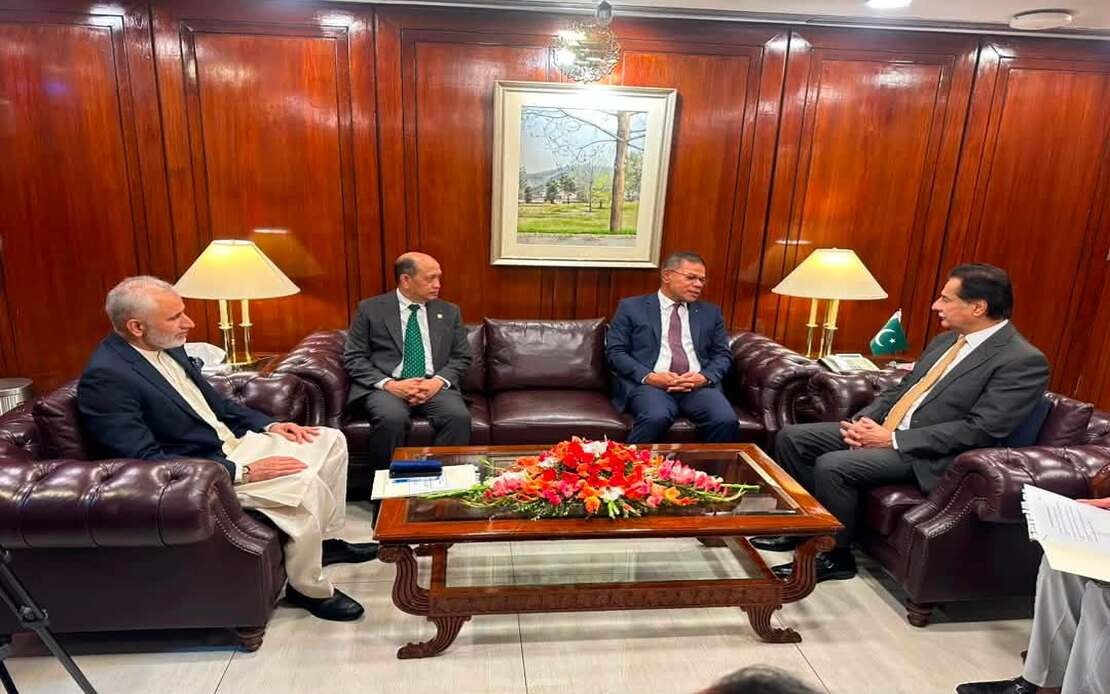
Malaysia's Home Minister Datuk Seri Saifuddin Nasution Ismail has reinforced the commitment of both nations to dialogue and peaceful resolution of disputes during his official visit to Pakistan, signalling a united front on navigating an increasingly complex geopolitical landscape. The conversations, held with Speaker of the National Assembly of Pakistan Sardar Ayaz Sadiq and Senate Chairman Syed Yousaf Raza Gilan, reflect a broader recognition in the Muslim-majority world that military posturing and confrontation have given way to the more nuanced diplomacy required in an era of competing global powers and regional instability.
During his second day in Islamabad, Saifuddin Nasution articulated how Malaysia has positioned itself as a steady advocate for constructive engagement within ASEAN frameworks. This positioning carries particular weight given Malaysia's geographical position as a Southeast Asian anchor state and its historical role in mediating regional disputes. By sharing this experience directly with Pakistani parliamentary leaders, the Home Minister has essentially offered a template that extends beyond bilateral matters into the broader question of how medium-sized powers can maintain agency and influence in a world shaped by great-power competition. The emphasis on ASEAN's model suggests that Malaysia sees value in institutionalised cooperation and regular dialogue mechanisms as antidotes to the zero-sum thinking that characterises much contemporary international relations.
The discussions also encompassed the strengthening of parliamentary institutions and diplomacy as tools for advancing bilateral relations. This focus on institutional engagement rather than purely executive-level dealings represents a sophisticated understanding of how durable international relationships develop. Parliamentary exchanges tend to create deeper networks of understanding across political divides and generational cohorts, establishing groundwork that survives changes in government and electoral cycles. For Malaysia and Pakistan, nations that have experienced significant political transitions and institutional development, such exchanges carry symbolic importance beyond their immediate diplomatic utility.
The foundation of Malaysia-Pakistan relations rests on shared cultural, religious, and historical ties that have endured for decades. Both countries maintain Muslim-majority populations and have positioned themselves as voices for the Global South within international forums. However, geographical distance and divergent foreign policy priorities have sometimes limited the depth of bilateral cooperation compared to their rhetorical closeness. Saifuddin Nasution's visit demonstrates an effort to translate this latent affinity into more concrete institutional mechanisms and regular high-level engagement.
Critically, the timing of such diplomatic overtures matters in the current context. The international environment remains fractured by tensions in the Middle East, ongoing conflicts in Europe and Asia, and deepening strategic competition between major powers. For nations like Malaysia and Pakistan that occupy important positions in their respective regions, maintaining clear commitment to peaceful resolution and dialogue serves both as a stabilising force domestically and as a signal to the international community about their preferred role in global affairs. Saifuddin Nasution's statements therefore carry weight beyond Islamabad's corridors of power.
The Home Minister's visit to Parliament Museum underscored recognition of Pakistan's constitutional journey and the development of its parliamentary democracy. This cultural and institutional dimension to high-level visits often goes underappreciated in analyses focused purely on trade statistics or security agreements. Such exchanges facilitate mutual respect and understanding by acknowledging each nation's particular path to democratic governance. For Malaysia, which has its own complex constitutional history and continues to evolve its democratic institutions, understanding Pakistan's experience provides comparative insight into managing institutional growth and reform.
The emphasis on trust and mutual respect between the Malaysian and Pakistani peoples represents an important counterbalance to state-level diplomacy. Bilateral relationships ultimately depend not only on government-to-government connections but also on people-to-people bonds. Malaysia hosts significant Pakistani expatriate communities, while Pakistani students and professionals have contributed to Malaysian development. These lived connections provide resilience to formal relations and create constituencies invested in maintaining strong ties.
For Southeast Asia more broadly, Malaysia's approach to diplomacy through institutions and dialogue mechanisms carries implications for regional architecture. As ASEAN continues to grapple with internal disagreements and external pressures from larger powers, Malaysia's advocacy for constructive engagement and peaceful solutions provides a counterweight to more militaristic or isolationist tendencies. By bringing this experience to bear in conversations with Pakistani leadership, Malaysia contributes to a wider normative environment favouring dialogue over confrontation.
The discussions also implicitly addressed the challenge of how parliamentary systems can contribute meaningfully to foreign policy formation in an era when executive power often dominates international relations. By elevating parliamentary diplomacy and encouraging exchanges at that level, both nations signal their commitment to ensuring that elected representatives—closer to constituent concerns and electoral pressures—remain engaged in shaping international relations. This model potentially creates additional checks on hasty or unilateral diplomatic decisions.
Moving forward, the visit sets the stage for potentially deeper cooperation across several dimensions. Enhanced parliamentary exchanges could facilitate knowledge-sharing on legislative matters of mutual concern. Expanded institutional linkages might extend to areas such as counterterrorism cooperation, maritime security, or economic collaboration. For Malaysia and Pakistan, both facing pressures to demonstrate effective governance and regional relevance, strengthening bilateral relations serves multiple policy objectives simultaneously.
The visit ultimately reflects a mature understanding that in an increasingly interconnected world, even nations separated by considerable geography share fundamental interests in maintaining international order, preventing escalation of regional conflicts, and ensuring that smaller states retain meaningful influence over their own destinies. Saifuddin Nasution's diplomatic mission to Islamabad, though conducted in quiet institutional channels, contributes to the broader architecture of stability that the Asia-Pacific region requires for continued prosperity and peace.

