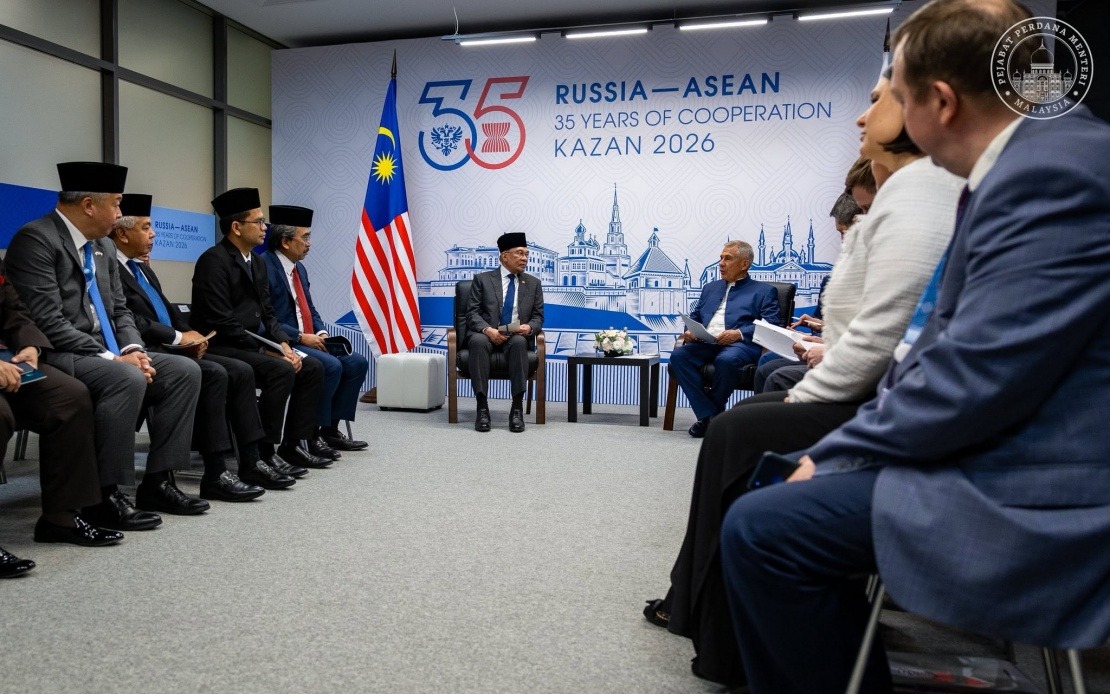
Prime Minister Datuk Seri Anwar Ibrahim has identified substantial avenues for Malaysia to strengthen its relationship with Tatarstan, one of Russia's most economically significant regions, signalling Kuala Lumpur's intent to diversify partnerships beyond traditional Southeast Asian boundaries. The overture came during a bilateral meeting with Tatarstan's leader Rustam Minnikhanov in the regional capital Kazan, where discussions ranged from conventional trade arrangements to emerging sectors like the digital economy and halal commerce.
The timing of this engagement is significant, arriving as Anwar leads Malaysia's delegation to the ASEAN-Russia Commemorative Summit, a biennial gathering that underscores the bloc's multifaceted diplomatic strategy toward Moscow despite broader geopolitical tensions. For Malaysia specifically, the visit represents an opportunity to strengthen economic ties with a Russian constituent republic that commands substantial hydrocarbon resources and manufacturing capabilities.
Energy cooperation emerged as the centrepiece of discussions between the two leaders. Tatarstan stands as one of Russia's principal oil-producing regions, making it a strategic partner for Malaysia's downstream petroleum sector. Both nations see potential not merely in crude extraction but in refining operations and petrochemical manufacturing, sectors where Malaysian companies have demonstrated competitive advantages and technical expertise. Such downstream partnerships could create employment opportunities while reducing Malaysia's energy import vulnerability, a persistent concern for policymakers managing the nation's long-term economic resilience.
Beyond hydrocarbons, the bilateral framework encompasses education and talent development—areas where Malaysia has positioned itself as a regional hub for higher learning. Malaysian universities and vocational institutions could attract Tatar students, while collaborative research initiatives in emerging fields like renewable energy transition might benefit both economies. The emphasis on talent development suggests recognition that economic competitiveness increasingly depends on human capital mobility and knowledge transfer across borders.
The halal industry featured prominently in Anwar's characterisation of partnership opportunities, reflecting Malaysia's global positioning as a halal certification and standards authority. Tatarstan, with its significant Muslim population and food manufacturing base, represents a natural market for Malaysian halal expertise, certifications, and value-added products. This sector holds particular relevance as both nations seek to tap growing global consumer demand for halal-certified goods, a market segment projected to expand substantially across European and Central Asian regions.
Tourism and cultural exchange were also flagged as cooperation areas. Kazan's recent recognition as the Islamic World Cultural Capital 2026 by the Islamic World Educational, Scientific and Cultural Organisation aligns naturally with Malaysia's own positioning as a bridge between Islamic and secular modernity. Enhanced tourism flows between the nations could stimulate hospitality sectors in both jurisdictions while fostering deeper people-to-people understanding.
Anwar's public acknowledgment of the Kazan Forum's role in strengthening business ties signals Malaysia's recognition that formal diplomatic channels must be accompanied by robust private-sector engagement mechanisms. The forum serves as a practical platform where companies can identify investment opportunities and establish partnerships without waiting for government-to-government frameworks to develop. This pragmatic approach reflects lessons learned from Malaysia's earlier economic opening to new markets.
The broader ASEAN-Russia relationship provides essential context for bilateral Malaysia-Tatarstan developments. Since establishing dialogue relations three decades ago, the association has evolved into a Strategic Partnership by 2018, creating institutional frameworks that facilitate deeper economic integration. Malaysia's proactive bilateral engagement with Tatarstan thus represents a microcosm of ASEAN's wider strategy to maintain substantive engagement with Moscow despite competing geopolitical pressures from Western powers and regional rivals.
Geographically, Kazan's position—situated roughly 800 kilometres east of Moscow along the Volga and Kazanka rivers—makes it a significant economic centre. With 1.3 million residents, the city functions as Russia's cultural and commercial third hub after Moscow and Saint Petersburg. For Malaysian investors and entrepreneurs, Tatarstan offers access to Russian and Eurasian markets while maintaining a more predictable regulatory environment than some other regions. The region's historical role as a centre of Islamic learning and culture also provides soft-power advantages for Malaysia's broader engagement strategy with Russia.
Anwar's visit, accompanied by senior ministers including Investment, Trade and Industry Minister Datuk Seri Johari Abdul Ghani and Economy Minister Akmal Nasrullah Mohd Nasir, underscores the delegation's high-level commitment. The participation of these economic portfolio holders signals that discussions carry weight beyond ceremonial diplomacy, with concrete policy initiatives likely to follow. The two-day summit structure allows for deeper engagement than typical bilateral meetings, providing opportunity for sustained negotiations and relationship-building.
For Malaysia's economic policymakers, the Tatarstan engagement represents a calculated diversification strategy. As Malaysia navigates evolving trade tensions and supply chain uncertainties, partnerships with energy-rich regions in Russia offer alternative sourcing options for critical materials and investment outlets for accumulated capital. The emphasis on technology and digital economy cooperation additionally positions Malaysia to benefit from Tatarstan's advances in certain industrial sectors while potentially attracting Russian investment in Malaysian digital enterprises.
Looking forward, the success of this bilateral framework depends substantially on translating high-level political rhetoric into operational business arrangements. Government-sponsored business delegations, sector-specific seminars, and institutional twinning arrangements between Malaysian and Tatar enterprises will prove essential. The halal certification pathway offers a particularly promising starting point, given Malaysia's established authority and Tatarstan's demonstrated need for such expertise.
Ultimately, Anwar's Kazan visit exemplifies Malaysia's attempt to calibrate its foreign policy through selective deepening of non-traditional partnerships. Rather than concentrating exclusively on Southeast Asian neighbours or Western trading partners, Malaysia leverages its unique positioning as an Islamic-majority nation with market-oriented economic policies to forge connections with economically significant regions like Tatarstan. Such engagement diversifies Malaysia's options while potentially yielding tangible commercial benefits across energy, investment, education and innovation sectors.