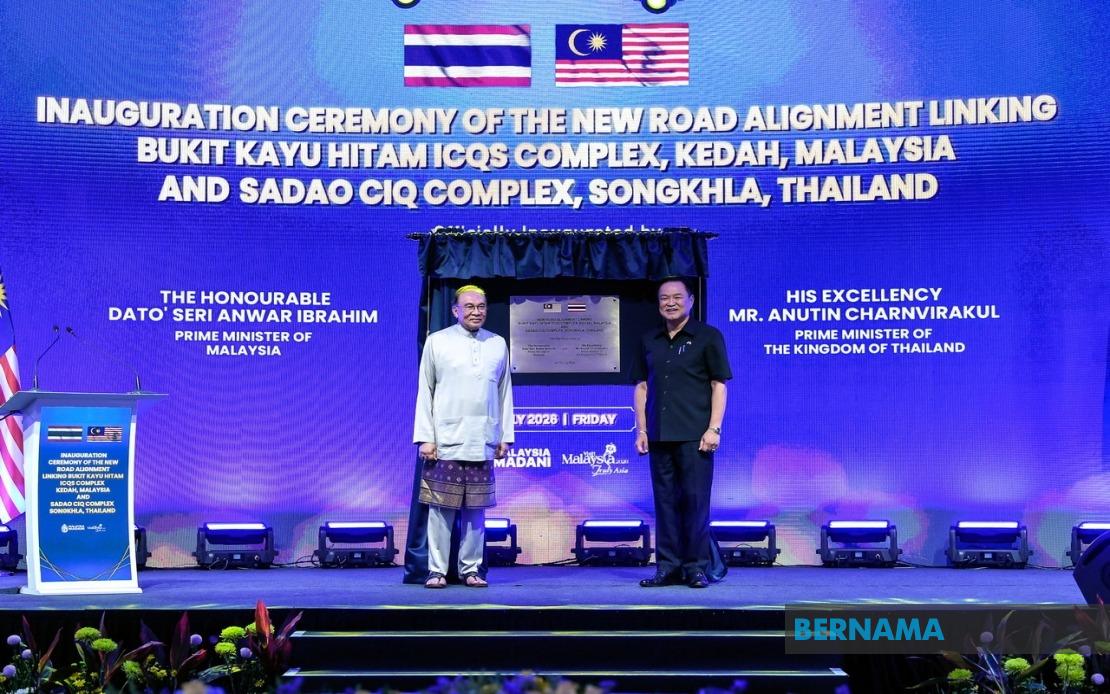
Prime Minister Datuk Seri Anwar Ibrahim and Thailand's Prime Minister Anutin Charnvirakul jointly opened a new road alignment connecting Malaysia's Bukit Kayu Hitam Immigration, Customs, Quarantine and Security Complex in Kedah with Thailand's Sadao Customs, Immigration and Quarantine facility on July 10, marking what both leaders described as a transformative moment in bilateral relations. The infrastructure project carries symbolic weight beyond its immediate purpose, representing a tangible commitment to deepening economic ties between the two neighbouring nations and addressing long-standing logistical barriers that have constrained cross-border commerce.
The new road alignment serves as physical infrastructure for an ambitious vision that extends well beyond conventional border management. Anwar emphasised that the project forms part of a broader initiative to establish a special economic border zone encompassing Perlis, Kedah, Kelantan, Perak and Penang on the Malaysian side, working in concert with southern Thai provinces. This approach recognises that border regions, often economically marginalised despite their geographic advantages, can become engines of growth when provided with appropriate institutional frameworks and cross-border coordination. The Malaysian government views this development as essential for elevating living standards in northern Peninsular Malaysia, an area that has historically lagged behind more developed central regions.
The significance of Anutin's visit to Bukit Kayu Hitam rather than conducting business solely in capital cities underscores a deliberate shift in how both governments approach regional development. By bringing Thailand's highest executive to the border area, both leaders sought to demonstrate that border communities merit direct attention from national leadership rather than distant policy-making. This messaging carries particular importance in Malaysia, where northern states have long advocated for greater investment and infrastructure development. The ceremony itself symbolised mutual recognition that prosperity in one nation's periphery depends partly on conditions in the adjacent country's periphery.
Beyond the ribbon-cutting ceremony, the two premiers made concrete commitments to expedite resolution of regulatory obstacles that have historically complicated cross-border commerce. Malaysian and Thai negotiators agreed to accelerate solutions to outstanding issues spanning customs procedures, immigration protocols, fisheries management and trade facilitation. According to Anwar, several long-standing matters that had consumed years or even decades of diplomatic negotiations were resolved during Anutin's two-day visit, suggesting an unusual acceleration in bilateral problem-solving. These practical improvements matter immensely to small and medium-sized traders who navigate border procedures daily and for whom regulatory delays directly impact business viability.
The two governments have set an ambitious bilateral trade target of USD30 billion by 2027, a figure that demands significantly enhanced commercial activity across multiple sectors. Current trade levels fall substantially short of this goal, indicating that the new road alignment and border zone framework are intended to address genuine structural impediments to expanded commerce. Stronger infrastructure and streamlined procedures represent necessary conditions for achieving this target, though success will also require competitive advantage, product development and market access policies that attract investment from both private Malaysian and Thai enterprises as well as third-country investors seeking to leverage the border region's geographic position.
The special economic border zone concept represents an evolution in how Southeast Asian neighbours approach development cooperation. Rather than treating border regions as administrative dividing lines requiring security and control, the framework positions them as integrated economic landscapes where goods, investment and labour can flow more freely under mutually agreed parameters. This model has gained traction across the region following successful applications in other contexts, though implementation requires sustained political commitment and technical capacity from both sides. Malaysia and Thailand have demonstrated such resolve, Anwar noted, by successfully negotiating resolutions to issues that previously appeared intractable.
For Malaysian businesses and communities in the northern states, this development opens potential channels for expanded market access to Thailand's economy, investment opportunities in joint ventures and industrial zones, and employment in new enterprises serving integrated cross-border supply chains. Thai counterparts gain similar advantages in accessing Malaysian markets and participating in regional production networks. The arrangement also holds implications for third countries and multinational enterprises considering regional investment, as a more seamlessly integrated Malaysia-Thailand economic space could enhance the attractiveness of the broader region as a production and logistics hub.
The border zone initiative carries indirect benefits extending beyond direct trade participants. Infrastructure improvements required to support expanded cross-border commerce will generate construction employment and economic activity in intermediate communities. Enhanced customs and immigration procedures reduce transaction costs and time delays that currently burden legitimate traders, potentially shifting competitive advantage away from informal channels and toward regulated commerce. These efficiency gains translate into cost reductions for consumers and improved fiscal revenue for both governments.
Anwar's emphasis on political commitment and close cooperation resonates within the Malaysian context, where northern states have periodically expressed frustration over perceived neglect in national development priorities. By securing Thai buy-in for a joint regional development framework, Anwar signals recognition of these concerns and commitment to deploying federal resources toward addressing them. The initiative also reflects broader Malaysian strategic objectives of strengthening ASEAN cohesion through practical economic integration that benefits peripheral regions and communities often excluded from globalisation's benefits.
The technical challenges ahead should not be underestimated, however. Establishing special economic zone governance structures requires harmonising differing regulatory systems, managing labour and environmental standards, and addressing potential anxieties about rapid industrial development in border regions. Both nations must maintain adequate security oversight while facilitating legitimate commerce, a balance that demands sophisticated border management rather than simply opening crossings. Success will depend on continued high-level political attention even after the initial enthusiasm of the launch ceremony fades.
The Malaysia-Thailand border crossing project illustrates how physical infrastructure projects acquire meaning beyond their immediate function when framed within broader development narratives and accompanied by institutional reform. The new road represents not merely improved connectivity but a commitment to fundamentally reframing Malaysia-Thailand relations from conventional diplomatic engagement toward deeper economic integration that directly touches the lives of border community members. Whether this ambitious vision materialises into sustained prosperity for northern Malaysian regions and southern Thai provinces will emerge over the coming years through implementing the frameworks, institutions and cross-border cooperation mechanisms launched during this July visit.

