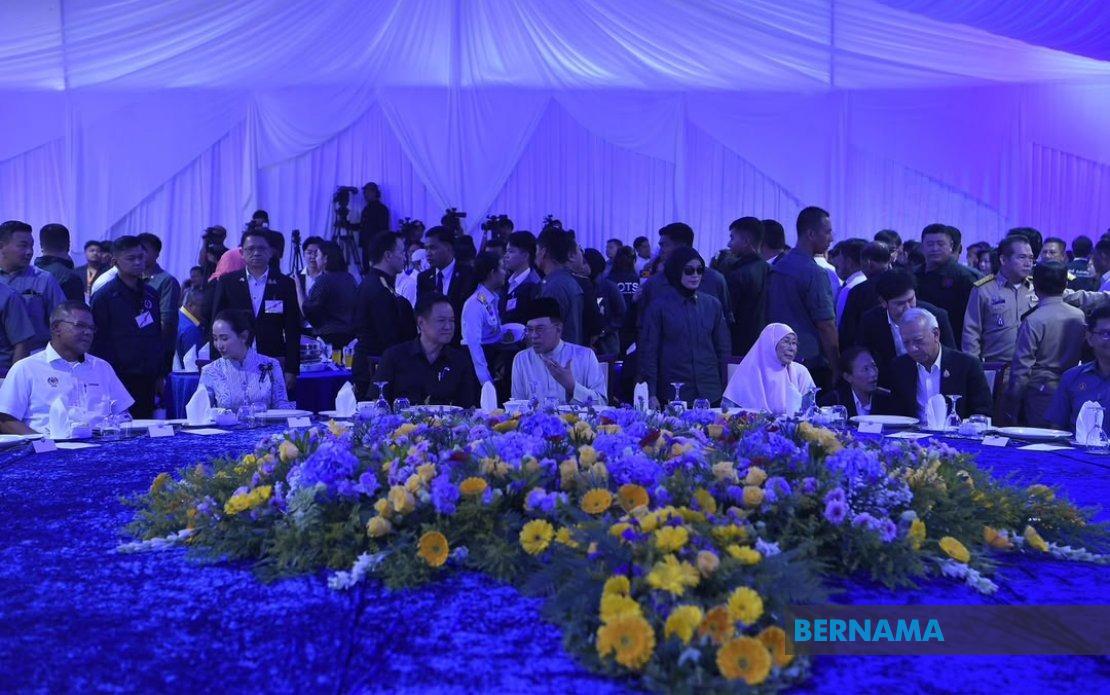
Prime Minister Datuk Seri Anwar Ibrahim and Thai Premier Anutin Charnvirakul have jointly inaugurated a newly constructed road linking Malaysia's Bukit Kayu Hitam Immigration, Customs, Quarantine and Security complex with Thailand's corresponding Sadao Customs, Immigration and Quarantine facility. The ceremonial launch, held on July 10, represents a significant infrastructure milestone in the region and underscores both nations' determination to modernise their shared border operations and deepen bilateral cooperation.
The new road corridor opens to the travelling public at 6 am Malaysia time on July 11, marking the beginning of a new era in cross-border mobility between the two countries. Simultaneously, authorities will permanently shut down the longstanding Bukit Kayu Hitam-Danok border crossing at midnight Malaysia time the same day, ending decades of service at that location. This transition represents not merely a shift in physical infrastructure but signals a deliberate strategic repositioning of how Malaysia and Thailand manage the flow of people, goods and services across their shared frontier.
According to the Home Ministry, the completion of this modern border infrastructure demonstrates both countries' unwavering commitment to strengthening diplomatic relations whilst simultaneously advancing cross-border strategic cooperation. The project is framed as instrumental in improving regional connectivity and facilitating shared economic growth that benefits both Malaysian and Thai citizens. The successful execution of this joint initiative reflects years of planning and coordination between relevant authorities in Kuala Lumpur and Bangkok.
Beyond its immediate border management function, the new road serves as a tangible expression of the decades-long friendship between Malaysia and Thailand. Both nations have consistently worked to maintain stable, prosperous relations despite periodic diplomatic challenges. This infrastructure project embodies their shared vision of a well-integrated Southeast Asian region and aligns directly with ASEAN's broader connectivity agenda, which emphasises reducing barriers to the movement of people, capital and commodities across member states.
The upgraded border crossing will significantly enhance Malaysia's participation in the ASEAN North-South Economic Corridor, a transcontinental trade route that connects Myanmar, Thailand, Laos, Vietnam and Cambodia to Malaysia and beyond. By modernising the gateway at Bukit Kayu Hitam-Sadao, both countries unlock potential for substantially increased bilateral trade flows. The new infrastructure incorporates contemporary customs procedures, integrated control systems and modern quarantine facilities designed to process larger volumes of legitimate cross-border traffic whilst maintaining stringent security standards.
The project delivers multiple tangible benefits for border communities and regional commerce. Traders, logistics operators and regular cross-border commuters will experience dramatically reduced wait times and more predictable travel patterns through the streamlined facility. The enhanced efficiency translates directly into lower transaction costs for businesses dependent on regular Malaysia-Thailand commerce, from agricultural products to manufactured goods. Supply chains that previously experienced bottlenecks at the Danok crossing now benefit from expanded capacity and faster processing at the new Sadao complex.
Economic growth in Malaysia's northern border regions stands to accelerate considerably as a result of improved connectivity. Kedah and Perlis, which have historically served as gateways to Thailand and beyond, are now positioned to capture greater shares of regional trade. Investment in cross-border zones, special economic areas and joint manufacturing ventures becomes more attractive when border infrastructure no longer represents a constraining factor. Thai investors similarly gain easier access to Malaysian industrial and port facilities, whilst Malaysian businesses can more efficiently tap Thai and broader Southeast Asian markets.
The modern infrastructure also strengthens Malaysia's border security architecture in alignment with national priorities. Integrated control systems enable authorities to monitor cross-border movements more effectively, detecting illicit activities whilst maintaining the flow of legitimate traffic. The consolidated facility replaces the fragmented approach inherent in the old Danok arrangement, creating a single point of control where Malaysian and Thai authorities can coordinate seamlessly. Enhanced quarantine capabilities protect both nations' agricultural and public health interests in an increasingly interconnected region.
The Home Ministry explicitly positioned this project within Malaysia MADANI, the government's development framework emphasising inclusive growth, institutional excellence and sustainability. Border management represents a critical component of national security and economic competitiveness. The Bukit Kayu Hitam-Sadao corridor demonstrates commitment to modernising Malaysia's entry points through technology adoption, process improvement and international cooperation. This aligns with broader government objectives to position Malaysia as a competitive regional hub attracting investment and facilitating commerce.
The successful completion of this high-impact project required sustained coordination across multiple Malaysian agencies including customs, immigration, quarantine and security departments, alongside their Thai equivalents. Both governments mobilised substantial resources and demonstrated political will to navigate the complexities of cross-border infrastructure development. The joint commitment signals confidence in the enduring partnership between Malaysia and Thailand and willingness to undertake ambitious projects delivering mutual benefits.
Regional observers view the new crossing as a blueprint for future Malaysia-Thailand cooperation and potentially a model for other ASEAN border upgrades. As regional integration deepens and trade intensifies, border infrastructure quality increasingly determines competitive advantage. Nations investing in modern, efficient crossing points position themselves advantageously within Southeast Asian supply chains and logistics networks. The Bukit Kayu Hitam-Sadao project demonstrates that strategic infrastructure investment yields returns spanning security, economic growth and diplomatic strengthening.
Looking ahead, both nations indicated confidence that the new road ushers in enhanced cross-border economic dynamism and strengthens bilateral relations across multiple dimensions. The modern facility promises safer, more transparent and substantially more efficient border operations that protect national interests whilst facilitating the legitimate movement of people and commerce. For Malaysian travellers, traders and investors, the upgraded crossing at Bukit Kayu Hitam represents tangible infrastructure improvement with immediate practical benefits. For the region, it exemplifies the type of strategic cooperation required to unlock ASEAN's full economic potential.

