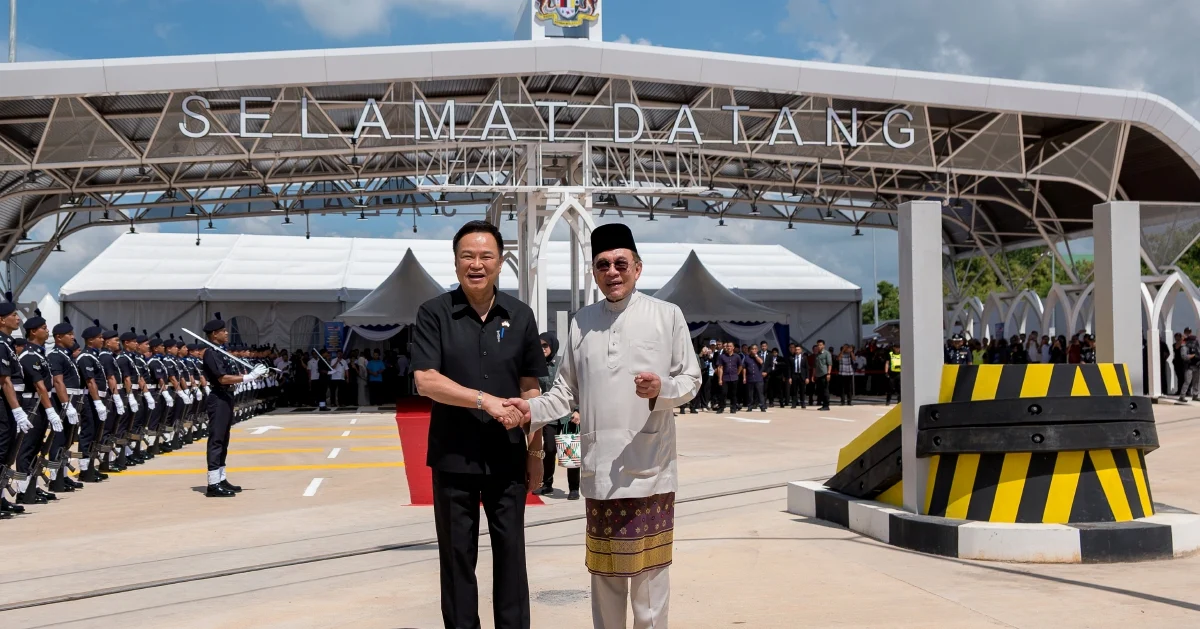
Prime Minister Datuk Seri Anwar Ibrahim and Thai Prime Minister Anutin Charnvirakul jointly inaugurated a new road corridor connecting Malaysia's Bukit Kayu Hitam border complex with Thailand's Sadao Customs, Immigration and Quarantine facility. The opening ceremony at Bukit Kayu Hitam underscores the two neighbouring nations' commitment to enhancing bilateral connectivity and streamlining the movement of goods and people across one of Southeast Asia's busiest land borders.
The new thoroughfare represents a significant infrastructure investment aimed at reducing bottlenecks that have long plagued the Malaysia-Thailand border crossing. Previously, traffic congestion at the conventional crossing points created delays for commercial vehicles, tourists, and travellers, particularly during peak seasons. By providing an alternative route that directly connects the two nations' purpose-built border facilities, the road promises to distribute traffic flow more efficiently and reduce wait times for customs clearance and immigration procedures.
For Malaysian businesses engaged in regional trade, the improved connectivity offers tangible benefits. Freight operators can now access Thai markets more reliably, with predictable transit times bolstering supply chain efficiency. Small and medium enterprises in northern Malaysia's manufacturing and agricultural sectors stand to gain from expedited access to Thai distribution networks. Similarly, Thai exporters gain faster passage to Malaysian ports and onward shipment to global markets, creating mutual economic incentives for sustained border region development.
The Bukit Kayu Hitam complex on the Malaysian side and the Sadao facility across the border represent modern, purpose-built infrastructure designed to handle contemporary border operations. These integrated customs, immigration and quarantine facilities consolidate multiple government functions under one roof, theoretically simplifying procedures for travellers and traders. The new road eliminates the need for vehicles to navigate town centres and reduces friction with local communities, addressing longstanding complaints about congestion in Bukit Kayu Hitam township itself.
Tourism flows between the two countries are expected to benefit substantially. Malaysian holidaymakers seeking Thai attractions now face fewer obstacles to spontaneous cross-border trips, while Thai visitors to Malaysia's northern regions can reach destinations such as Penang more conveniently. The Bukit Kayu Hitam-Sadao corridor sits strategically along the Pan-Asian Highway, making it a crucial node in broader Southeast Asian tourism and logistics networks that link Myanmar, Laos, and Cambodia to Malaysian ports and Singapore's regional hub.
The project reflects deepening Malaysia-Thailand cooperation beyond trade. The two governments have coordinated extensively on border security, labour migration, and regional stability. By investing jointly in infrastructure, both nations signal confidence in the relationship and acknowledge their mutual dependence on stable, prosperous border regions. This contrasts with historical periods when border areas were sources of tension; today, they increasingly function as economic engines.
For Malaysia specifically, the road advancement aligns with the government's broader ambitions to position the country as Southeast Asia's logistics and trade hub. Improved border infrastructure reduces total logistics costs, making Malaysian ports and manufacturing bases more competitive against regional alternatives. The initiative also demonstrates Malaysia's willingness to partner with ASEAN neighbours on shared infrastructure challenges, positioning the country as a constructive regional player.
The timing of the launch carries diplomatic significance. High-level bilateral visits and joint infrastructure inaugurations serve as platforms for both governments to reaffirm partnership commitments amid complex regional geopolitics. The presence of both Prime Ministers at the ceremony underscored the importance each government attaches to the cross-border relationship and signalled to private investors and trading communities that the border corridor enjoys sustained political backing.
Looking ahead, the road's success will depend partly on harmonisation of border procedures between Malaysian and Thai authorities. Even with excellent physical infrastructure, bottlenecks can occur if customs, immigration, or quarantine processes remain uncoordinated. Regional observers will watch whether both governments follow infrastructure investment with procedural reforms that genuinely accelerate cross-border movement. Previous initiatives have sometimes disappointed when physical improvements outpaced institutional modernisation.
The Bukit Kayu Hitam-Sadao corridor also presents opportunities for regional integration beyond immediate bilateral relations. As ASEAN pursues deeper economic integration through mechanisms like the ASEAN Framework Agreement on Comprehensive Investment, border infrastructure improvements directly enable those objectives. Malaysian and Thai officials have indicated interest in further joint projects, suggesting this road represents an opening chapter rather than a completed story.
For Malaysian enterprises in Perlis, Kedah, and northern Perak, the road opens concrete possibilities for Thailand market expansion without the prohibitive logistics costs that previously made cross-border commerce marginal for smaller firms. Agricultural exporters, processed food manufacturers, and automotive component suppliers all gain strategic advantage through improved corridor access. Thai investors considering Malaysia-based operations similarly find reduced operational friction attractive.
The investment also addresses environmental and social considerations. By routing traffic through dedicated border facilities rather than town centres, the road reduces air and noise pollution affecting resident populations in Bukit Kayu Hitam. This reflects evolving approaches to border infrastructure that seek to balance economic efficiency with community welfare, a lesson learned from earlier projects that sacrificed local quality of life for traffic throughput.
As regional supply chains increasingly fragment across ASEAN nations, border infrastructure quality becomes a competitive advantage. The Bukit Kayu Hitam-Sadao corridor positions Malaysia and Thailand as serious about seamless intra-ASEAN commerce. Multinational manufacturers considering where to locate regional operations increasingly factor border friction into location decisions; modern, efficient crossing points prove attractive to such investors. Both governments recognise this reality, explaining their sustained commitment to this project despite significant upfront costs.

