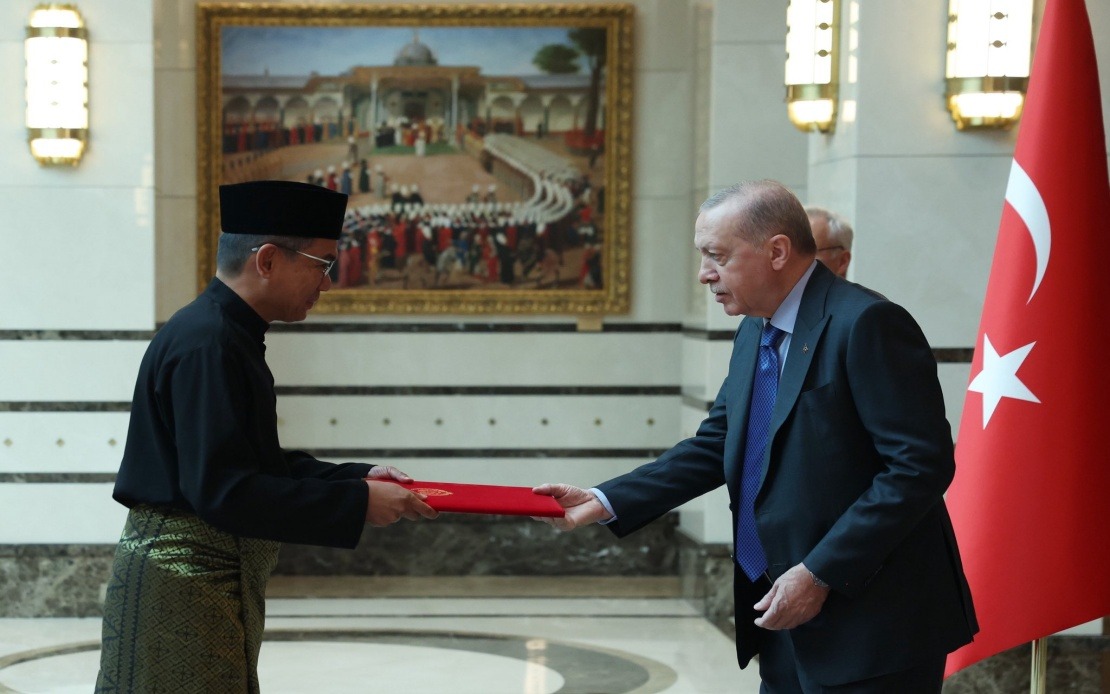
Malaysia has thrown its weight behind Türkiye's pursuit of ASEAN Dialogue Partner status, signalling deepening diplomatic engagement between Kuala Lumpur and Ankara. The support was formally communicated during the presentation of Malaysian Ambassador to Türkiye Adlan Mohd Shaffieq's credentials to Turkish President Recep Tayyip Erdoğan at the Presidential Complex on June 17, marking a significant moment in bilateral relations and regional diplomacy.
Ambassador Shaffieq's remarks to President Erdoğan underscored the trajectory of Türkiye's growing influence within Southeast Asia. The ambassador characterised Türkiye as an increasingly pivotal partner for the region, pointing to several dimensions of engagement that extend beyond traditional diplomatic channels. Economic investment flows, strategic partnerships addressing regional challenges, and connections forged between citizens of Türkiye and ASEAN member states have all contributed to positioning the country as a valuable interlocutor for the bloc.
The formal backing from Malaysia carries particular weight given the nation's standing within ASEAN structures and its role in shaping regional consensus on external partnerships. By publicly endorsing Türkiye's aspirations, Malaysia is essentially vouching for the nation's commitment to ASEAN principles and its capacity to contribute meaningfully to regional objectives. This endorsement also reflects confidence in Türkiye's ability to engage constructively across the diverse interests represented within the ten-member bloc.
The bilateral relationship between Malaysia and Türkiye has matured considerably over recent years, built upon foundations of shared values and complementary strategic interests. Ambassador Shaffieq's articulation of this partnership emphasised mutual respect, trust, and aligned visions for regional peace and prosperity. These are not merely diplomatic courtesies but reflect substantive cooperation architectures that have developed across multiple sectors, creating networks of genuine interdependence.
Education has emerged as a particularly robust pillar of Malaysia-Türkiye cooperation. Turkish universities have attracted increasing numbers of Malaysian students, while academic exchanges and research partnerships have deepened intellectual ties between the two nations. Simultaneously, the defence relationship has matured, with growing military-to-military engagement and collaborative security initiatives. These domains represent areas where both nations see mutual benefit in pooling expertise and resources.
The halal industry dimension of the partnership deserves particular attention for Malaysian readers. Türkiye's established position in halal certification and production networks aligns naturally with Malaysia's aspirations to position itself as a global halal hub. Collaboration in this sector creates commercial opportunities while also strengthening cultural and religious ties. For Malaysian businesses seeking to expand internationally, Turkish platforms and networks provide valuable gateways to markets across the Middle East, Central Asia, and Europe.
Ambassador Shaffieq conveyed personal greetings from His Majesty Sultan Ibrahim and Prime Minister Datuk Seri Anwar Ibrahim to President Erdoğan, emphasising the high-level political commitment underpinning the relationship. The explicit reference to the strong personal rapport between Prime Minister Anwar and President Erdoğan is significant, as such interpersonal relationships often catalyse more ambitious collaborative initiatives. The ambassador specifically advocated leveraging this relationship to expand cooperation across all economic and political sectors.
President Erdoğan's response demonstrated reciprocal enthusiasm for deepening ties. His emphasis on expanding bilateral trade and pursuit of a US$10 billion trade target reflects ambitious but achievable goals given the complementary nature of the two economies. Türkiye's manufacturing sectors, particularly in textiles, automotive components, and electronics, align with Malaysian market demands, while Malaysian petrochemicals, palm products, and technology exports find ready demand in Turkish markets. Achieving this trade target would require systematic removal of non-tariff barriers and intensified business-to-business networking.
The timing of this endorsement carries geopolitical implications extending beyond the bilateral sphere. As the international system undergoes realignment, ASEAN faces decisions about which external powers to deepen engagement with and under what terms. Türkiye, bridging Europe and Asia, offers a distinct geopolitical positioning that appeals to ASEAN's broader strategic interests in maintaining diverse partnerships and avoiding excessive dependence on any single power. Supporting Türkiye's dialogue partner aspirations thus reflects ASEAN's inclusive engagement strategy.
For Malaysia specifically, backing Türkiye's regional integration serves multiple objectives. It strengthens a valued bilateral partnership while demonstrating Malaysia's influence in shaping ASEAN's external relationships. It also positions Malaysia as a bridge between ASEAN and the broader Muslim world, an identity Malaysia has increasingly cultivated. Türkiye's profile as a Muslim-majority nation with significant geopolitical reach enhances this bridging function.
The pathway to ASEAN Dialogue Partner status typically involves formal applications reviewed by existing dialogue partners and ASEAN consensus mechanisms. Malaysia's public endorsement provides important political momentum for Türkiye's candidacy, though formalising the status will require navigating procedural frameworks and securing support across all ten member states. The diplomatic groundwork Ambassador Shaffieq laid during his credential presentation suggests Malaysian officials view this as a priority requiring sustained high-level attention.
Looking forward, deeper Malaysia-Türkiye engagement should extend to regional security cooperation, particularly concerning maritime challenges in the Strait of Malacca and counterterrorism initiatives. Turkish technological expertise in defence systems could complement Malaysian capabilities, while Turkish experience managing diverse ethnic and religious communities offers lessons for Southeast Asian pluralist societies. These deeper dimensions of partnership remain largely underdeveloped but represent significant untapped potential.