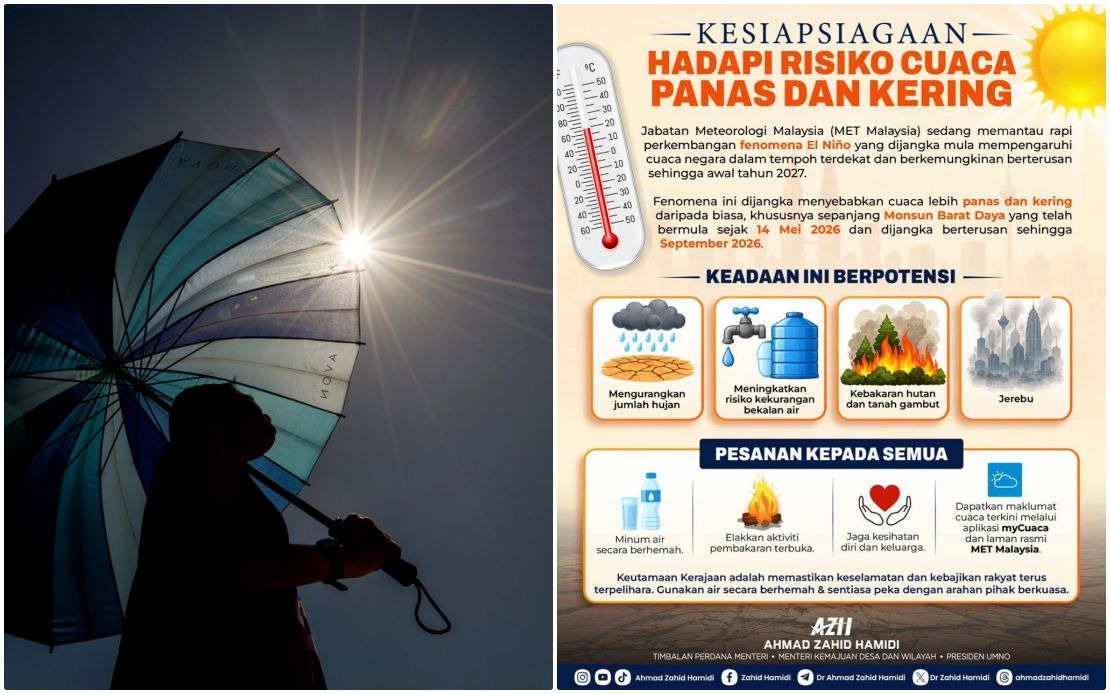
The coming months will test Malaysia's resilience as climate patterns shift markedly toward drier conditions. Deputy Prime Minister Datuk Seri Dr Ahmad Zahid Hamidi has issued a comprehensive advisory urging all Malaysians to prepare for an extended period of elevated temperatures and reduced rainfall, attributed to the intensifying El Niño phenomenon. Speaking in his capacity as chairman of the Central Disaster Management Committee, he underscored that the climatic disruption could persist through to early 2027, presenting a sustained challenge rather than a short-term weather event.
The El Niño effect will compound existing pressures during the Southwest Monsoon period, which commenced on May 14 and extends through September. Rather than the typical rainfall patterns that residents have come to expect, this particular monsoon season is forecast to deliver hotter and considerably drier conditions across much of the peninsula and East Malaysia. The implications extend beyond mere discomfort: precipitation deficits in key regions could trigger a cascading series of environmental and public health challenges that demand immediate preparatory action from households, businesses, and government agencies alike.
Water security emerges as perhaps the most pressing concern. The Malaysian Meteorological Department projects that rainfall reductions in several areas will significantly strain water resources precisely when demand typically peaks during the dry season. Urban and rural water supplies could face unprecedented pressure, necessitating stringent conservation protocols and potentially triggering rationing in affected localities. Agricultural regions dependent on seasonal rainfall patterns face particular vulnerability, as reduced moisture availability may compromise crop yields and livestock productivity during critical growth periods.
Beyond water scarcity, the combination of heat and drought creates ideal conditions for forest and peatland fires to ignite and spread with alarming velocity. Malaysia's extensive forested areas, particularly in Sabah and Sarawak, contain vast peatland reserves that are exceptionally prone to combustion during dry spells. Historical precedent demonstrates the capacity of such fires to generate transboundary haze affecting neighbouring nations and causing widespread respiratory illness. The 2015 El Niño event, for instance, triggered unprecedented forest fires across the region and created a public health crisis that lasted months.
In response to these multifaceted risks, Ahmad Zahid has articulated a framework centered on public vigilance and individual responsibility. His directive emphasizes prudent water usage across all sectors—from domestic consumption to agricultural and industrial applications. Simultaneously, he has flagged the critical need to curtail open burning activities, a practice that frequently occurs during land preparation and agricultural cycles but becomes extraordinarily dangerous when combined with dry atmospheric conditions and elevated temperatures. Public cooperation in avoiding uncontrolled burning could prove instrumental in preventing catastrophic fire events.
Vulnerable population segments demand particular attention during this period. The elderly, young children, and individuals with pre-existing respiratory or cardiovascular conditions face heightened health risks from sustained heat exposure and potential air quality degradation from haze. Ahmad Zahid's call for prioritizing the well-being of these groups reflects recognition that climate disruptions do not affect communities uniformly; certain demographics bear disproportionate burdens and require tailored support mechanisms.
Information accessibility has been positioned as a cornerstone of the response strategy. The Malaysian Meteorological Department has been tasked with ensuring continuous dissemination of weather updates through multiple channels, particularly the myCuaca application, which provides real-time meteorological data and early warning systems. By centralizing reliable weather intelligence and making it readily available to the public, authorities aim to empower individuals to make informed decisions about daily activities and long-term preparedness.
The government has committed to active monitoring and dynamic response protocols throughout the affected period. Ahmad Zahid emphasized that sustained vigilance and adaptive management will underpin efforts to minimize risks and protect public safety. This encompasses real-time assessment of water resource availability, pre-positioning of emergency supplies, activation of contingency plans for water distribution, and coordination with environmental agencies to implement fire prevention and suppression strategies.
Beyond immediate government action, the advisory implicitly calls for a collective responsibility model wherein businesses, community organizations, and individual households integrate climate adaptation into their planning. Agricultural sectors should explore drought-resistant crop varieties and irrigation efficiency improvements. Municipal water utilities must optimize distribution networks and implement demand-side management. Household consumption patterns require conscious adjustment toward conservation-oriented practices that can accumulate into substantial resource savings when aggregated across millions of users.
The extended timeline—potentially stretching to early 2027—suggests that adaptation must transcend short-term crisis management and embed itself within medium-term planning frameworks. Businesses dependent on water availability should diversify supply sources or invest in storage capacity. Communities in fire-prone regions require enhanced firefighting infrastructure and trained personnel. Educational campaigns promoting climate awareness and individual behavioral change need sustained investment to foster genuine attitudinal shifts toward resource stewardship.
For Southeast Asia more broadly, Malaysia's experience with El Niño adaptation carries regional implications. As a major economy and regional hub, Malaysia's response strategies and outcomes may serve as reference points for neighbouring countries confronting similar climatic pressures. Information-sharing on effective adaptation measures and transboundary coordination on haze management assume heightened importance, given the interconnected nature of regional weather systems and environmental challenges.