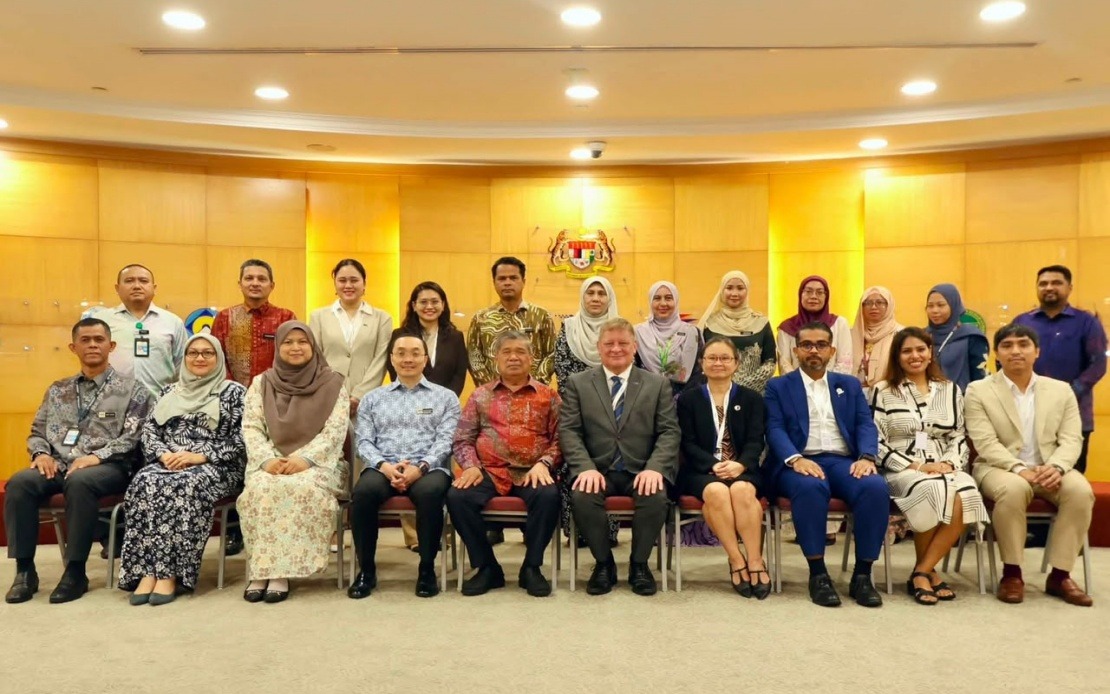
Malaysia and the European Union are intensifying their partnership in agricultural modernisation and food security, with Agriculture and Food Security Minister Datuk Seri Mohamad Sabu hosting a high-level delegation from the EU-ASEAN Business Council at Wisma Tani in Putrajaya this week. The meeting between Mohamad and EU-ABC executive director Chris Humphrey and his team underscores the growing strategic importance of agri-food cooperation between Malaysia and Europe, particularly as both regions grapple with supply chain vulnerabilities and climate-related pressures on production.
The discussion centred on four substantive areas of mutual concern and opportunity. Chief among these was progress on implementing Malaysia's National Agro-Food Policy 2.0, which frames the government's vision for ensuring domestic food security through modern farming techniques and knowledge transfer. The agenda also encompassed the adoption of agricultural technology and artificial intelligence applications—technologies where European firms possess considerable expertise and operational track records. Beyond policy frameworks, both sides examined practical measures to reinforce Malaysia's dairy sector along its entire supply chain, from production through to distribution, alongside efforts to strengthen the nation's animal health protocols and biosecurity infrastructure.
For Malaysia, the timing of this engagement reflects a broader strategic calculation. The country has positioned the EU as a cornerstone technology and commercial partner for transforming its agri-food ecosystem into one that is simultaneously more sustainable, resilient, and technologically advanced. This positioning acknowledges that Malaysia's agricultural sector faces multiple pressures: the need to boost productivity while managing limited arable land, the imperative to reduce environmental impacts, and the challenge of competing globally while maintaining domestic food affordability. European expertise in precision farming, organic certification systems, and supply chain traceability offers concrete solutions to these interlocking challenges.
Climate change and international supply chain disruptions featured prominently in the discussions, reflecting shared vulnerabilities that transcend geography. Malaysia's tropical location makes it susceptible to monsoon-driven yield volatility, while global food security increasingly depends on countries diversifying their sourcing and production strategies. By collaborating with EU partners on agricultural innovation, Malaysia strengthens its capacity to navigate these headwinds while positioning itself as a more reliable supplier to regional and international markets.
Minister Mohamad used the occasion to outline specific areas where Malaysian stakeholders would benefit from sustained European involvement. He highlighted the need for capacity building among local farmers and breeders, with particular emphasis on meeting international quality standards and sanitary and phytosanitary measures—regulatory hurdles that often exclude smaller producers from export markets. Access to European markets for Malaysian agricultural products depends heavily on compliance with SPS protocols, a domain where technical assistance can unlock significant economic opportunity. The minister also flagged the importance of EU support in exploring new export destinations and streamlining trade facilitation mechanisms.
Both delegations expressed solid backing for the ongoing Malaysia-European Union Free Trade Agreement negotiations, signalling that agricultural modernisation sits within a broader economic architecture being constructed between the two parties. The MEUFTA represents a flagship trade arrangement with potential to reshape bilateral commerce across goods, services, and investment flows. Agriculture's inclusion in these discussions—rather than its exclusion—indicates that both economies view food and agri-products as central to the relationship rather than as peripheral sectors.
Strategic cooperation between European companies and their Malaysian counterparts emerged as a priority theme. The ministry specifically called for deeper technology partnerships in the agricultural sector, suggesting that Malaysia sees value not merely in purchasing imported equipment or expertise, but in fostering genuine joint ventures and knowledge partnerships. This approach could facilitate technology transfer and help build indigenous innovation capacity within Malaysia's agri-food ecosystem. Such collaboration would modernise supply chain operations, from farm management systems to logistics and cold storage, ultimately ensuring more reliable availability of fresh produce and protein across the country.
The minister took the opportunity to extend an invitation to the EU-ABC delegation to participate in MAHA 2026, the Malaysia Agricultural, Horticulture and Agro-Tourism Exhibition scheduled for August 28 through September 6 at the Malaysia Agricultural Expo Park in Serdang, Selangor. This annual showcase attracts industry players, policymakers, and technology providers from across the region and internationally, serving as both a networking platform and a window on Malaysia's agricultural capabilities and ambitions. The invitation signals Malaysia's interest in elevating EU participation in the country's agricultural discourse and in positioning the event as a venue for forging new commercial relationships.
For Malaysian stakeholders, the broader significance of this engagement lies in the implicit recognition that modernising the agri-food system requires external partnerships and technology infusions. Unlike some sectors where domestic innovation suffices, agriculture in a globalised world increasingly depends on adopting frontier practices developed elsewhere. Europe's regulatory frameworks, particularly around sustainability and food safety, often set benchmarks that influence buyer expectations in Southeast Asia. By deepening ties with European firms and policymakers, Malaysia positions its agricultural exports more competitively while simultaneously upgrading domestic production systems.
The meeting also reflects Malaysia's middle-power strategy in trade negotiations. Rather than approaching the MEUFTA as a supplicant, Malaysia has positioned agriculture as a domain of mutual interest and benefit. European consumers and producers benefit from access to Malaysian tropical products and emerging export markets, while Malaysia gains from European technology, expertise, and market access. This reciprocal framing helps ensure that any free trade arrangement serves both economies' interests.
Looking ahead, the success of this partnership will depend on translating diplomatic goodwill into concrete projects and measurable outcomes. Whether EU technology transfer translates into higher yields and export volumes for Malaysian farmers, whether capacity building initiatives reach smallholder producers effectively, and whether the MEUFTA creates genuine opportunities for bilateral agri-trade expansion will ultimately determine the partnership's value. For now, the engagement demonstrates that Malaysia's agricultural leadership recognises the sector's potential as a driver of food security, rural prosperity, and economic competitiveness in a region where food security concerns will only intensify.

