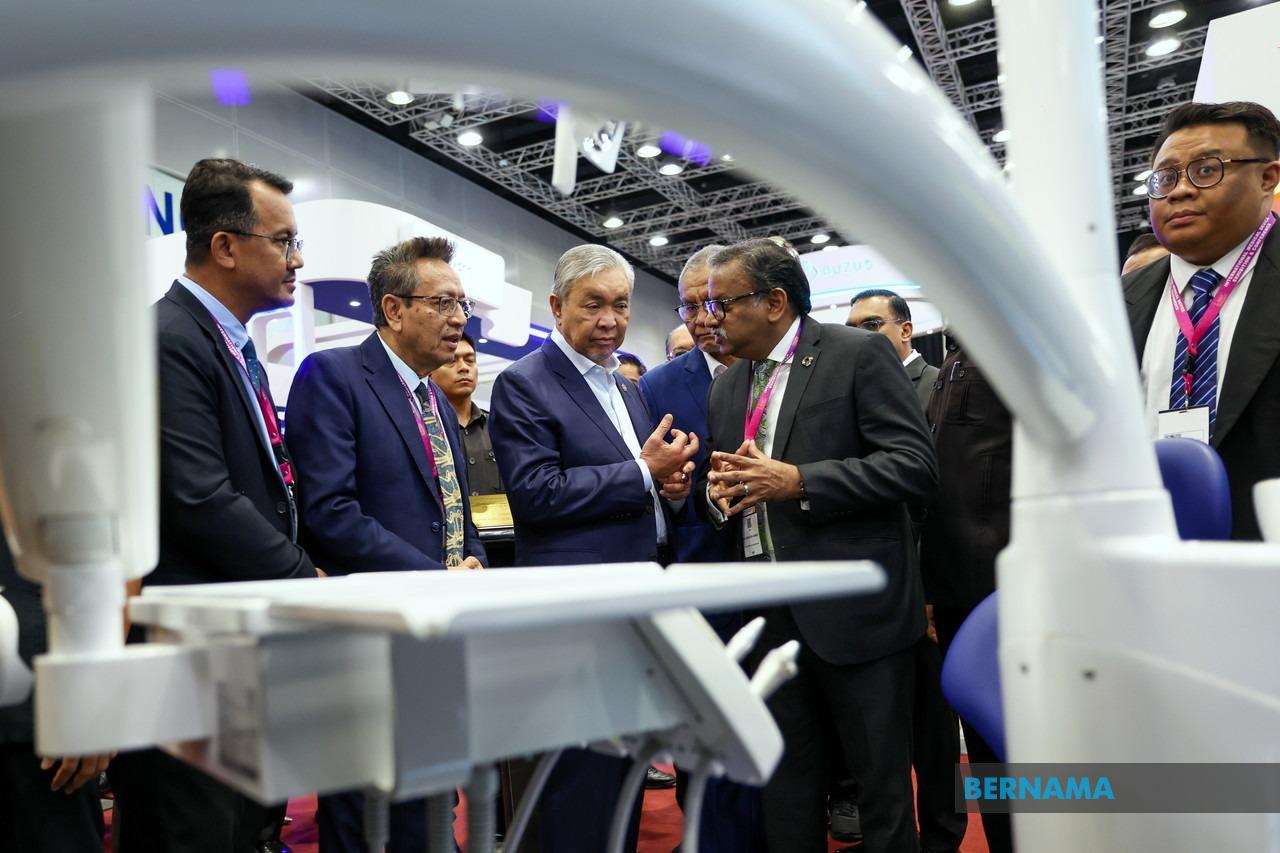
Malaysia is positioning itself as a regional medical technology powerhouse with an ambitious plan to nearly double its medical device exports within the next five years. Deputy Prime Minister Datuk Seri Dr Ahmad Zahid Hamidi unveiled the export aspiration during the closing of the International Medical Device Exhibition and Conference (IMDEC) 2026 in Kuala Lumpur this week, signalling the government's determination to transform the sector from a volume-driven business into a high-value innovation hub.
The proposed target of exceeding RM50 billion in annual exports by 2030 represents a 45 per cent jump from the RM34.54 billion achieved last year, reflecting growing confidence in Malaysia's manufacturing capabilities and competitive positioning. This growth trajectory aligns with the global trajectory of the medical device industry, which exceeded USD572 billion in 2025 and is forecast to surge past USD1 trillion within the next decade. For Malaysian manufacturers and investors, this expanding international market offers substantial opportunities, though competition from established economies and emerging manufacturing hubs remains fierce.
Beyond raw export numbers, Ahmad Zahid articulated a more nuanced development strategy centred on three interconnected pillars designed to elevate Malaysia's standing in the global MedTech ecosystem. The first pillar focuses on scaling exports, but critically emphasises the necessity of transitioning toward higher-margin, technology-intensive products rather than continuing reliance on lower-value assembly and contract manufacturing. This pivot reflects a mature understanding that volume-based growth alone cannot sustain long-term competitiveness or create meaningful employment in an industry increasingly shaped by innovation and intellectual property.
The second ambition targets the creation of at least ten homegrown MedTech champions capable of competing on regional and global stages. This objective represents a deliberate effort to reduce Malaysia's dependency on multinational corporations and contract manufacturers, fostering instead a ecosystem of locally-owned enterprises that design, develop, and commercialise their own technologies. Such domestically-rooted companies tend to retain more value within the economy, invest more heavily in research and development, and contribute more substantially to the nation's technological sovereignty and capabilities.
Ahmad Zahid emphasised that Malaysia possesses the foundational assets required for this transformation: an established manufacturing base, preferential market access through regional trade agreements, and substantial international confidence in its regulatory frameworks and quality standards. However, leveraging these advantages requires deliberate policy choices and sustained coordination between government, industry, educational institutions, and the investment community. The challenge lies not in capacity but in orchestrating a deliberate upgrade across the entire value chain.
The third pillar addresses a persistent weakness in Malaysia's manufacturing sector: the quality and calibre of jobs created by new investments. Presently, only 33.1 per cent of positions in the medical device sector fall into managerial, technical, and supervisory categories—a figure that Ahmad Zahid deemed inadequate for a purportedly high-value industry. By 2030, the government aims for at least half of all new employment generated by MedTech investments to occupy these higher-skill brackets, fundamentally reshaping the sector's workforce profile and ensuring that economic gains translate into meaningful career progression and skills development for Malaysian workers.
This employment-focused dimension of the strategy reveals a sophisticated understanding that manufacturing competitiveness increasingly hinges on human capital rather than merely labour costs or infrastructure. Ahmad Zahid, drawing on his position as National Technical and Vocational Education and Training Council chairman, advocated for a proactive approach in which international investors collaborate with educational and training providers well before establishing operations, rather than recruiting reactively when labour shortages emerge. Such partnership models enable curriculum alignment, industrial apprenticeship programmes, and skills forecasting that reduce hiring friction and accelerate the development of genuinely high-value roles.
The 2025 data illustrates current momentum: Malaysia approved RM4 billion in new medical device investments across 46 distinct projects, generating nearly 3,400 employment opportunities. While this represents solid activity, scaling these figures whilst simultaneously improving job quality requires intensified collaboration and targeted policy interventions. The medical device sector's relatively modest MTS index of 33.1 per cent suggests that many positions created thus far remain concentrated in assembly, packaging, quality control, and logistics—vital roles but not the advanced engineering, regulatory affairs, clinical evaluation, or product development positions that command premium compensation and forge career pathways.
The government's messaging also contains an implicit critique of foreign investors who have historically treated Malaysia as a low-cost manufacturing destination rather than a genuine centre of innovation. By explicitly welcoming international corporations whilst simultaneously cultivating local competitors and upgrading skills, Malaysia is attempting to differentiate itself as a location where intellectual property creation, advanced manufacturing, and commercialisation can profitably coexist—not merely a repository for outsourced production. This repositioning carries particular resonance for Southeast Asia, where multiple nations are pursuing similar strategies and competing for the same investment pools and talent bases.
The IMDEC 2026 conference itself, convening over 160 exhibitors and 50 regional and international speakers across three days, demonstrated the sector's growing maturity and international engagement. The breadth of participation—spanning regulation, innovation pathways, and healthcare transformation—indicates that Malaysia has moved beyond simple manufacturing considerations into the more sophisticated terrain of policy harmonisation, clinical validation, reimbursement strategy, and market access across multiple jurisdictions. For Malaysian policymakers and industry participants, this level of international engagement provides both benchmarking opportunities and access to global best practices.
Implementing these three ambitions simultaneously presents a formidable coordination challenge. Achieving RM50 billion in exports requires sustained demand and competitive advantage; developing ten Malaysian champions demands patient capital, entrepreneurial talent, and tolerance for innovation-related risk; and elevating the employment profile necessitates educational and training system transformation that extends far beyond the medical device sector itself. Success will depend substantially on whether government policy initiatives remain aligned across multiple ministries and whether the private sector genuinely commits to partnership with educational institutions rather than viewing workforce development as an external problem to be solved through immigration or wage suppression.
The ambitious timeline of 2030—less than six years away—underscores the urgency with which Malaysia views this transformation. The window for establishing regional and global competitive advantage in MedTech is narrowing as other Southeast Asian economies, China, and India intensify their own efforts to position themselves as medical device hubs. For Malaysian stakeholders across manufacturing, healthcare, education, and investment, Ahmad Zahid's vision articulates both the opportunity and the imperative: Malaysia can capture a substantially larger share of a rapidly expanding global market, but only by consciously abandoning the low-value manufacturing model and investing aggressively in capability, innovation, and talent.

