The Prime Minister's Department (Religious Affairs) is rolling out an ambitious new platform designed to democratise access to the intellectual heritage of Malaysia's most respected Islamic thinkers. Announced at an official ceremony in Putrajaya, the Maal Hijrah Lecture Series represents a strategic effort to transport complex Islamic scholarship out of university halls and into the mainstream consciousness of Malaysian society across all demographic layers.
Minister in the Prime Minister's Department (Religious Affairs) Dr Zulkifli Hasan framed the initiative as a response to a perceived knowledge gap. He emphasised that allowing the contributions of nationally and internationally recognised Islamic figures to remain confined within specialised academic environments or restricted intellectual circles would represent a missed opportunity for society at large. The minister articulated a vision where theological and jurisprudential insights become accessible conversation topics at the community level rather than remaining the exclusive domain of scholars and students within university settings.
The timing of this initiative coincides with the Islamic New Year celebration of Maal Hijrah 1448H/2026, positioning the lecture series within Malaysia's broader calendar of religious observance and scholarly reflection. By anchoring the programme to this significant date, authorities have created a framework that aligns grassroots intellectual engagement with established patterns of religious commemoration. This calendrical approach suggests the series will become a recurring annual event with evolving content and participant rosters.
Crucially, Dr Zulkifli signalled ambition for interfaith reach. He expressed hope that the thinking of Maal Hijrah figures would resonate not only with Malaysia's Muslim majority but also across non-Muslim communities. This suggests a recognition that Islamic jurisprudence and ethics contain universal principles relevant to Malaysia's multicultural society, and that cross-communal intellectual exchange could strengthen social cohesion. Such positioning distinguishes this initiative from purely intra-faith scholarship programmes.
The institutional architecture supporting the series already demonstrates substantial traction. The Religious Affairs Ministry has secured endorsements and partnership commitments from two major Malaysian Islamic higher education institutions: Universiti Sains Islam Malaysia (USIM) and International Islamic University Malaysia (IIUM). These partnerships provide crucial infrastructure—lecture venues, academic credibility, student audiences, and distribution networks—that would be difficult for a government ministry to establish independently.
The minister indicated that the initial partnership framework represents merely a foundation. Plans already envision expansion to encompass additional universities and educational institutions across the country. This phased approach to institutional engagement suggests the ministry recognises that genuine dissemination requires buying into the existing intellectual ecosystems and quality standards of established academic bodies rather than attempting top-down imposition of content.
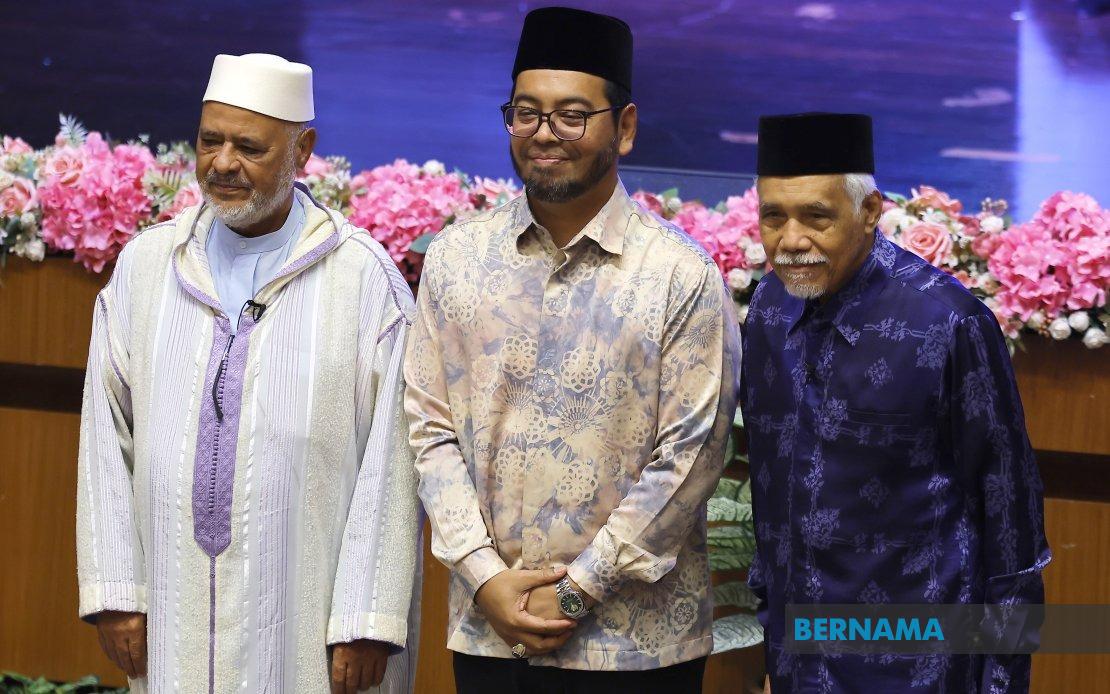
The inaugural lecture series featured two prominent award recipients whose selection underscores the calibre of scholarship the initiative aims to showcase. Emeritus Professor Osman Bakar, rector of IIUM, received recognition as the national Maal Hijrah figure, validating a scholar whose institutional position grants him significant influence within Malaysia's Islamic intellectual establishment. Internationally, Professor Sheikh Dr Ahmad Al-Raysuni, a distinguished Islamic jurisprudence specialist from Morocco, was honoured as the international Maal Hijrah figure. This pairing of domestic and international scholars creates a model whereby local audiences encounter both proximate Malaysian voices and broader Arab-Islamic intellectual traditions.
The formal awards were presented during the national-level Maal Hijrah 1448H/2026 celebration at Masjid Putra by Sultan Nazrin Shah of Perak, underscoring the ceremonial weight placed on recognising these intellectual contributions. The presentation of cash prizes alongside trophies and certificates signals tangible institutional investment in honouring scholarship, with monetary recognition validating the economic value placed on intellectual labour in advancing Islamic thought.
For Malaysia's educational and religious landscape, this initiative addresses a structural challenge common across many Muslim-majority nations: the translation of sophisticated scholarship into public discourse. Islamic universities in Malaysia have produced substantial intellectual output, yet this scholarship often circulates primarily within academic networks with limited popular engagement. By creating dedicated platforms for scholar engagement with broader audiences, the lecture series potentially catalyses a shift toward greater public intellectual participation among Malaysia's Islamic academics.
The programme also reflects current government priorities regarding Islam's role in contemporary society. Rather than positioning Islamic scholarship as oppositional to or separate from modern governance structures, the initiative integrates scholars into public institutional frameworks, suggesting a vision of Islam as a source of ethical guidance compatible with professional educational and administrative systems. This positioning carries implications for how Malaysians encounter Islamic intellectual authority, potentially normalising engagement with scholarly Islamic voices as part of routine civic and educational life.
Geographically, the initiative carries potential resonance across Southeast Asia. With IIUM's substantial international student population and both institutions' regional scholarly networks, the lecture series could establish Malaysia as a hub for Islamic intellectual exchange within the broader Southeast Asian context. This positioning complements Malaysia's longstanding role as a centre for Islamic finance and Islamic business education, extending the country's intellectual capital into theological and jurisprudential domains.
The success of this initiative will likely depend on implementation fidelity. Moving from ministerial announcement to sustained, high-quality programming requires consistent funding, effective promotion, and ensuring that lectures genuinely attract diverse audiences rather than reproducing the same academic-circular engagement patterns the programme aims to transcend. How effectively the Religious Affairs Ministry navigates these practical challenges will determine whether the Maal Hijrah Lecture Series becomes a durable feature of Malaysia's intellectual landscape or remains a well-intentioned initiative that fails to achieve meaningful public penetration.