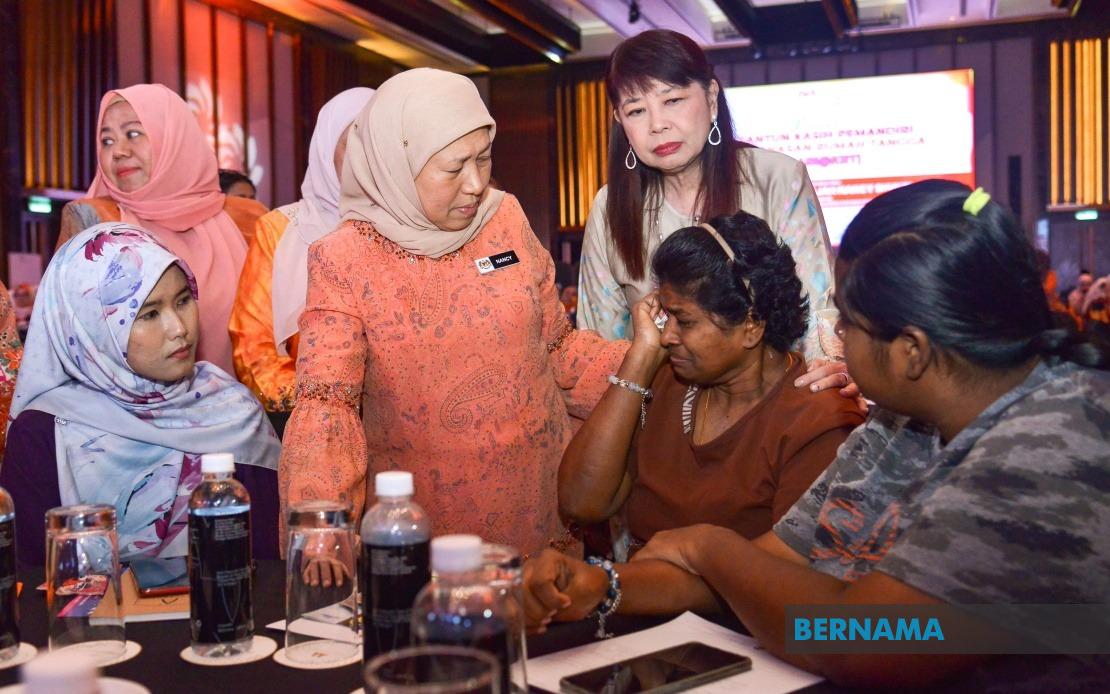
Malaysia's Ministry of Women, Family and Community Development has unveiled a comprehensive support initiative aimed at enabling approximately 1,400 domestic violence survivors to rebuild their lives with renewed confidence and economic independence. The SARI@KRT: Road to Eliminate Violence Against Women (EVAW) 2026 programme, officially launched in Kuala Lumpur, represents a strategic push by the government to move beyond awareness-raising towards tangible intervention and long-term victim rehabilitation.
Minister Datuk Seri Nancy Shukri articulated the programme's fundamental philosophy during its inauguration, emphasising that the initiative extends far beyond conventional public messaging. She stressed that the government's commitment centres on restoring survivors' self-belief and demonstrating that domestic violence situations carry pathways toward resolution through established support mechanisms. The ambitious scale of the rollout positions the effort as a flagship intervention, with targeted deployment of at least 100 participants across each state, ensuring geographic equity in service delivery.
The programme's architecture incorporates three interconnected pillars essential to survivor recovery. Psychosocial support forms the cornerstone, addressing the deep-rooted emotional and psychological damage inflicted by abuse. Legal assistance provision ensures that survivors navigate the complex machinery of the justice system without navigating alone, while the economic empowerment component recognises that financial independence remains crucial to preventing survivors from retreating to abusive situations born of economic desperation. This integrated approach reflects international best practice in domestic violence intervention, acknowledging that sustainable escape from abuse requires simultaneous addressing of emotional, legal, and financial dimensions.
Recent data presented by Nancy at the launch underscores the scale of Malaysia's domestic violence challenge. Police statistics reveal a concerning upward trajectory, with 4,014 reported cases between January and June 2024, representing a marked increase from 3,678 cases during the identical period the previous year. This nine per cent year-on-year escalation signals either a worsening problem or, as Nancy suggested, heightened victim reporting rates reflecting growing awareness and diminished stigma around disclosure. Johor emerged as the hotspot with 721 incidents, followed by Selangor's 614 cases and Perak's 405 cases, indicating that the phenomenon transcends particular regions but concentrates most heavily in economically active, densely populated areas.
Understanding the root causes proves essential for crafting targeted interventions. Official analysis reveals that misunderstandings and communication breakdowns remain the dominant catalyst, triggering 1,967 cases—nearly half of all reported incidents. This finding carries particular significance for Malaysian policymakers, suggesting that many domestic violence episodes stem from fixable communication failures rather than irredeemable relationship collapse. Drug abuse materialiised as the second major factor in 444 cases, while financial stress precipitated 378 incidents. These statistics highlight that socioeconomic pressures, rather than inherent malevolence, frequently ignite household violence, suggesting that addressing poverty and providing economic mobility could prevent many incidents before escalation.
Financial abuse represents a dimension that Nancy emphasised warrants greater public understanding and legal recognition. She articulated that when a household member possesses financial capacity but deliberately withholds support for essential family needs, effectively forcing a spouse to shoulder household expenses alone, this constitutes a form of abuse deserving serious classification. This framing proves significant for Malaysian discourse, as it reframes financial neglect from moral failing into abuse category, potentially opening legal pathways previously unavailable to survivors. She stressed that family financial responsibility represents a shared obligation rather than unilateral burden, challenging traditional household hierarchies where one party monopolises earning power while another remains economically dependent and consequently vulnerable.
The government's recognition of court-related expenses as barriers to justice demonstrates sophisticated understanding of practical obstacles survivors face. KPWKM provision of special allowances enabling survivors to attend court proceedings involving child maintenance claims addresses a concrete hindrance to legal remedy. Many survivors refrain from pursuing maintenance actions or attending hearings due to transportation costs, lost work hours, or childcare expenses—invisible expenses that effectively deny justice to the economically marginalised. This targeted financial assistance removes such practical barriers, signalling that the government recognises access to justice requires more than legislation; it demands removal of economic impediments.
Nancy's characterisation of increased reporting as potentially positive represents an important reframing of what might superficially appear as deteriorating conditions. When victim reporting rises, two interpretations emerge simultaneously: the actual incidence of violence may have increased, or survivors feel sufficiently emboldened and protected to disclose incidents previously hidden. The latter interpretation aligns with Nancy's emphasis on the government's efforts to create psychological safety around disclosure. This distinction matters enormously for policy evaluation, as rising statistics might paradoxically indicate success in changing victim behaviour and institutional response, even while reflecting ongoing violence in households.
The SARI@KRT initiative arrives at a juncture when Malaysian civil society and government institutions increasingly recognise that domestic violence represents not merely private family failure but public health and social development concern. The programme's magnitude—targeting 1,400 survivors nationally—suggests institutional commitment proportionate to problem scale. However, scaling such interventions across Malaysia's diverse geography and demographic landscape presents substantial implementation challenges, particularly in rural areas where stigma remains acute and survivor isolation runs deepest.
For Malaysian readers, this initiative carries implications extending beyond symbolic government action. The programme's emphasis on economic empowerment directly addresses a root cause enabling abuse: survivor financial vulnerability. By combining income generation opportunities with legal protection and psychological rebuilding, the initiative targets the complete ecosystem trapping many survivors in violent situations. The special allowances for court attendance remove practical barriers that disproportionately affect low-income survivors, potentially democratising access to justice previously skewed toward economically privileged victims.
The initiative also signals institutional willingness to evolve legal and social frameworks around family matters. Nancy's explicit discussion of financial abuse and shared family responsibility suggests the government recognises that traditional household structures, where one party monopolises earnings while another remains economically dependent, create structural vulnerabilities exploitable as abuse mechanisms. This perspective shift, while subtle, potentially opens pathways for legislative reform addressing forms of abuse historically categorised as private domestic matters beyond state intervention.
Survivors and their advocates should monitor programme implementation rigorously, ensuring that the ambitious 1,400-participant target translates into genuine support rather than administrative processing. The success metric extends beyond participant numbers to encompassing measurable improvements in survivor employment rates, legal resolution outcomes, and psychological wellbeing indicators. For the broader Malaysian community, the SARI@KRT launch represents acknowledgment that eliminating domestic violence requires sustained institutional effort, economic resources, and societal commitment to fundamental change in how families negotiate power, money, and safety.

