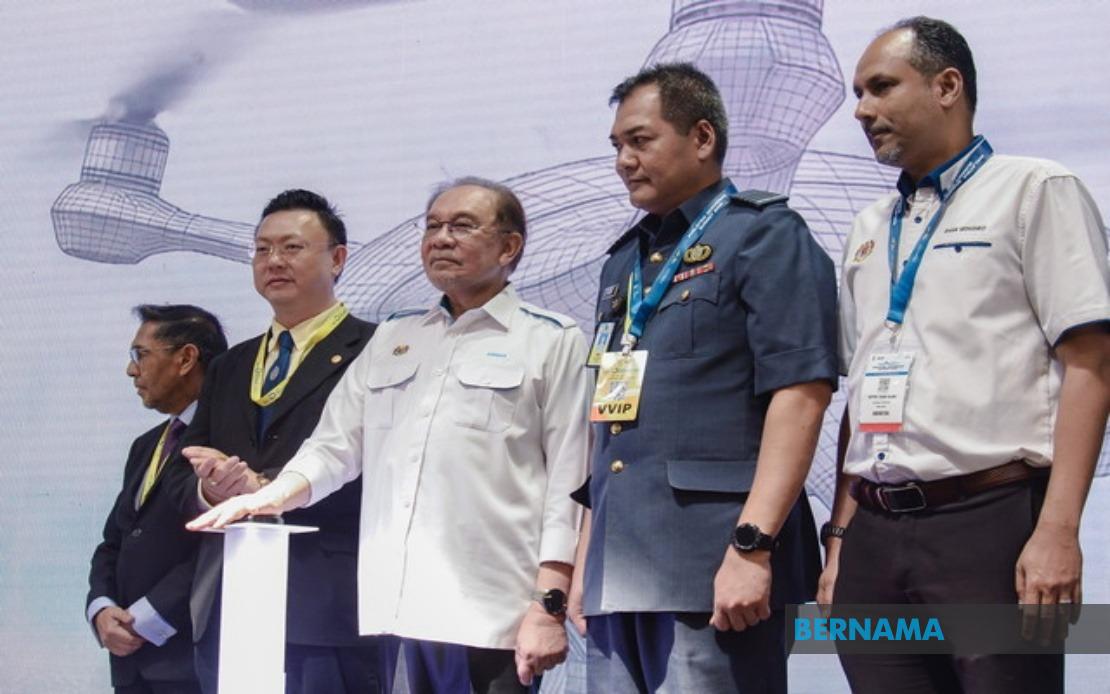
Prime Minister Datuk Seri Anwar Ibrahim has sounded a clarion call for Malaysia to accelerate its engagement with drone technology and unmanned aerial vehicles (UAVs), positioning the sector as essential to the nation's economic future. Speaking at the MyDrone Expo 2026 closing ceremony in Sepang, Anwar emphasised that technological adoption in emerging fields represents a prerequisite for Malaysia's sustained economic competitiveness on the global stage. His remarks reflect a broader recognition within government circles that the low-altitude economy represents a significant opportunity for national development and international economic positioning.
The drone sector occupies a distinctive space within Malaysia's technological landscape, functioning simultaneously as a standalone industry and as an integrator of complementary innovations. Anwar highlighted the intrinsic connections between UAV development, artificial intelligence, and digital transformation, suggesting that progress in one domain naturally catalyses advancement across the others. This interconnected approach underscores a strategic understanding that isolated technological investments yield diminishing returns; rather, fostering synergies between sectors multiplies their collective economic impact and creates genuine competitive advantages.
Market dynamics provide compelling justification for Malaysia's heightened focus on this sector. The global UAV market is anticipated to surpass USD55 billion in value by 2030, representing compound growth driven by expanding applications across agriculture, logistics, infrastructure inspection, and emergency response. The emergence of the low-altitude economy as a significant investment vector signals that commercial operators and venture capital increasingly recognise drone technologies as fundamental infrastructure for modern economies. Malaysia's early positioning in this space could prove transformative, offering pathways to manufacturing leadership, service excellence, and technology export opportunities throughout Southeast Asia and beyond.
The MyDrone Expo 2026 itself provided tangible evidence of the sector's growing vitality within Malaysia. The three-day exhibition attracted more than 100 booths and thousands of participants representing 46 countries, demonstrating both international interest in Malaysian capabilities and the domestic ecosystem's expanding sophistication. This breadth of participation indicates that Malaysia has begun establishing itself as a credible regional hub for drone innovation and commerce, a positioning that could be leveraged to attract multinational investment and foster knowledge transfer.
Recognising the imperative for coordinated governmental action, Anwar has directed Cabinet ministers, policymakers, research institutions, and regulatory bodies to provide comprehensive support mechanisms for industry expansion. This direction signals a whole-of-government approach extending well beyond symbolic endorsement. The commitment encompasses tangible elements including regulatory framework modernisation, enhanced research and development funding, and improved testing and certification infrastructure. Such institutional scaffolding proves essential for transforming nascent enthusiasm into sustained industrial development.
The government's willingness to extend support across both defence applications and civilian use cases reflects a sophisticated understanding of ecosystem building. By encouraging drone deployment in agriculture, plantation management, and productivity enhancement, policymakers create immediate commercial incentives that drive investment and innovation. Simultaneously, defence and security applications provide additional revenue streams and technological development drivers. This dual-track approach maximises the economic and strategic value extracted from the sector.
However, technological leadership requires more than policy directives and market enthusiasm. Malaysia must establish robust talent development pathways equivalent to those already developed for artificial intelligence and quantum computing. Anwar explicitly urged collaboration between private enterprises, government research establishments, and universities to create comprehensive skills pipelines. The success of these educational initiatives will prove determinative in whether Malaysia can transition from hosting manufacturing and assembly operations to developing proprietary drone technologies and systems.
The regional context amplifies the strategic importance of Malaysia's drone sector development. Southeast Asia's rapidly expanding economies increasingly require sophisticated technological solutions for agricultural productivity, disaster management, environmental monitoring, and infrastructure development. A Malaysian drone industry capable of serving these regional needs would access substantial markets while positioning the country as a technology leader within ASEAN. This regional perspective offers opportunities extending beyond Malaysia's borders.
International partnerships and knowledge exchange mechanisms will prove critical to accelerating Malaysia's development trajectory. The presence of delegates from 46 countries at the MyDrone Expo suggests international willingness to engage with Malaysian stakeholders. Strategic partnerships with established drone manufacturers, research institutions, and technology firms from advanced economies could significantly compress Malaysia's learning curve and facilitate rapid capability development.
The broader economic implications of PM Anwar's directives merit careful consideration. Drone technology development represents precisely the type of high-value-added manufacturing and innovation activity that advanced economies pursue to maintain prosperity. For Malaysia, successfully capturing a meaningful share of global drone markets could provide economic diversification, reduce dependence on commodity exports, and create high-skilled employment opportunities. The sector's growth trajectory suggests that early movers will establish enduring competitive advantages.
Policymakers must simultaneously address potential risks and challenges accompanying rapid sector expansion. Regulatory clarity regarding airspace usage, safety standards, and privacy protections requires careful calibration to enable innovation while protecting public interests. International cooperation on standards development will prove essential to ensuring Malaysian products achieve global market acceptance. Investment in safety research and testing infrastructure must pace technological advancement.
The government's commitment to drone sector development represents pragmatic economic planning aligned with global technological trajectories. Malaysia possesses geographic advantages, growing technical capabilities, and increasing international recognition as an emerging technology hub. Success in this sector could catalyse broader technological advancement across the economy while creating prosperity and employment for Malaysian workers. The window for establishing regional leadership in drone technology remains open, but decisive action and sustained commitment will prove necessary to capitalise fully on emerging opportunities.

