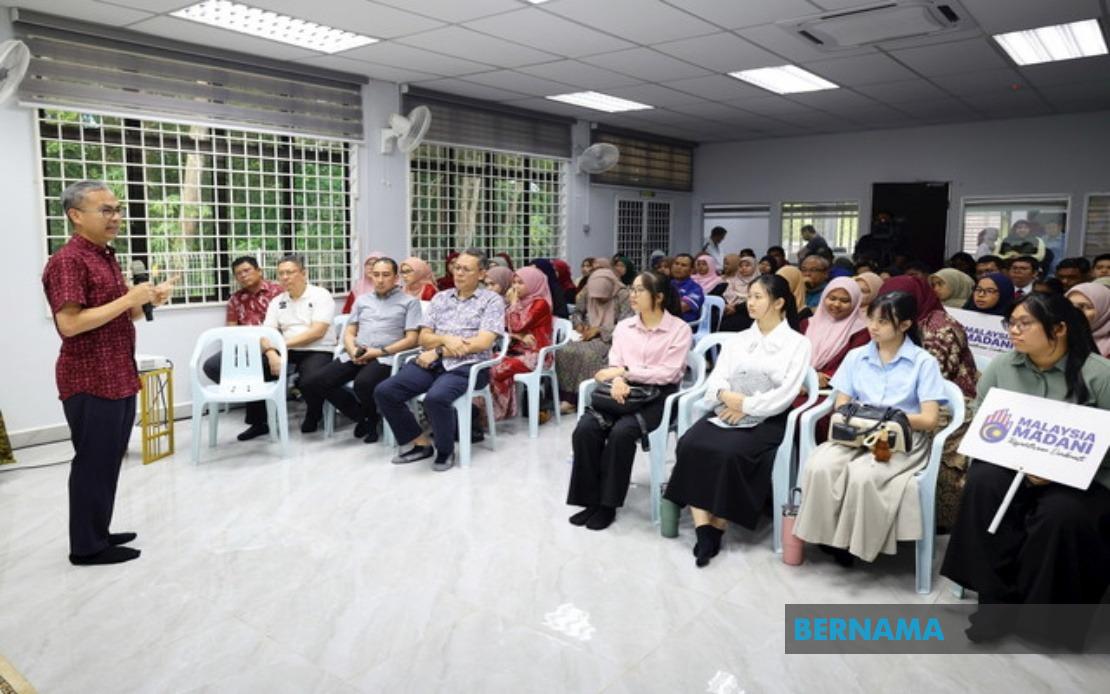
Communications Minister Datuk Seri Fahmi Fadzil has stressed the urgent need to continuously develop patriotic consciousness and digital competency among Malaysian youth, particularly those in secondary education. Speaking after an engagement session in Jempol with Form Six students, Fahmi highlighted that young Malaysians must grasp both the historical foundations of their nation and the practical skills required to navigate an increasingly digital world. This dual emphasis, he suggested, forms the backbone of developing citizens capable of contributing meaningfully to the country's advancement in an era defined by rapid technological change and information saturation.
The minister's remarks came during a structured dialogue event organised by the Department of Information Malaysia (JaPen) in partnership with the Malaysian Communications and Multimedia Commission (MCMC). The programme brought together approximately 60 students from three secondary schools within the Jempol parliamentary constituency: Sekolah Menengah Kebangsaan Batu Kikir, SMK Seri Perpatih, and SMK Datuk Mansor. What distinguished this initiative from conventional government-to-youth outreach was its interactive design, which positioned it as a genuine two-way exchange rather than a top-down information delivery mechanism.
Fahmi emphasised that understanding Malaysia's historical narrative and the responsibilities inherent in citizenship represents a foundational requirement for the next generation. He articulated this position by framing national consciousness not merely as academic knowledge but as a practical understanding of individual obligations within the broader collective endeavour of nation-building. This framing suggests a deliberate effort by the ministry to position patriotic education as integral to practical citizenship rather than ceremonial or symbolic attachment to the nation.
The engagement revealed several substantive concerns among the young participants that resonate across Malaysia and the wider Southeast Asian region. Students raised questions spanning misinformation and disinformation online, mental health challenges exacerbated by social media exposure, and their apprehensions regarding technological disruption to future employment prospects. Artificial intelligence emerged as a particularly significant concern, reflecting how rapidly technological advancement has penetrated youth consciousness even at the secondary school level. These concerns underscore a generation grappling with unprecedented information complexity and the psychological toll of constant digital connectivity.
The programme employed what organisers termed an "edutainment" methodology—combining educational content with performance-based elements including singing, dancing, and dramatic presentations. This approach emerged from Pentarama, a performance unit operating under JaPen that translates government policy messaging and patriotic values into engaging entertainment formats. The strategic deployment of entertainment as a delivery mechanism reflects an institutional recognition that traditional lecturing methods struggle to capture youth engagement in contemporary contexts, particularly when competing against algorithmically-optimised social media platforms.
Within the broader framework of this youth engagement initiative sits the Pentarama X Kelab Malaysiaku programme, which focuses on amplifying messages of independence, national unity, and preparations for significant national celebrations including National Day and Malaysia Day observances. The programme has expanded substantially since its inception, now operating through 850 Kelab Malaysiaku chapters distributed across Malaysia. This infrastructure suggests a coordinated, nationwide effort to establish institutional touchpoints for patriotic messaging and civic education at the school level, effectively embedding government-led patriotic cultivation within institutional settings where young Malaysians spend significant portions of their formative years.
The timing and emphasis of this initiative carry particular significance within Malaysia's current political and social landscape. As digital platforms have proliferated and misinformation campaigns have intensified across the region, Malaysian authorities have grappled with balancing open information access against the need to combat harmful falsehoods. The government's explicit focus on equipping youth with digital literacy—rather than simply restricting their access—represents a pedagogical approach emphasising critical thinking and discernment over censorship. This strategy acknowledges that young Malaysians cannot be isolated from digital content and instead require the cognitive tools to navigate it effectively.
Fahmi's remarks also implicitly address the challenge of maintaining national cohesion within Malaysia's increasingly fractious political environment. The emphasis on shared historical understanding and mutual responsibility suggests a governmental desire to foster cross-communal identification with the nation itself, particularly among younger citizens who may be experiencing heightened political polarisation through family discussions and social media exposure. By channelling patriotic messaging through entertainment and dialogue rather than didactic pronouncements, the ministry appears to be attempting to make national unity feel relevant and generationally resonant rather than imposed from above.
The programme's explicit inclusion of mental health concerns within its scope reflects growing institutional recognition that youth wellbeing extends beyond traditional educational metrics to encompass psychological resilience in an interconnected age. By creating space for students to discuss mental health impacts of social media usage, the initiative positions government agencies not merely as censors or controllers of information but as stakeholders invested in holistic youth development.
Erwin Khairul Ahmad, JaPen's director-general, characterised the expanded programme as serving dual purposes: enhancing National Month commemorations whilst simultaneously functioning as a listening mechanism through which senior government officials can directly absorb youth perspectives and aspirations. This framing repositions patriotic education as a bidirectional conversation rather than unidirectional messaging, potentially creating feedback loops through which youth concerns shape policy discussions at senior levels.
The initiative also reflects regional trends across Southeast Asia whereby governments have invested substantially in youth digital literacy programmes amid mounting concerns about misinformation campaigns, particularly those with geopolitical dimensions. Malaysia's approach of coupling digital literacy development with patriotic consciousness-building suggests an institutional calculation that technological competency and national commitment reinforce rather than contradict one another.
Looking forward, the expansion of the Kelab Malaysiaku network and continued dialogue sessions indicate that Malaysia's government views sustained engagement with youth as essential infrastructure for democratic resilience and social stability. Whether this approach successfully cultivates the desired balance between critical digital thinking and patriotic consciousness will likely depend on consistent implementation across diverse school communities and ongoing responsiveness to the specific concerns young Malaysians articulate.

