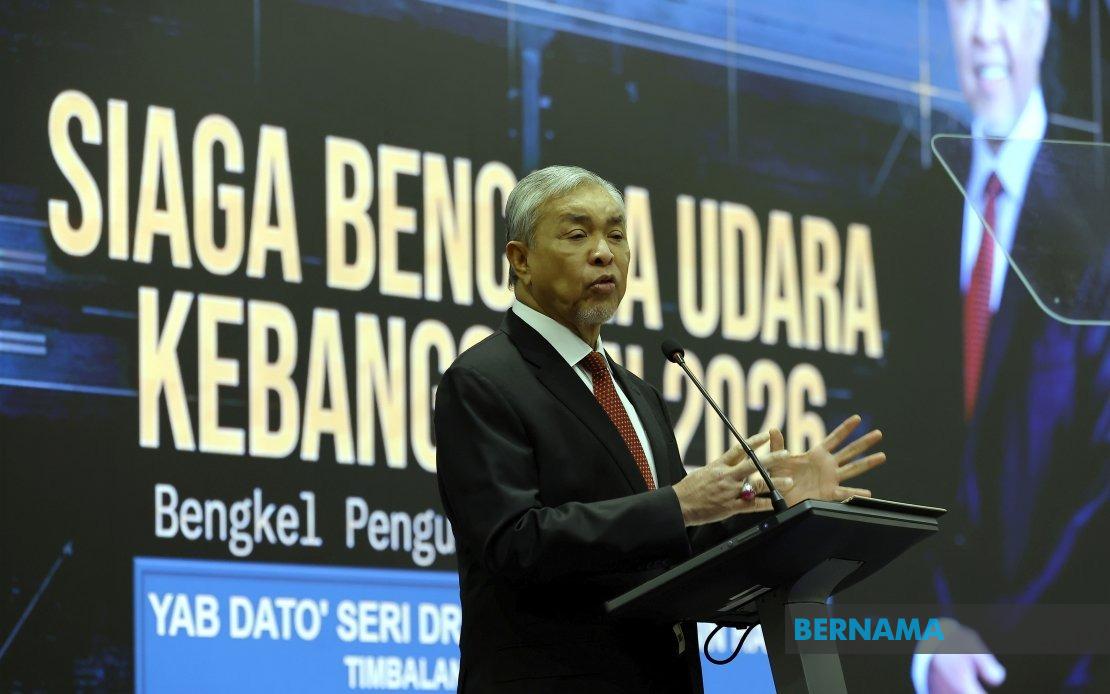
Malaysia must urgently establish a cohesive air disaster management framework that allows government agencies, emergency services, and aviation stakeholders to operate from a single operational foundation, Deputy Prime Minister Datuk Seri Dr Ahmad Zahid Hamidi declared at a national preparedness workshop in Sepang. The call underscores growing recognition that fragmented responses to aviation emergencies—where multiple agencies may act independently—risk compromising rescue effectiveness and loss of life. Ahmad Zahid's vision of "one system, one command, and one action" represents a fundamental reorientation of how Malaysia approaches catastrophic events at its airports and airspace.
The Deputy Prime Minister emphasised that readiness cannot be assessed purely on paper or during routine operations; genuine capability emerges only when agencies coordinate under extreme pressure, with incomplete information and urgent timelines. This distinction carries significant weight in aviation circles, where successful disaster management often depends on split-second decisions made by personnel operating across multiple jurisdictions and organisational hierarchies. Ahmad Zahid stressed that waiting for an actual crisis to discover communication failures or contradictory directives would be catastrophic, suggesting that Malaysia's current arrangements may harbour untested assumptions about inter-agency compatibility.
Effectiveness, he argued, should be measured not by asset quantity or staff numbers but by how seamlessly resources operate toward common objectives. Many nations maintain sophisticated disaster response infrastructure—specialized aircraft, trained personnel, equipment stockpiles—yet still struggle with operational coordination when disasters strike. Ahmad Zahid's emphasis on systems thinking rather than accumulation reflects lessons learned from international incidents where agencies possessed ample resources but lacked integration mechanisms. This approach aligns with contemporary disaster management theory that prioritises unified command structures and shared situational awareness over resource multiplication.
The two-day National Air Disaster Preparedness 2026 workshop convened more than 100 representatives from government ministries, law enforcement, rescue agencies, airlines, and airport operators to test procedures, evaluate communication protocols, and clarify operational responsibilities. Such exercises serve dual purposes: identifying gaps in coordination before emergencies occur and building familiarity among personnel who may have limited prior interaction. Malaysia's diverse stakeholder base—involving both civilian and security agencies, private operators, and international aviation standards bodies—creates inherent complexity that only systematic integration can address.
Ahmad Zahid outlined four strategic priorities for strengthening air disaster management capacity. First, Malaysia must review and clarify its chain of command and decision-making authority, ensuring that formal procedures align with operational realities and that no ambiguity exists about who holds authority during emergencies. Second, the nation needs enhanced information-sharing protocols and integrated communication systems allowing real-time situational updates across all responding agencies. Currently, agencies may operate parallel communication channels or experience delays in receiving critical updates, potentially fragmenting responses. Third, scenario-based training should expand beyond airport terminals to encompass surrounding areas and difficult-to-access locations where aircraft incidents might occur, preparing responders for diverse geographical and operational challenges.
The fourth priority—accelerating digitalisation of disaster management—acknowledges that modern emergencies demand rapid data processing and seamless information transfer across systems. Digital integration enables agencies to access shared databases, coordinate resource deployment, and track response actions in real time. For Malaysia, this modernisation carries particular importance given the complexity of managing emergencies at major international hubs like Kuala Lumpur International Airport and the potential for incidents involving aircraft from numerous countries with varying communication standards.
Aviation safety transcends technical or operational classification and qualifies as strategic national importance, Ahmad Zahid contended, citing aviation's foundational role in Malaysia's economic ecosystem. The sector directly supports tourism, trade facilitation, and investment attraction—sectors generating extraordinary economic returns. Malaysia attracted 42.2 million international tourists in the previous year, generating RM110.6 billion in direct tourism revenue, while domestic tourism spending reached RM121.3 billion. Aviation incidents would not merely threaten lives but potentially undermine global confidence in Malaysia's safety standards, triggering reduced visitor numbers, reduced airline capacity allocation, and investment hesitation.
This economic framing represents sophisticated policy communication, linking disaster preparedness to prosperity narratives that resonate across government and business sectors. Decision-makers often prioritise investments promising economic returns; by positioning air disaster management as protecting revenue streams and investor confidence alongside saving lives, Ahmad Zahid broadens the constituency supporting preparedness spending. This approach proves particularly valuable in developing nations where budgets face competing demands and disaster prevention investments may seem abstract compared to immediate infrastructure or service delivery needs.
The involvement of Malaysia Airports Holdings Bhd, represented by chairman Tan Sri (Dr) Azmil Khalid and managing director Datuk Mohd Izani Ghani, alongside Deputy Transport Minister Datuk Hasbi Habibollah and National Disaster Management Agency director-general Datuk Meor Ismail Meor Akim, indicates whole-of-government commitment to the initiative. Such high-level participation signals that air disaster preparedness commands attention at Malaysia's policy apex and that coordinating competing interests remains a priority, not an afterthought. Regional observers note that Southeast Asian nations increasingly emphasise disaster management integration as aviation expansion continues and metropolitan areas concentrate around major airports where incidents would create complex rescue scenarios.
Malaysia's push for integrated air disaster management reflects broader regional trends toward comprehensive emergency response frameworks. Neighbouring countries including Singapore and Thailand have invested substantially in unified command systems and inter-agency coordination protocols, establishing regional standards that Malaysia must match to maintain competitive positioning and participate effectively in mutual aid arrangements. The National Air Disaster Preparedness 2026 workshop represents tangible progress toward meeting these evolving international expectations while addressing domestic vulnerabilities in coordination that previous incidents or near-misses may have exposed.
The government's commitment to supporting capacity-building efforts through improved policies and enhanced coordination mechanisms suggests that air disaster preparedness will receive ongoing attention rather than fading after current media focus dissipates. However, translating vision into sustained operational change requires persistent resource commitment, regular training cycles, and periodic exercises to maintain readiness as personnel change and systems evolve. Ahmad Zahid's emphasis on systematic thinking and measured effectiveness establishes intellectual foundations for this sustained commitment, moving Malaysian aviation safety discourse beyond equipment acquisition toward the more demanding challenge of organisational integration.

