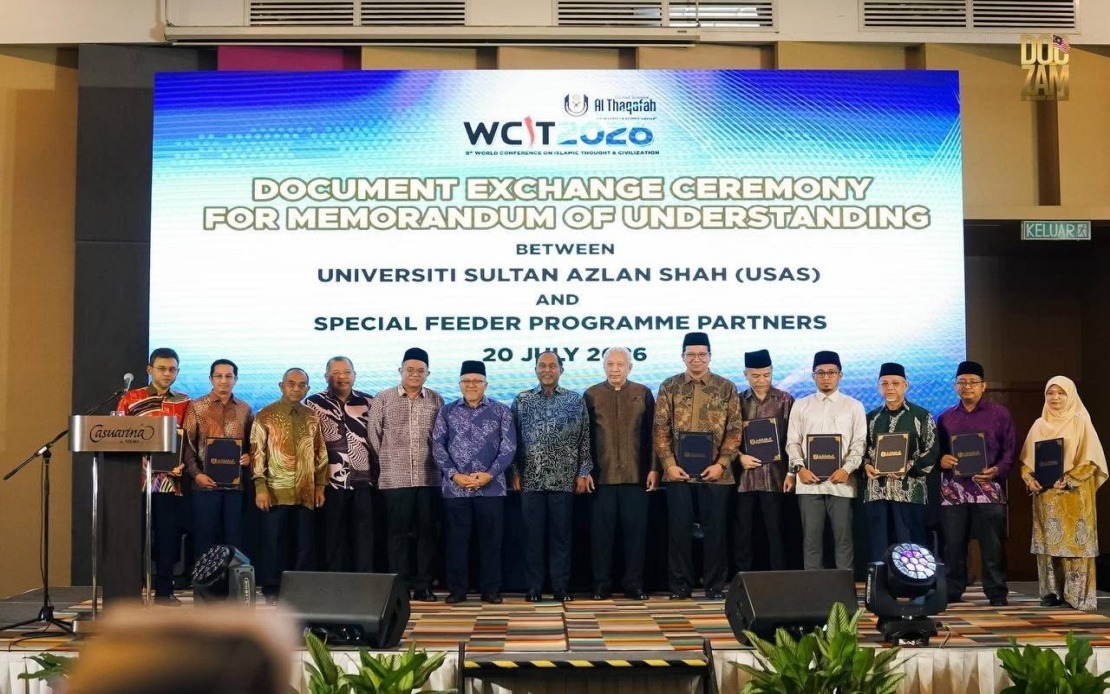
Malaysia is cementing its position as a global hub for intellectual exchange and higher learning, with the government signalling renewed commitment to fostering collaborative networks that bridge diverse academic perspectives. Higher Education Minister Datuk Seri Dr Zambry Abdul Kadir articulated this vision during the opening of the 8th World Conference on Islamic Thought and Civilisation (WCIT2026), which convened in Kuala Lumpur with participation from over 180 international delegates, scholars, and researchers. The conference represents a strategic platform for the nation to demonstrate its capacity to host meaningful cross-cultural dialogue while advancing solutions to pressing contemporary challenges affecting both the Islamic world and global communities.
The minister's framing of Malaysia's aspirations extends beyond mere hospitality. By positioning the country as a "bridge for dialogue" and "centre of excellence in higher education," Zambry articulated an ambitious national agenda that seeks to leverage the country's geographic location, institutional resources, and multicultural fabric as competitive advantages in the knowledge economy. This positioning carries particular significance for Southeast Asian nations competing to attract international academic partnerships and research investments. Malaysia's ability to convene scholars from diverse backgrounds and facilitate constructive intellectual engagement offers tangible benefits to its own universities and research community, which increasingly rely on international collaboration to advance their standing in global rankings and academic impact metrics.
Zambry's emphasis on knowledge transcending political and technological boundaries strikes at a fundamental tension in contemporary higher education. Universities worldwide face mounting pressure to align research priorities with national interests and security concerns, yet the minister's assertion that "knowledge is a shared heritage of all humanity" pushes back against narrower nationalist frameworks. This philosophical stance has practical implications for Malaysian institutions seeking to maintain robust research partnerships with international counterparts while navigating geopolitical sensitivities. The statement implicitly acknowledges that intellectual progress depends on open exchange rather than compartmentalisation along civilisational or national lines.
Central to the minister's argument is the proposition that the Islamic world's future depends on innovation and competitive scholarship rather than reverence for historical achievements. This framing represents a significant departure from rhetoric that sometimes romanticises past Islamic golden ages without addressing contemporary institutional weaknesses. By emphasising research capacity, integrity-driven leadership, and educational excellence as prerequisites for advancing the ummah's interests, Zambry aligns Malaysia with a growing movement among Muslim-majority nations to strengthen their research ecosystems and technological capabilities. For Malaysian universities, this message reinforces the importance of investing in faculty development, laboratory infrastructure, and postgraduate research programmes that can compete at international standards.
The minister's invocation of historical destruction—specifically Baghdad, Granada, Sarajevo, and the ongoing conflict in Palestine—carries particular weight in the present geopolitical climate. By framing the destruction of universities and libraries as catastrophic losses to civilisation itself, Zambry addresses contemporary anxieties about conflict's toll on academic institutions and intellectual heritage. The reference to Palestine reflects Malaysia's consistent diplomatic positioning on Middle Eastern issues, while the broader argument about preserving institutional sanctuaries for knowledge production resonates with international scholarly concerns about academic freedom and institutional autonomy under political pressure.
The WCIT2026 initiative provides Malaysia with a platform to showcase its commitment to scholarly excellence while simultaneously advancing its soft power objectives in the Islamic world. By hosting international thought leaders and facilitating high-level intellectual dialogue, the nation reinforces its credentials as a trusted venue for serious academic engagement. This carries downstream benefits for Malaysian universities' recruitment of international faculty, attraction of postgraduate researchers, and ability to position themselves as nodes in global knowledge networks. For the government, the conference demonstrates Malaysia's capacity to organise complex international events that generate tangible outcomes beyond ceremonial protocols.
The three-day duration of WCIT2026 and the minister's explicit hope for concrete "resolutions and new ideas" suggest an expectation that the conference will produce substantive policy recommendations and scholarly consensus statements. This focus on deliverables distinguishes the event from purely networking forums and indicates that Malaysia seeks to position itself not merely as a convenient meeting venue but as an active participant in generating solutions to challenges confronting Islamic societies and the broader international community. The articulation of measurable outcomes also serves domestic audiences, demonstrating to Malaysian stakeholders that international academic engagement translates into tangible benefits.
Higher education excellence, as articulated by Zambry, encompasses more than research productivity or academic rankings. The minister's emphasis on values-based knowledge ecosystems suggests recognition that Malaysian institutions must cultivate not only intellectual rigour but also ethical frameworks guiding knowledge production and application. This holistic approach addresses growing international concern about research integrity, conflicts of interest, and the social responsibility of scholars and universities. For Malaysian academics and policymakers, this language signals that investment in higher education should encompass institutional governance and ethical frameworks alongside capital expenditure and faculty recruitment.
The involvement of Universiti Sultan Azlan Shah in organising the dinner preceding the conference demonstrates the role of Malaysia's public universities in advancing national diplomatic and educational objectives. By engaging institutional leadership and international academics in structured dialogue, USAS and similar Malaysian universities function as crucial infrastructure for intellectual exchange and international relations. This symbiosis between higher education institutions and national strategic interests has historical precedent but requires careful management to ensure universities maintain academic autonomy while contributing to broader national goals.
Looking forward, Malaysia's commitment to bridging knowledge dialogue and driving higher education excellence requires sustained investment beyond conference rhetoric. The government's messaging must translate into concrete funding for research facilities, competitive compensation packages for faculty, and streamlined processes for international collaboration. Universities will need to balance the ambitious vision articulated by Zambry with practical realities of resource constraints and regional competition from established academic powerhouses. However, Malaysia's demonstrated willingness to convene global scholarly communities and articulate a coherent vision for inclusive, knowledge-based development positions it favourably within Southeast Asia's evolving knowledge economy.

