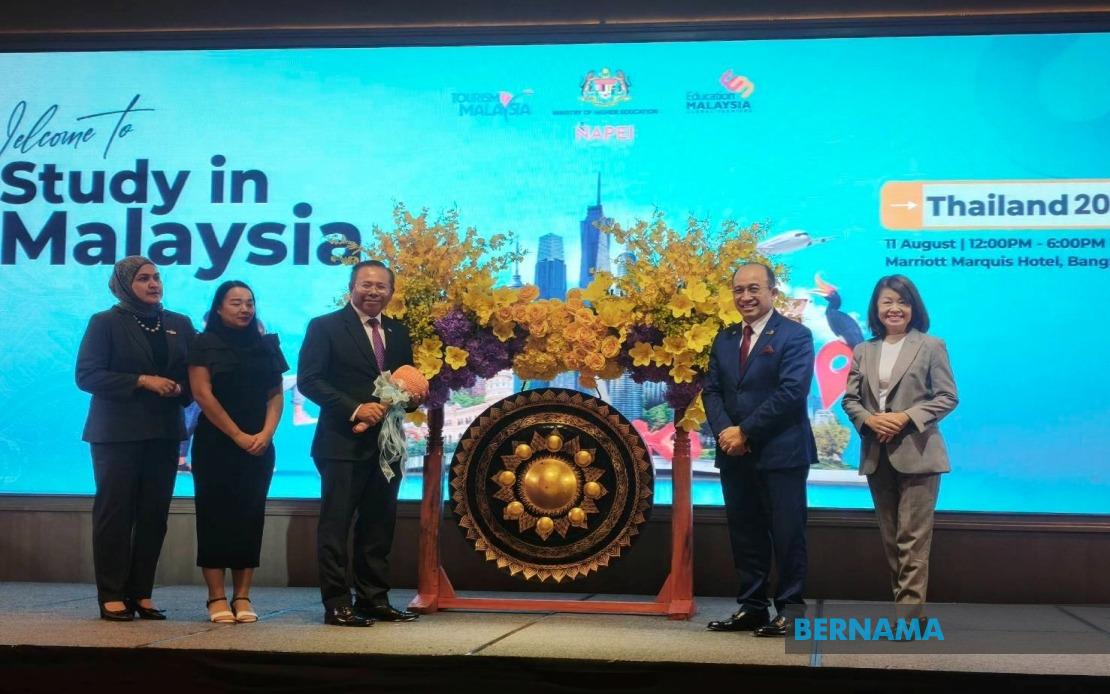
Malaysia is intensifying efforts to draw a significantly larger cohort of Thai students to its universities, capitalising on geographic proximity and competitive tuition fees to establish itself as a preferred destination for cross-border education in Southeast Asia. The initiative, spearheaded by Education Malaysia Global Services (EMGS), targets a growth exceeding 20 per cent in Thai student enrolment over coming years, building on a recent upswing that saw numbers climb from 300 students in 2024 to 360 in 2025.
The strategy reflects recognition that neighbouring Thailand represents substantial untapped potential for Malaysia's higher education sector. Currently, 634 Thai students are actively enrolled across Malaysian institutions, according to EMGS data, with distribution heavily skewed towards undergraduate qualifications despite a notable postgraduate presence. This composition suggests room for institutional expansion in advanced degree offerings that might appeal to Thai professionals seeking specialised credentials without leaving the region.
EMGS chief executive Novie Tajuddin outlined the core appeal to potential Thai students during the launch of a multi-city Study in Malaysia Education Fair this month, emphasising three interconnected advantages. Malaysia's position immediately north of Thailand eliminates lengthy travel times and associated costs, a factor often overlooked in global rankings but crucial for students with family obligations or limited resources. The affordability of Malaysian institutions, whether public or private, significantly undercuts regional competitors, particularly for students whose families have moderate purchasing power. Educational quality standards enforced through Malaysia's regulatory framework meanwhile provide assurance of credential recognition across ASEAN and internationally.
Central to the outreach campaign is a partnership with the Thai International Education Consultants Association (TIECA), the only professional body representing education agents in Thailand with 78 active members. This network, comprising licensed consultants who advise Thai students on overseas study options, provides EMGS with direct access to trusted intermediaries who shape student decisions. By positioning Malaysian opportunities through TIECA channels, EMGS bypasses traditional marketing constraints and reaches prospects through advisers they already trust.
A particularly compelling incentive now available to Thai graduates is Malaysia's one-year Graduate Pass, a recently expanded visa category permitting international degree holders to remain in Malaysia and secure employment across designated sectors following programme completion. This pathway directly addresses a critical barrier for Thai students contemplating overseas study: the question of whether education abroad translates into meaningful career development. By guaranteeing legal work authorisation for twelve months post-graduation, Malaysia extends the value proposition beyond classroom instruction to tangible professional advancement.
The recruitment campaign manifested through a coordinated three-city education fair covering Chiang Mai on August 9, Bangkok on August 11, and Hat Yai on August 13. This geographical spread recognises distinct Thai student populations—Bangkok representing Bangkok metropolitan students and northern provinces through Chiang Mai, while Hat Yai serves southern Thailand's student base with inherent proximity to Malaysia. The fair, organised collaboratively by EMGS, Tourism Malaysia and the National Association of Private Educational Institutions (NAPEI), showcases Malaysia's institutional diversity to Thai audiences through direct institutional representation.
Complementing visa incentives, Malaysia's Ambassador to Thailand Datuk Wan Zaidi Wan Abdullah proposed a parallel initiative: dedicated scholarship programmes administered through Malaysian public and private universities targeting Thai students. Such schemes would neutralise cost sensitivity as a barrier to application and signal systematic institutional commitment to Thai cohorts rather than incidental admissions. The ambassador framed scholarships as mechanisms to shift Thai student perceptions from viewing Malaysian education as a secondary option to recognising it as a strategically advantageous choice.
Enhancing these initiatives, EMGS maintains collaborative channels with the Thai Embassy in Malaysia to ensure reciprocal institutional support and streamlined communication around student welfare, visa matters and educational standards. This diplomatic coordination prevents the recruitment campaign from appearing ad-hoc or commercially exploitative, instead positioning education exchange as a structured bilateral priority reflecting broader Malaysia-Thailand cooperation frameworks.
The institutional context underpinning this drive is EMGS's dual mandate as a Ministry of Higher Education entity. Beyond visa processing facilitation, EMGS holds responsibility for positioning Malaysia as a regional hub for talent acquisition and knowledge production. Thai student recruitment directly advances this objective by internationalising Malaysian campuses, enhancing cultural diversity within student bodies, and establishing Malaysia as a destination where Thai professionals develop networks spanning multiple Southeast Asian countries. Graduates returning to Thailand often become advocates for Malaysian education quality within their home markets, generating organic demand.
From a regional perspective, this campaign reflects competitive dynamics within Southeast Asian higher education. Thailand itself hosts significant numbers of international students, yet Thai domestic demand for overseas credentials remains strong. Malaysian institutions, sharing linguistic and cultural similarities while offering cost advantages over Western alternatives or developed-nation competitors like Singapore or Australia, occupy a strategically optimal position. Conversely, attracting Thai students enhances Malaysia's competitive positioning against Indonesia, Vietnam and the Philippines—nations also pursuing cross-border student recruitment.
The timing of intensified recruitment also aligns with Malaysia's broader aspirations as a talent hub within ASEAN. Young Thai professionals educated in Malaysia develop familiarity with Malaysian institutional and business environments, facilitating subsequent professional mobility across borders. This represents soft power accumulation—establishing Malaysia as a destination where Thai youth invest formative years of education and early careers, generating generational cohorts with stake in Malaysia-Thailand bilateral relations.
Success of the current initiative remains contingent on execution consistency. Scholarship rollout must translate from ambassadorial proposal into institutional reality, requiring coordination between EMGS, university administrators and the Ministry of Higher Education to establish framework, funding mechanisms and promotional clarity. Similarly, the Graduate Pass pathway must function reliably in practice, with employers' familiarity with the visa status ensuring genuine employment opportunities materialise for Thai graduates rather than the category becoming nominal.
Moving forward, Malaysia's education sector possesses genuine structural advantages for capturing Thai demand. Whether recruitment targets prove achievable depends on sustained political commitment to scholarship funding, ministerial coordination across public and private sectors, and consistent quality maintenance across institutions. The campaign represents calculated recognition that geographic proximity, affordability and post-study employment access form a compelling value proposition—one demanding systematic cultivation through partnership-based outreach rather than passive institutional marketing.

