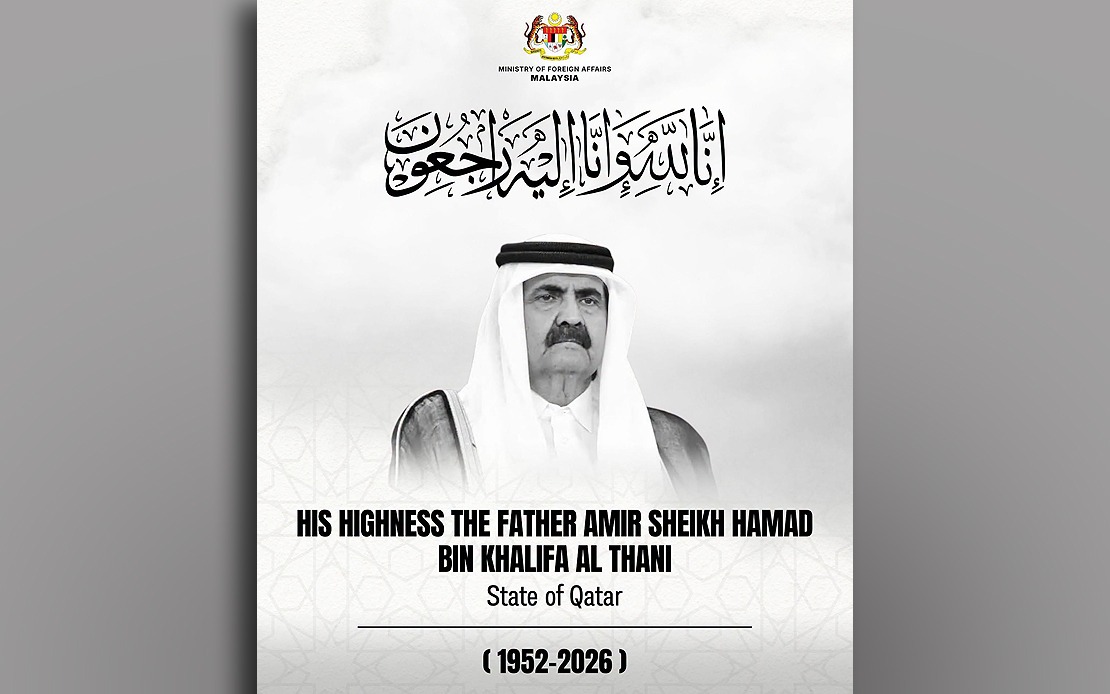
Malaysia has dispatched Higher Education Minister Datuk Seri Dr Zambry Abdul Kadir to Qatar to represent the Malaysian government in paying final respects to Sheikh Hamad bin Khalifa Al Thani, the late Father Amir of Qatar. The minister's visit to the Persian Gulf state spans July 13 to 14, during which he will participate in the formal mourning proceedings that have engulfed the nation following the passing of its founding leader.
The State of Qatar has declared four days of official national mourning, commencing on July 12 and extending through the middle of the month. During this extended period of remembrance, all government ministries, public institutions, and state entities across Qatar will remain closed, signifying the gravity with which the Gulf nation regards the loss of its patriarch. This wholesale suspension of government operations underscores the profound impact of Sheikh Hamad bin Khalifa Al Thani's leadership on Qatar's modern institutional framework and national identity.
The formal reception of international condolences will take place at Lusail Palace, where Sheikh Tamim bin Hamad Al Thani, the current Amir of Qatar, will receive delegations from foreign heads of state, members of the Al Thani ruling family, and senior dignitaries alongside ordinary citizens from July 13 to 15. This three-day period of diplomatic receiving ceremonies demonstrates the significant standing that Sheikh Hamad bin Khalifa Al Thani commanded on the global stage and the breadth of international relationships Qatar has cultivated under his stewardship.
Malaysia's decision to send a cabinet-level representative reflects the importance that Kuala Lumpur places on its relationship with Doha, one of the region's most influential and economically dynamic states. The Higher Education Ministry's assignment as the lead delegation body suggests the contemporary focus of bilateral engagement, particularly in educational cooperation and knowledge-sharing initiatives that have grown increasingly central to Malaysia-Qatar ties in recent years.
Through its Foreign Ministry, Malaysia issued a formal statement expressing deep sorrow at the passing of Sheikh Hamad bin Khalifa Al Thani and reaffirming the nation's commitment to standing alongside Qatar during this time of collective grief. The statement emphasized that Malaysia recognises not only the loss experienced by Qatar's government structure but also the emotional impact on the broader Qatari population, many of whom have lived their entire lives under his reign and shaped by his vision.
This gesture of respect carries particular significance given the historical context of Qatar's transformation from a modest Gulf emirate into a global economic and diplomatic powerhouse. Sheikh Hamad bin Khalifa Al Thani, who ruled for nearly four decades before his abdication in 2013, oversaw Qatar's emergence as a major player in international affairs, including hosting major sporting events, establishing itself as a diplomatic hub, and leveraging its natural gas reserves to achieve unprecedented prosperity. Malaysia's participation in the mourning acknowledges this transformative legacy.
For Malaysia, attendance at such high-profile state mourning ceremonies serves multiple diplomatic functions beyond simple expressions of condolence. It reinforces bilateral relations with an important economic partner and ally in the Islamic world, demonstrates Malaysia's engagement with Gulf affairs, and positions the nation within the broader network of Muslim-majority states that maintain strong institutional connections. Qatar's role as a financial and political force in the region means that Malaysian interests—ranging from investment opportunities to regional security cooperation—remain closely tied to stable, positive relations with Doha.
The formal protocols surrounding Sheikh Hamad bin Khalifa Al Thani's passing and the international response reflect broader patterns of how the Gulf states manage moments of dynastic transition and national loss. The presence of delegations from numerous countries at Lusail Palace will serve as both a show of respect for the departed leader and an opportunity for participating nations to reaffirm their commitment to relations with Qatar under its current leadership.
As Malaysia sends its minister to pay respects, the move also carries implicit recognition of Sheikh Hamad bin Khalifa Al Thani's significant influence not only on Qatar but on the broader Muslim world and international community. His reign saw Qatar expand its role in conflicts ranging from Palestinian affairs to Syria, establish itself as a mediator in regional disputes, and become a voice for Gulf interests in global forums. His passing thus marks a significant moment in contemporary Middle Eastern history, and Malaysia's formal participation acknowledges this historical importance.

