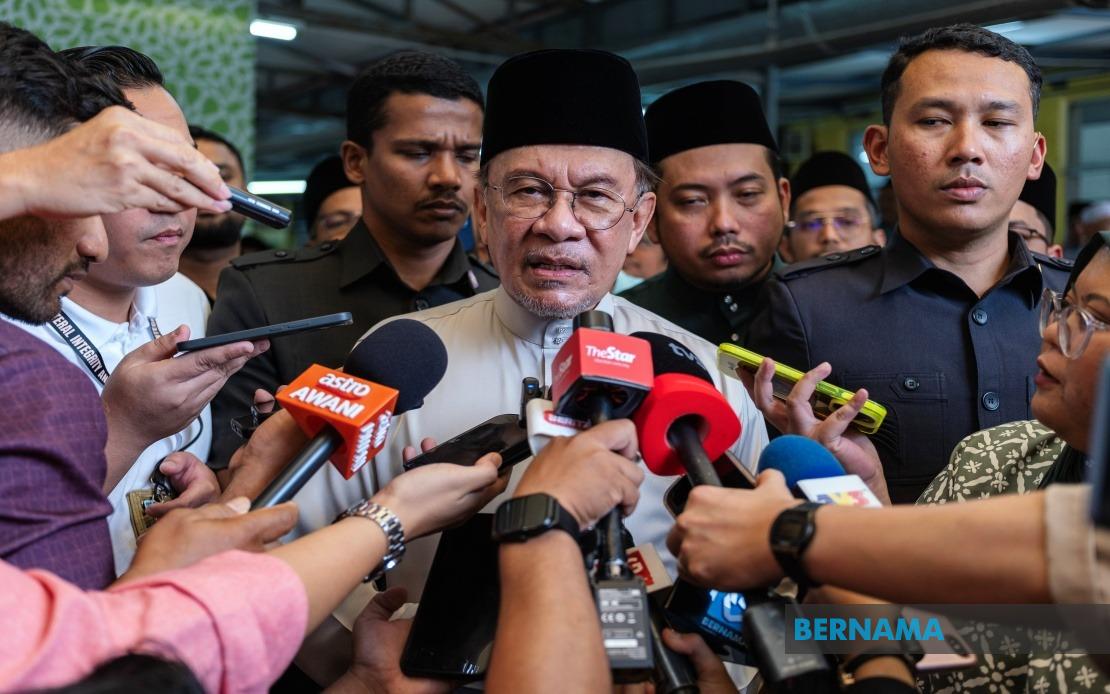
Malaysia will not alter its position regarding fugitive businessman Low Taek Jho—commonly known as Jho Low—regardless of potential action from the United States, Prime Minister Datuk Seri Anwar Ibrahim declared on Friday. The assurance came as international media outlets reported that Jho Low features among approximately 250 candidates under consideration for presidential clemency as the Trump administration marks the nation's Independence Day celebrations.
Anwar's statement underscores Malaysia's resolute commitment to prosecuting cases through its judicial system, independent of foreign policy considerations. Speaking to journalists following midday prayers at Masjid As-Sodiqin in Taman Kobena, the Prime Minister emphasised that Kuala Lumpur operates according to established legal principles and will neither yield to nor be deterred by external pressures. The clarity of his remarks signals to both domestic stakeholders and international observers that Malaysia views the Jho Low case as a domestic matter of national importance.
The timing of Anwar's comments coincides with speculation that the Trump administration might grant pardons or commutations on or near July 4, when the United States celebrates its 250th anniversary of independence. Jho Low, the alleged orchestrator of the 1Malaysia Development Berhad scandal that resulted in billions in missing funds, has remained a fugitive despite intensive international manhunts and extradition efforts. Any US decision to provide him sanctuary would represent a significant diplomatic and legal setback for Malaysia's anti-corruption agenda.
Jho Low's evasion has long frustrated Malaysian authorities and the public alike. The businessman fled the country as investigations intensified, eventually establishing himself outside Malaysia's reach. His role in the 1MDB affair—which implicated senior political figures and devastated the nation's international reputation—makes his status as a fugitive a symbol of unfinished justice. Malaysian courts have convicted him in absentia on money laundering charges, yet his physical location and legal vulnerability remain contested on the global stage.
Anwar's assertion that Malaysia will maintain its stance regardless of US action reflects a broader principle: that national legal systems must operate autonomously from diplomatic considerations. The Prime Minister's language—emphasising that Kuala Lumpur will not be "influenced, disturbed or affected"—suggests awareness that any US pardon could be perceived domestically as capitulation to external pressure. By pre-emptively rejecting such scenarios, Anwar seeks to reassure citizens that Malaysia's commitment to the rule of law transcends international relationships.
The relationship between Malaysia and the United States has historically incorporated tension over accountability mechanisms. While the two nations maintain robust diplomatic and security ties, Malaysia has occasionally found itself at odds with Washington's foreign policy priorities. The potential clemency for Jho Low would represent an unusual case where US executive authority might collide directly with Malaysian judicial interests. Anwar's comments suggest that Kuala Lumpur will not accommodate such a collision, even if it complicates bilateral relations.
The legal architecture surrounding Jho Low's case involves multiple jurisdictions. Beyond Malaysia, Jho Low faces scrutiny in other countries where proceeds from the 1MDB fraud allegedly transited or were deployed. The United States Department of Justice has previously pursued cases related to the scandal, recovering substantial sums laundered through American financial institutions. A US pardon would not necessarily shield him from prosecutions elsewhere, though it would eliminate the possibility of extradition to America as leverage for his surrender to Malaysian authorities.
Anwar's unwavering position also carries domestic political implications. The 1MDB scandal scarred Malaysia's democracy and galvanised public demand for accountability. When the previous administration under Mahathir Muhammad returned to power in 2018, the investigation and prosecution of figures connected to 1MDB became central to demonstrating the integrity of Malaysia's institutions. Any appearance that the current government is acquiescing to external pressure—particularly from a powerful ally—would undermine public confidence in judicial independence and anti-corruption efforts.
Separately, Anwar noted that the United States has proposed a RM1 million contribution toward the restoration of Tugu Negara, the National Monument, as part of Malaysia's upcoming National Day celebrations next year. This gesture, while modest in financial terms, carries symbolic weight in bilateral relations and reflects American willingness to support Malaysian national heritage initiatives. The Prime Minister indicated that the Cabinet would deliberate on this proposal in its forthcoming meeting, signalling that such international partnerships merit serious governmental consideration.
The juxtaposition of these developments—Malaysia's refusal to bend on Jho Low coupled with acceptance of US financial support for a national monument—illustrates the complexity of managing relationships with major powers. Nations must simultaneously defend their legal sovereignty while maintaining pragmatic engagement on matters of mutual interest. Anwar's framing suggests Malaysia can do both without contradiction: rejecting foreign interference in judicial matters whilst welcoming cooperation in areas of shared benefit.
For regional observers, Malaysia's stance on Jho Low carries implications beyond the individual case. Southeast Asian nations frequently grapple with the challenge of ensuring that fugitives do not escape accountability through geographic distance or refuge in countries with greater economic or military power. Malaysia's insistence on its legal prerogative, should it be tested by a US pardon, would establish a precedent for other regional states confronting similar dilemmas. The principle that domestic justice systems must operate independently from great power politics remains contested globally, making Malaysia's position a potential touchstone for regional jurisprudence and international relations.
Looking ahead, should the Trump administration indeed grant clemency to Jho Low, Malaysia's response will likely involve diplomatic remonstration through formal channels rather than public acrimony. The government will probably seek to reinforce Jho Low's status as a fugitive through coordinated international efforts, including liaison with countries where he might be detected or where his assets remain frozen. Anwar's advance declaration that Malaysia will not be swayed by such a scenario effectively inoculates the government against accusations of capitulation, positioning any future developments as external actions rather than failures of Malaysian resolve.

