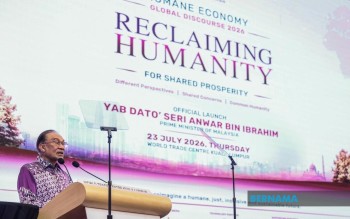
Prime Minister Datuk Seri Anwar Ibrahim has signalled that the Malaysian government will commence work on Budget 2027 during August, ahead of its scheduled presentation to Parliament in early October. Speaking in his dual capacity as Finance Minister, Anwar outlined the philosophical underpinnings that will shape the nation's fiscal roadmap for the coming year, moving beyond conventional metrics of economic performance to embrace what he termed a "humane economy" framework.
At the heart of the upcoming budget lies a fundamental reorientation of how Malaysia measures and pursues economic success. Rather than fixating on headline growth figures or consumption volumes, Anwar articulated a vision in which prosperity serves as the foundation for human dignity, security and purpose. This rhetorical pivot reflects broader global conversations about inclusive economics and shared prosperity, positioning Malaysia alongside nations reconsidering the adequacy of gross domestic product as the sole barometer of national progress. For ordinary Malaysians, this framing suggests the budget may allocate resources toward tangible quality-of-life improvements rather than abstract economic expansion.
The prime minister elaborated on this philosophy during his keynote address at the Humane Economy Global Discourse 2026 in Kuala Lumpur, emphasising that every significant policy decision warrants scrutiny through a fundamental question: does it expand opportunity or constrain it? This test applies to all major economic initiatives, from semiconductor development and energy transition strategies to the nation's digital transformation agenda. The approach hints at potential realignments in how Malaysia prioritises competing development goals, possibly signalling greater emphasis on equitable outcomes alongside technological advancement.
Under this framework, genuine prosperity demands that economic growth translate into meaningful wage improvements for workers across sectors. Beyond mere income increases, Anwar stressed the importance of work that provides genuine satisfaction and purpose, suggesting the budget may contain provisions supporting job quality and not merely job creation. This distinction carries particular relevance for Malaysia, where concerns about stagnant wages and underemployment have persisted despite periods of overall economic expansion.
Housing affordability emerges as another critical focal point in the articulated vision. Malaysia's property market has faced mounting criticism for pricing ordinary families out of homeownership, particularly in major urban centres. By explicitly identifying affordable housing within the budget's moral framework, Anwar signals potential government intervention through subsidies, first-time buyer schemes, or enhanced financing mechanisms. Such measures could substantially impact household finances and inter-generational wealth accumulation patterns across the country.
Healthcare accessibility and educational quality feature prominently in the prime minister's enumeration of budget priorities. The emphasis on making healthcare accessible rather than merely available suggests possible moves toward reducing out-of-pocket expenses for patients and expanding preventive care programmes. Similarly, the focus on quality education rather than simply increasing school enrolment numbers may presage curriculum reforms, improved teacher remuneration, or enhanced funding for disadvantaged institutions. These areas directly affect Malaysian households' budgetary constraints and long-term economic mobility.
Community resilience has also been identified as a budget consideration, marking a departure from purely individualistic economic metrics. This language suggests potential investments in local economic development, small and medium enterprise support, or neighbourhood infrastructure that strengthens social bonds alongside economic productivity. For Malaysia's diverse communities, such an approach could foster more inclusive development patterns than growth concentrated in major corporations or wealthy urban pockets.
The sustainability dimension introduced by Anwar addresses intergenerational equity, cautioning against transferring environmental, financial or social burdens to future Malaysians. In practical budgetary terms, this could translate to increased allocations for environmental remediation, reduced short-term extraction of natural resources for immediate fiscal gain, or enhanced provisions for managing long-term liabilities. Given Malaysia's ongoing environmental challenges and climate vulnerability, this framing suggests budget measures may increasingly weight ecological considerations alongside conventional fiscal metrics.
Anwar's invocation of innovation as a tool for expanding human capabilities rather than deepening inequality signals awareness of technological disruption's distributional consequences. As Malaysia pursues advanced sectors including semiconductors and artificial intelligence, the budget framework implies measures to ensure such opportunities benefit broad populations rather than concentrating gains among elite groups. This could encompass technology skills training, digital infrastructure for underserved regions, or safeguards protecting workers from displacement without adequate support mechanisms.
The integration of these principles into Budget 2027 represents a significant articulation of development philosophy for Southeast Asia's third-largest economy. Whether subsequent budget details match the aspirational rhetoric remains to be seen; implementing such comprehensive priorities within fiscal constraints will demand difficult trade-offs. Nevertheless, the stated framework positions Malaysia within conversations about post-growth economics and stakeholder capitalism that dominate policy discussions internationally.
For regional observers, Malaysia's budget approach carries implications extending beyond national borders. As a major Southeast Asian economy and technology hub, Malaysian policy choices influence regional investment flows, labour migration patterns, and development models that other nations assess. A successful demonstration that growth and equity can be simultaneously pursued might reshape regional development priorities, while implementation challenges could conversely reinforce scepticism about alternatives to conventional growth maximization.
The August commencement of Budget 2027 formulation provides several months for translating philosophical principles into specific allocations and policy instruments. The October tabling date allows parliamentary scrutiny before the budget's January implementation. Throughout this process, Malaysian stakeholders from civil society, business sectors, and vulnerable populations will likely seek assurances that humane economy rhetoric translates into measurable budgetary commitments rather than remaining purely aspirational language divorced from fiscal reality.

