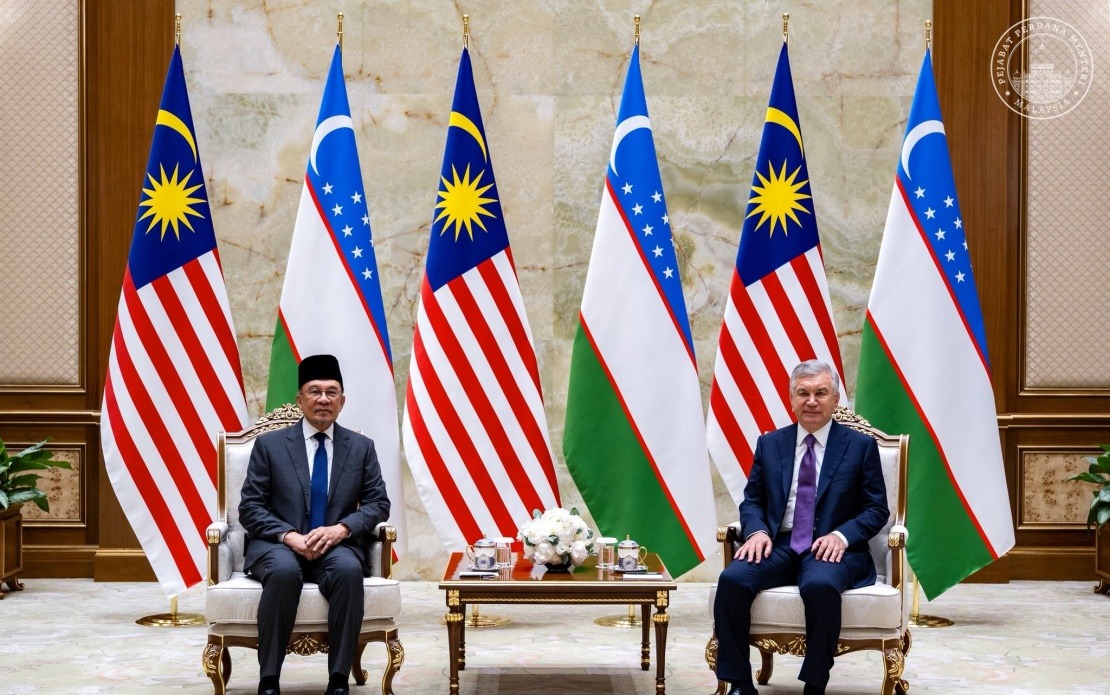
Prime Minister Datuk Seri Anwar Ibrahim has identified substantial opportunities for Malaysia and Uzbekistan to deepen their partnership across multiple strategic domains, following a high-level meeting with Uzbekistan President Shavkat Mirziyoyev during a transit stop in Tashkent en route to Russia. The encounter, which took place as Anwar's delegation prepared to continue onwards to Kazan for the ASEAN-Russia Commemorative Summit on June 17-18, underscored the growing importance Malaysia attaches to Central Asian engagement beyond its traditional Southeast Asian focus.
The bilateral discussions covered an expansive agenda spanning conventional trade and investment channels alongside emerging areas of mutual interest. Energy cooperation emerged as a particularly promising avenue, with both leaders acknowledging untapped potential in gas and petroleum sectors that could furnish Malaysia with alternative energy sources while opening markets for Uzbekistan's hydrocarbon exports. Such arrangements hold significance for Malaysia's ongoing energy security calculations, particularly as the nation seeks to diversify its supply chains and reduce exposure to volatile global petroleum markets.
Beyond commercial transactions, the leaders emphasised the role of education in cementing lasting ties between the two nations. Educational exchanges and institutional partnerships can facilitate knowledge transfer, particularly in technical fields where Uzbekistan possesses established expertise. Tourism and the halal industry were also highlighted as sectors where natural synergies exist. Uzbekistan's growing tourism infrastructure and its substantial Muslim population create obvious opportunities for Malaysian halal certification bodies and tourism operators to expand regional operations.
A notable dimension of the Tashkent meeting involved discussion of Islamic civilisation and scholarly traditions. This reflects Malaysia's broader positioning as a bridge between the Islamic world and the Asia-Pacific region, a role that resonates particularly in Central Asia where Islamic heritage runs deep. The emphasis on preserving Islamic intellectual legacies and celebrating historical contributions to human advancement signals Malaysia's intent to engage Uzbekistan on cultural and civilisational grounds, not merely transactional economic ones.
The energy sector discussion carries particular weight given Malaysia's evolving energy landscape. As the nation works towards balancing economic growth with sustainability commitments, partnerships with gas-rich neighbours like Uzbekistan could provide cleaner fuel alternatives compared to coal-dependent power generation. Energy cooperation simultaneously addresses Malaysia's development aspirations and international climate obligations, making it a natural focal point for bilateral engagement.
Anwar's remarks about elevating human dignity and promoting equitable development reflect Malaysia's diplomatic positioning under his leadership, which emphasises values-based partnerships rather than purely extractive arrangements. This approach distinguishes contemporary Malaysian foreign policy, particularly in engagement with traditionally less-visited regions like Central Asia. By framing bilateral cooperation within broader frameworks of inclusive prosperity and knowledge empowerment, Malaysia projects itself as a responsible partner committed to mutual benefit rather than extractive advantage.
Uzbekistan's strategic importance has grown considerably following its liberalisation under President Mirziyoyev, who has undertaken significant institutional and economic reforms since assuming office. The country's central position within Central Asia's transport networks and its considerable energy resources make it an increasingly relevant interlocutor for Southeast Asian nations seeking to expand their geographic reach. Malaysia's proactive engagement with Tashkent reflects recognition that Central Asian markets and partnerships warrant greater attention from ASEAN economies.
The meeting also demonstrated Anwar's personal commitment to deepening Malaysia's Central Asian footprint through high-level diplomatic engagement. While transit stops are often ceremonial, their elevation to substantive policy discussions signals intentionality. The halal industry dimension deserves particular attention, as Malaysia's dominance in Islamic finance and halal certification positions it advantageously to assist Uzbekistan in certifying and marketing halal products to broader Islamic markets, creating value-addition opportunities across both economies.
Investment flows between Malaysia and Uzbekistan remain modest by regional standards, suggesting considerable upside potential as both nations remove barriers and establish clearer frameworks for commercial activity. Malaysian companies operating in sectors ranging from petroleum services to telecommunications could find Uzbekistan's reforming economy increasingly receptive. Conversely, Uzbekistan's energy companies and infrastructure specialists might identify opportunities within Malaysia's ongoing infrastructure development initiatives.
The football reference, touching on Uzbekistan's preparations for the 2026 FIFA World Cup, may seem peripheral but serves a diplomatic function. Such gestures humanise bilateral relations and demonstrate cultural awareness, qualities that facilitate deeper engagement beyond formal channels. The good wishes extended to Uzbekistan's national team suggest Malaysia views the relationship as sufficiently matured to encompass non-governmental spheres.
Looking forward, the Tashkent meeting appears positioned as a foundation upon which more substantial engagement might be constructed. Concrete follow-up mechanisms, ministerial visits, and working group formations will determine whether the expressed aspirations translate into tangible cooperation. For Malaysian policymakers, Uzbekistan represents both an immediate commercial opportunity and a strategic hedge as the nation diversifies its international engagement patterns beyond traditional partners.
The timing of this engagement, concurrent with Malaysia's ASEAN leadership activities and broader Indo-Pacific positioning, underscores Anwar's multifaceted diplomatic approach. By simultaneously strengthening ASEAN cohesion through the Russia summit while cultivating Central Asian partnerships, Malaysia positions itself at the nexus of multiple regional architectures, potentially enhancing its influence and economic opportunities across Eurasian frameworks.