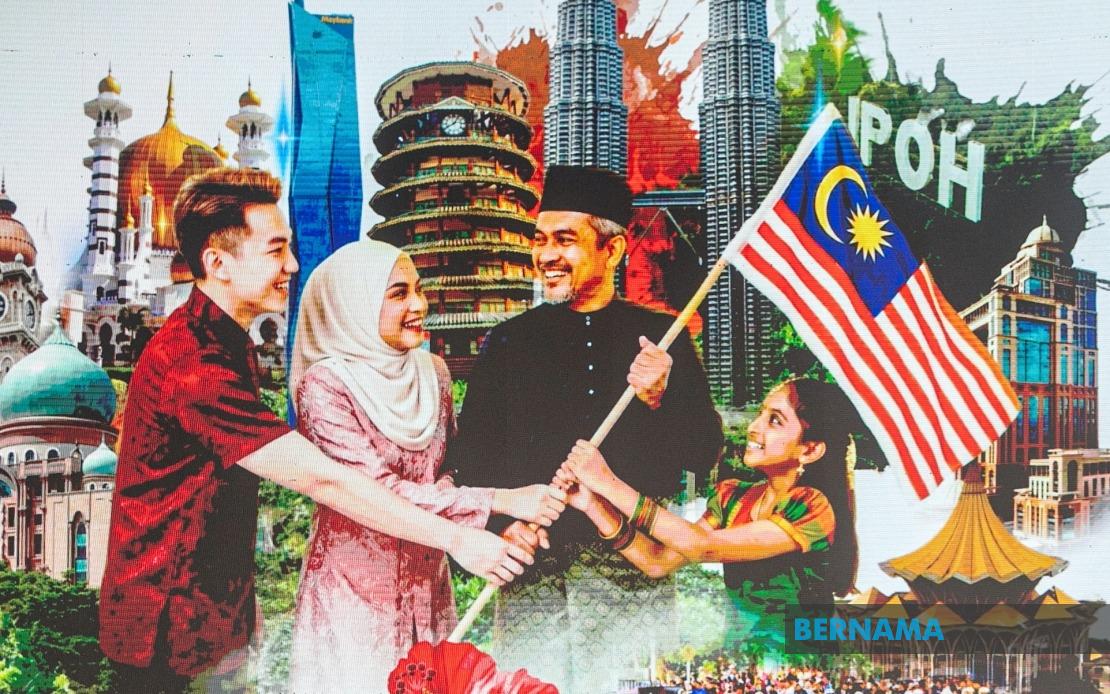
Communications Minister Datuk Seri Fahmi Fadzil has sounded an alarm about the risks of deploying artificial intelligence tools to generate content featuring Malaysia's national flag, urging both media organisations and ordinary citizens to exercise heightened vigilance during the forthcoming 2026 National Month celebrations. The warning emerged during the official launch of the 2026 National Month and Fly the Jalur Gemilang campaign, held in Ipoh on July 19 at the Sultan Azlan Shah Ministry of Health Training Institute in Tanjung Rambutan. The event, officiated by Prime Minister Datuk Seri Anwar Ibrahim, marks the beginning of a coordinated effort to reinvigorate patriotic sentiment across Malaysia ahead of the joint National Day and Malaysia Day observances.
At the heart of Fahmi's concern lies a technical problem that has become increasingly common in the age of generative AI: artificial intelligence systems frequently fail to accurately render the Jalur Gemilang's most defining characteristic—its precisely 14 horizontal stripes. This seemingly straightforward detail has proven surprisingly difficult for AI image generators to reproduce consistently, with algorithms sometimes omitting stripes, duplicating them, or altering their proportions. The error rate is sufficiently significant that Malaysia's government has determined it necessary to launch a public education campaign specifically addressing this vulnerability. For a nation where the flag carries profound constitutional and symbolic weight, such inaccuracies are far more than mere technical glitches; they represent potential affronts to national dignity and collective identity.
Fahmi emphasised that content creators bear a responsibility to validate their output before publishing, particularly those operating during National Month when flag imagery will saturate media channels and social platforms. The minister urged creators to invest time in understanding not merely how the Jalur Gemilang should appear, but also the broader protocols governing its proper display and handling. This educational component extends beyond simple technical specifications; it encompasses the cultural knowledge and respect that should accompany any representation of national symbols. By framing AI caution within a broader context of learning flag etiquette, the government has positioned the initiative as one rooted in promoting genuine patriotic understanding rather than merely policing aesthetic compliance.
To amplify this messaging, the Ministry of Communications has committed to partnering with the Malaysian Press Institute and the Malaysian Media Council to mobilise news organisations throughout Malaysia. This collaborative approach recognises that professional media outlets remain influential gatekeepers of visual content and can either inadvertently propagate AI-generated errors or serve as quality checkpoints that catch and correct them before publication. By enlisting these institutions as partners, the government has created an accountability framework that extends across the traditional and digital media landscape. Such partnerships are particularly valuable given that journalists and editors often work under tight deadlines that may not permit manual verification of every image, making systemic guidance and institutional standards essential.
When asked about enforcement mechanisms, Fahmi adopted a notably measured tone, indicating that the government's initial response would prioritise education and correction over punishment. Rather than immediately invoking legal provisions that do govern the display and representation of national symbols, the ministry plans first to contact individuals and organisations responsible for errors and request that they rectify mistakes voluntarily. This soft-touch approach reflects both pragmatic recognition that AI errors often stem from genuine misunderstanding rather than wilful disrespect, and awareness that heavy-handed enforcement could generate backlash in an age where many citizens have only recently begun experimenting with these emerging technologies. The minister did not rule out legal action should parties refuse to make corrections after being notified, preserving the government's authority while signalling its preference for cooperative compliance.
The broader context of these warnings relates to Malaysia's distinctive relationship with national symbolism. The Jalur Gemilang, with its 14 stripes representing Malaysia's 13 states plus the federal territories, and its yellow and blue colouring signifying the constitutional role of the monarchy, carries meanings that extend far beyond aesthetic. For many Malaysians, particularly in the context of an increasingly polarised political environment, the flag represents a shared national project transcending communal divisions. Inaccurate representations, even those generated unintentionally by algorithms, risk trivialising these meanings or inadvertently feeding narratives about national disrespect—concerns that carry particular weight in a country where symbols have historically been flashpoints for communal tension.
The 2026 National Month and Fly the Jalur Gemilang campaign itself represents an ambitious patriotic initiative, encouraging Malaysians to display their national flag continuously from July 19 through at least September 16. This extended display period, far longer than the traditional concentrated period around August 31, signals government determination to sustain patriotic sentiment throughout the crucial July-September window. By beginning the campaign a full 13 months before the actual 2026 observances, planners have apparently decided that adequate preparation time is necessary to ensure quality execution. The government has allocated the main National Day celebrations to Putrajaya, while Malaysia Day festivities will take place in Sarawak, a geographical distribution that reflects the federal structure and Sabah-Sarawak's distinctive constitutional position within Malaysia.
For Malaysian digital creators and businesses, Fahmi's cautionary message carries practical implications worth heeding. Content creators who routinely deploy AI image generation tools for social media, marketing, or editorial purposes should now factor in explicit verification steps before publishing any content featuring the Jalur Gemilang. This might involve cross-checking generated images against official specifications, maintaining a human review layer, or simply opting for photographic alternatives when available. For media organisations, the ministerial guidance effectively establishes an informal standard of expected practice, creating expectations that may eventually crystallise into formal industry guidelines or professional norms. The risk of reputational damage from inadvertently publishing AI-generated flag errors—coupled with the possibility of ministerial contact regarding corrections—provides sufficient incentive for most responsible institutions to implement safeguards.
The technical dimension of Fahmi's warning also points to broader questions about AI reliability in contexts where accuracy matters deeply. If algorithms consistently struggle with a flag containing just 14 stripes and two colours, what does this suggest about their performance in more complex domains requiring precise accuracy, such as medical information, legal documents, or financial reporting? Malaysia's experience may serve as a cautionary case study for other nations beginning to grapple with AI governance. The flag error issue, while seemingly niche, illustrates how emerging technologies can create novel governance challenges that existing legal and regulatory frameworks were never designed to address. By addressing the issue proactively through partnership and education rather than solely through legal mechanisms, Malaysia is experimenting with adaptive governance approaches that may prove relevant across multiple policy domains.
Looking ahead to the 2026 celebrations, the success of this initiative will depend substantially on voluntary compliance and genuine understanding among content creators. The government has positioned itself not as an enforcer of rigid rules, but as an educator promoting patriotic competence. This framing—suggesting that accurate flag representation reflects respect and care rather than mere rule-following—may ultimately prove more effective at generating the desired outcomes than a purely regulatory approach. As artificial intelligence becomes increasingly embedded in content creation workflows across Malaysia, establishing norms around responsible AI use in sensitive contexts will become progressively more important. The Jalur Gemilang, despite its apparent simplicity, has become an unlikely test case for how Malaysia will navigate this challenging terrain.

