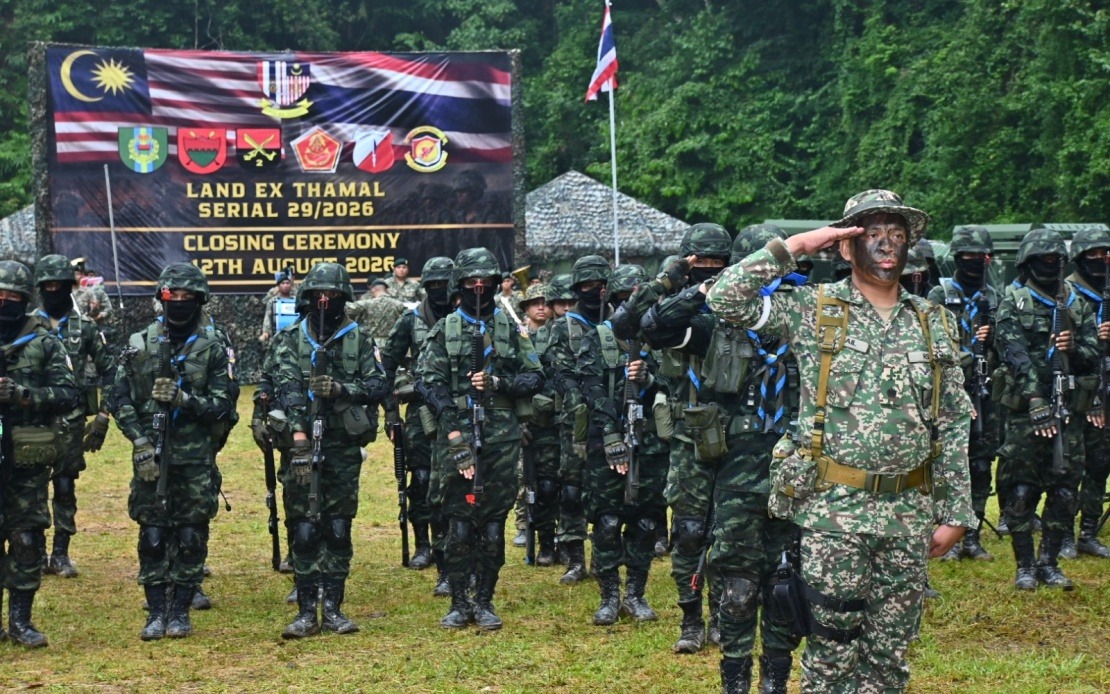
Two hundred and fifty-two military personnel from Malaysia and Thailand are undergoing intensive joint training in the northern Malaysian town of Gerik as part of Exercise LAND THAMAL Series 29/2026, which commenced on August 5. The multinational exercise brings together 197 officers and personnel from the Malaysian Army (TDM) and 55 from the Royal Thai Army (RTA), representing a significant commitment by both nations to deepen their military cooperation and operational readiness.
The exercise unfolds across three distinct phases designed to build capability at multiple levels. The Cross Training Exercise (CTX) provides foundational knowledge sharing, while the Field Training Exercise (FTX) exposes participating troops to practical tactical scenarios including combat procedures, obstacle negotiation, camp establishment, reconnaissance patrols, ambush tactics, and assault operations. The third component, Combined Military Civil Action (CMCA), incorporates a community engagement dimension through the Jiwa Murni Programme, allowing soldiers from both countries to conduct joint activities with local populations.
According to the Headquarters of the 2nd Malaysian Infantry Division, the primary objective extends beyond purely military training. The exercise creates a structured environment for knowledge transfer and experience-sharing between TDM and RTA personnel, with explicit emphasis on improving interoperability—a critical factor for any future coordinated response to shared security challenges. By working through actual tactical problems together, soldiers develop practical familiarity with each other's operational methods, communication protocols, and decision-making processes.
The opening ceremony on August 5 at Gerik Airstrip was jointly presided over by Brigadier General Datuk Mohd Zaini Hashim, Commander of the 30th Malaysian Infantry Brigade, and Senior Colonel Taweeporn Kanatong, his Thai counterpart from the 5th Infantry Brigade. This dual leadership structure symbolises the equal partnership between the two nations. During the ceremony, Senior Colonel Taweeporn articulated a broader strategic rationale for the exercise, emphasizing that LAND THAMAL serves purposes far beyond routine training, positioning it as a confidence-building mechanism that enhances both nations' capacity to respond to diverse transnational threats.
The exercise arrives at a time when Malaysia and Thailand face overlapping security concerns along their extensive shared border. Both nations contend with natural disasters—a persistent threat in Southeast Asia given the region's monsoon patterns and geological vulnerability. Beyond environmental hazards, traditional security threats including organised crime, weapons trafficking, and insurgent movements in border regions remain relevant. The exercise directly addresses these concerns by building institutional relationships and operational familiarity that would facilitate rapid coordination during crises.
For Malaysia specifically, the exercise demonstrates commitment to strengthening defence partnerships in Southeast Asia at a moment when regional geopolitical dynamics are shifting. As major powers compete for influence and regional security architecture evolves, bilateral military relationships provide stability and predictability. The involvement of a Thai unit signals Malaysia's strategic interest in maintaining robust ties with its northern neighbour, particularly across border zones where traditional administrative boundaries are often porous and where security challenges frequently transcend national jurisdictions.
The emphasis on tactical skill enhancement reflects recognition that modern security challenges require soldiers who can adapt to complex, evolving operational environments. Rather than scripted exercises, the FTX component exposes personnel to scenarios demanding improvisation, interdepartmental coordination, and rapid decision-making under pressure. When Malaysian and Thai soldiers practice these skills together, they develop tacit understanding—the unspoken recognition of how the other force operates—that cannot be acquired through briefing documents or policy statements alone.
The Jiwa Murni Programme component, implemented at Sekolah Menengah Kebangsaan Sultan Idris Shah II in Gerik, adds a crucial dimension often overlooked in military assessments. By conducting community development activities alongside training, both armies demonstrate that military cooperation extends beyond hardware and tactics to include genuine engagement with civilian populations. This approach builds local understanding and support for bilateral defence initiatives, softening potential resistance to military presence and operations in border regions.
According to military officials, the success of LAND THAMAL Series 29/2026 reflects the maturity of Malaysia-Thailand defence relations, which have evolved substantially since the exercise series began. The designation of this iteration as Series 29/2026 indicates decades of sustained cooperation, suggesting that bilateral military trust has been built incrementally through recurring interactions. Such institutional continuity matters strategically because it creates expectations of future cooperation and establishes precedents for coordinating responses to crises.
The exercise also carries implications for broader ASEAN security architecture. While individual bilateral relationships remain important, Southeast Asian security challenges increasingly require multilateral responses. Joint exercises between Malaysia and Thailand establish operational precedents and capability baselines that could inform future regional initiatives involving Singapore, Indonesia, and other neighbours. The interoperability improvements gained during LAND THAMAL potentially enhance Malaysia's ability to cooperate with other regional partners as well.
Military officials emphasised that the exercise strengthens institutional relationships beyond the personnel directly involved. The planning, coordination, and execution of a multinational training event requires liaison officers, administrative coordination, and policy-level decision-making that extends throughout both defence establishments. These institutional connections persist long after individual soldiers rotate to new postings, creating organisational memory that facilitates cooperation on subsequent challenges or initiatives.
Looking forward, Malaysian defence planners view exercises like LAND THAMAL as investments in long-term strategic stability. While the immediate training value is evident, the deeper significance lies in demonstrating to both regional and extraregional audiences that Malaysia maintains strong cooperative relationships with neighbouring countries. This stance contributes to regional security narratives emphasizing dialogue, incremental trust-building, and institutional cooperation over confrontational approaches.
The commitment to continue LAND THAMAL as a recurring platform reflects both nations' recognition that border security requires sustained, cooperative effort. As military technology evolves and security challenges transform, regular exercises provide opportunities to update tactics, test new equipment integration, and refresh personnel familiarity. This sustained engagement pattern helps ensure that Malaysia-Thailand defence cooperation remains dynamic and responsive to emerging threats rather than ossified around outdated procedures.

