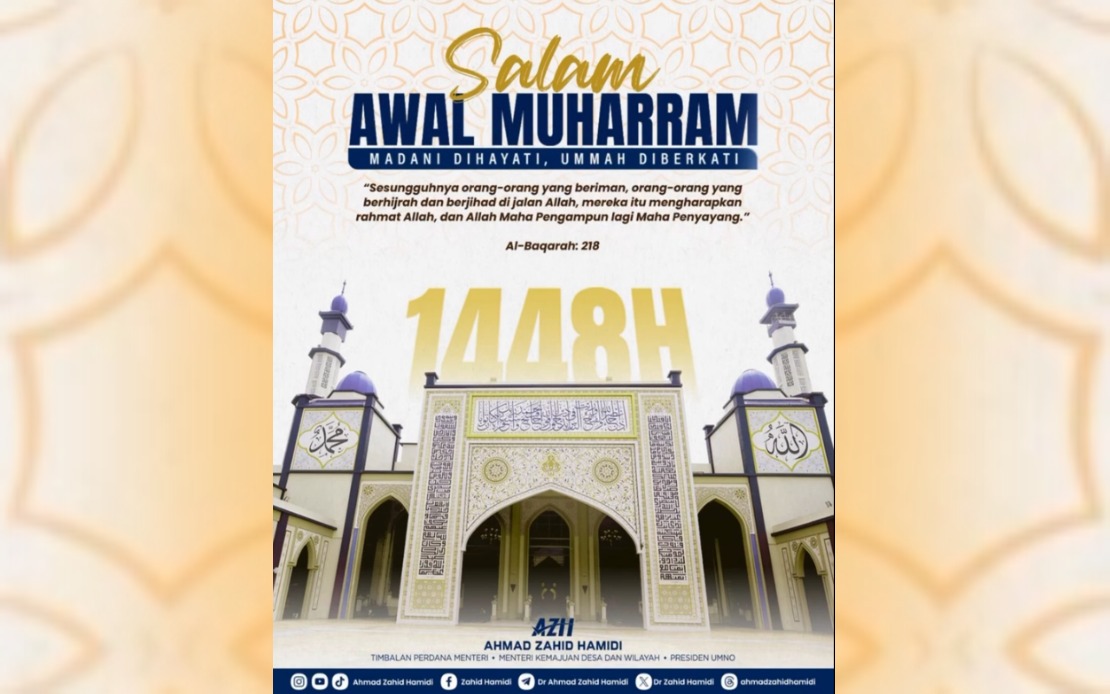
Government leaders across Malaysia have issued a collective appeal to citizens to embody the transformative spirit of Hijrah as the Islamic calendar enters 1448H, positioning the occasion as more than a ceremonial moment but as a call for substantive personal and national renewal. The observance of Awal Muharram, marking the Islamic New Year, has become a focal point for Malaysian leadership to articulate values of resilience, reform and social cohesion at a time when the country navigates complex global economic pressures.
Deputy Prime Minister Datuk Seri Dr Ahmad Zahid Hamidi framed Maal Hijrah as a fundamental lesson in the mechanics of meaningful change, asserting that transformation demands more than rhetorical commitment but requires concrete effort, discipline and unwavering determination to progress beyond present circumstances. His articulation of the concept positioned Hijrah not as a passive religious observance but as an active framework for institutional and personal improvement. The emphasis on sacrifice and perseverance reflects a deliberate messaging strategy aimed at encouraging Malaysians to view challenges as opportunities for strengthening character and national capacity.
The Deputy Prime Minister's call for courageous engagement with reform and honest confrontation of institutional weaknesses carries particular resonance given Malaysia's ongoing efforts to address governance concerns and economic competitiveness. His invocation of shared progress suggests a collective responsibility model where individual improvement directly contributes to national advancement. This framing aligns broader developmental imperatives with religious observance, creating a framework in which spiritual practice and national ambition become mutually reinforcing.
Deputy Prime Minister Datuk Seri Fadillah Yusof provided a complementary perspective by recontextualising Maal Hijrah beyond calendar mechanics as a summons to personal development, community strengthening and expanded civic responsibility. His assessment of Malaysia's current environment directly addressed the intersection of global supply chain disruptions, international economic volatility and their domestic ramifications, positioning the Hijrah spirit as essential intellectual and practical equipment for navigating turbulent conditions. The connection between Islamic principles of moderation and contemporary economic challenges demonstrates how traditional religious values are being actively deployed to address pressing material concerns.
Fadillah's emphasis on prudent consumption and resource stewardship represents a sophisticated approach to framing austerity and efficiency as expressions of spiritual commitment rather than mere economic necessity. His articulation that collective small actions generate significant cumulative benefits reflects an understanding that national resilience depends on distributed individual responsibility. The integration of household-level decisions about energy, water and food waste into a larger narrative of national stability illustrates how religious observance can legitimise and encourage behaviour modification across populations.
The Deputy Prime Minister's reinvigoration of national unity discourse, couched explicitly in terms of preventing division and maintaining social peace, addresses deep concerns about communal fragmentation in Malaysian society. His assertion that Malaysia's foundational strength rests on multiethnic cohesion, and that this unity must be deliberately maintained through active cooperation and mutual respect, reflects awareness that rapid social change and global challenges can strain traditional consensus mechanisms. The explicit warning against allowing differences to fracture society suggests leadership understanding of latent tensions requiring proactive management.
Communications Minister Datuk Fahmi Fadzil introduced the introspective dimension of Hijrah observance, positioning the moment as an opportunity for systematic self-examination and spiritual recalibration. His particular emphasis on courage to embrace positive change, patience in adversity and sincerity in effort provides a philosophical undergirding for the more practically oriented calls from his colleagues. This layering of perspectives across different ministry portfolios demonstrates coordinated messaging around core national themes through multiple channels and conceptual frameworks.
Minister in the Prime Minister's Department (Religious Affairs) Zulkifli Hasan grounded the national conversation in devotional practice, providing specific guidance on traditional prayers associated with the calendar transition while simultaneously elevating the observance beyond ritualism into deliberate self-assessment and improvement. His emphasis that Awal Muharram represents not merely a public holiday but a moment for Islah, understood as internal reformation and ethical renewal, reconnects abstract national calls to the intimate spiritual lives of Malaysian Muslims. The integration of family-centred religious practice into the broader national message reflects understanding that social cohesion ultimately depends on values transmitted and practiced within household units.
The breadth of ministerial participation, spanning portfolios from agriculture to digital transformation to youth development, indicates that the Hijrah narrative has been adopted as an overarching framework for articulating diverse policy imperatives and developmental objectives. Agricultural ministers can emphasise sustainable resource stewardship as aligned with Hijrah principles; technology ministers can discuss digital innovation as an expression of positive change; education officials can frame pedagogical reform as embodying the spirit of improvement. This conceptual elasticity allows religious observance to become a unifying language for coordinating disparate government functions around common national aspirations.
The Malaysian government's systematic mobilisation of the Hijrah narrative during an economically challenging period and amid persistent social diversity challenges suggests deliberate strategic deployment of shared religious and cultural frameworks to reinforce national identity and collective purpose. Rather than treating Islamic observance as separate from governance concerns, leadership has integrated spiritual principles into direct address of economic resilience, social stability and institutional reform. For a multiethnic nation where Islam holds constitutional significance and where a substantial Muslim majority exists alongside significant non-Muslim populations, the government's careful framing of Hijrah as principles of universal improvement, prudence and unity attempts to construct narratives that extend beyond sectarian boundaries to encompass national interest broadly.
The emphasis across multiple statements on personal responsibility, community cooperation, ethical conduct and institutional improvement reflects a particular vision of how religious observance can strengthen state capacity and social cohesion. By positioning Hijrah not as withdrawal from worldly engagement but as intensive commitment to positive transformation, Malaysian leadership articulates a theology of development and reform that legitimises modernisation, efficiency demands and structural change as manifestations of spiritual principle rather than secular imposition. This represents careful navigation of the complex terrain where Islamic values, modern governance requirements and multiethnic national consolidation must be integrated into coherent frameworks of meaning and action.