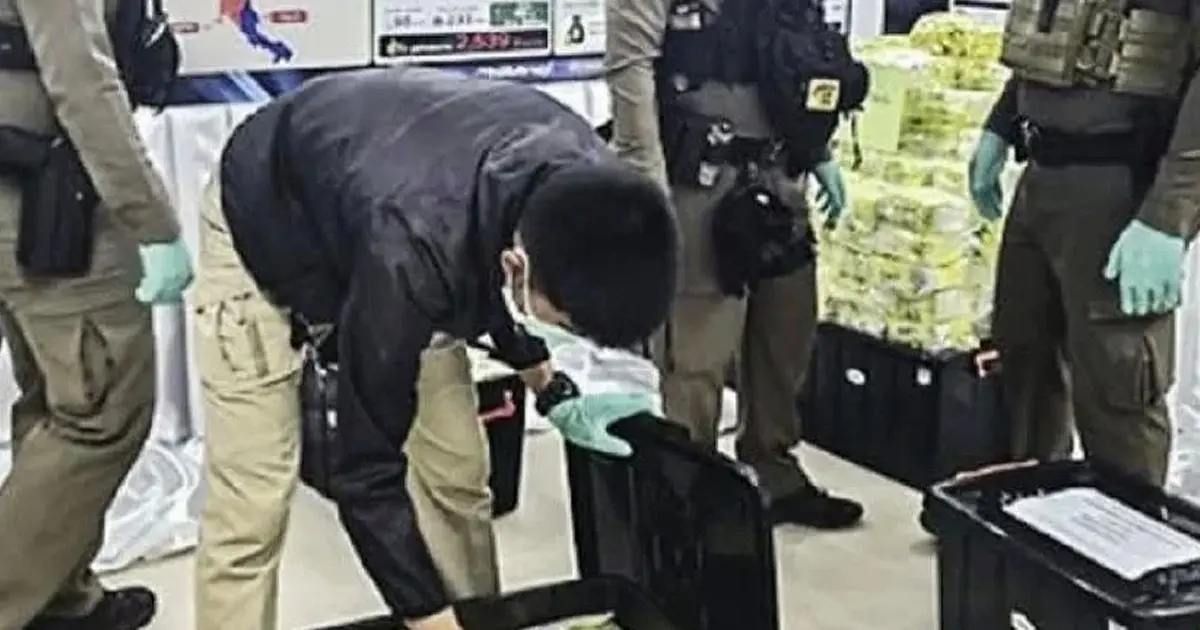
A young Malaysian motorist faces serious drug trafficking charges in Thailand after being intercepted with one of the region's larger recent methamphetamine seizures. The 20-year-old driver was apprehended when he tried to breach a security checkpoint in Hua Hin on Saturday, leading to the discovery of 166 kilograms of crystal methamphetamine in his vehicle.
The arrest underscores the persistent challenge of transnational drug movement along the Thailand-Malaysia corridor, a traditionally vulnerable crossing point for narcotics bound for markets across Southeast Asia and beyond. The sheer quantity involved—166 kilograms—signals an operation well above street-level dealing, suggesting links to organised trafficking networks with sophisticated distribution capabilities. Such shipments typically carry street values measured in tens of millions of baht or ringgit, reflecting the enormous profit margins that drive the illicit drug trade.
Thailand's law enforcement agencies have increased roadside checkpoint operations in popular transit zones like Hua Hin, a coastal province south of Bangkok that sits along major transport corridors. The decision by the driver to attempt evasion rather than submit to inspection proved fatally miscalculated, transforming a routine vehicle stop into a major narcotics bust. The checkpoint itself was presumably conducting routine vehicle and document verification when the driver's behaviour triggered closer examination.
For Malaysian authorities and citizens, this incident carries particular resonance given Malaysia's documented challenges with methamphetamine abuse, especially among younger demographics. The crystal form of the drug seized here represents one of the most dangerous variants, highly addictive and associated with violent crime and severe health consequences. Every kilogram intercepted represents a corresponding reduction in supply to street markets where it fuels addiction and criminal activity.
The age of the detained driver—just 20 years old—illustrates how trafficking networks deliberately recruit younger operatives, who typically face lighter sentences and are perceived as more expendable within organisational hierarchies. Whether acting as a paid courier with limited awareness of cargo details, or as a knowing participant in a larger scheme, his youth suggests exploitation by more senior trafficking figures who remain insulated from direct law enforcement contact.
Cross-border drug operations between Malaysia and Thailand operate within a complex legal landscape. Malaysian nationals arrested in Thailand face prosecution under Thai law, which maintains stringent penalties for drug trafficking. Sentencing typically runs into decades, with capital punishment theoretically possible for exceptionally large quantities, though such sentences have become less common in recent years. The detained driver's legal situation is grave regardless of his role's peripherality within any larger network.
The seizure demonstrates the continued effectiveness of Thai police and border control operations when resources concentrate on suspected trafficking corridors. However, such individual arrests represent only tactical successes within a much broader strategic challenge. Each successful interdiction likely displaces rather than eliminates trafficking activity, with criminal organisations simply routing shipments through alternative borders or using different methods entirely.
Malaysia and Thailand have attempted to strengthen bilateral cooperation on drug enforcement through various mechanisms, including information sharing and joint operations. Yet structural vulnerabilities persist—porous borders, limited resources relative to trafficking volumes, corruption within enforcement agencies, and the enormous financial incentives driving the trade. The lucrative nature of methamphetamine trafficking means that even when individual couriers face arrest and imprisonment, replacement operators emerge rapidly.
The incident also reflects broader regional dynamics around synthetic drug production and distribution. Methamphetamine manufactured primarily in clandestine labs across the Golden Triangle region moves through multiple countries before reaching final markets. Thailand serves simultaneously as a transit point, a destination market, and a source of precursor chemicals or finished product, creating complex enforcement challenges requiring sustained international cooperation.
For Malaysian policymakers and law enforcement, this arrest reinforces the need for comprehensive approaches addressing both supply and demand. While interdiction operations capture headlines and remove dangerous substances from circulation, sustained progress requires simultaneous attention to treatment capacity for dependent users, rehabilitation programmes, and community-level prevention. The supply side battle, illustrated by this week's seizure, represents merely one component of effective drug policy.
The detained driver's fate remains uncertain pending Thai judicial proceedings. Whether characterised as a paid courier bearing minimal responsibility or as a knowing participant in major trafficking, the charges he faces carry potential decades of imprisonment. His case will likely serve as a cautionary example to others considering involvement in cross-border drug transport, though the financial desperation or coercion that often motivates such involvement ensures that deterrent effects remain limited.

